


This is a season of stresses, so many ups and downs.
I find it difficult to sit and be still and not worry about the future or regret the past.
What’s the difference between change and transformation?
Many of us make new year’s resolutions or go to therapy, hoping to change our habits. But that’s just conditioning and often doesn’t stick beyond a few weeks.
Then there’s inner transformation and it’s really much more difficult. There seems to be a lot of resistance to real metamorphosis.
I feel bombarded by outside influences all the time, every day. It takes so much effort to quiet my mind and realize that so much conflict is not about me, I shouldn’t take it personally. While I have responsibilities and duty, I know I must take time to meditate for renewal and self-care to protect myself so I can continue to serve my family.
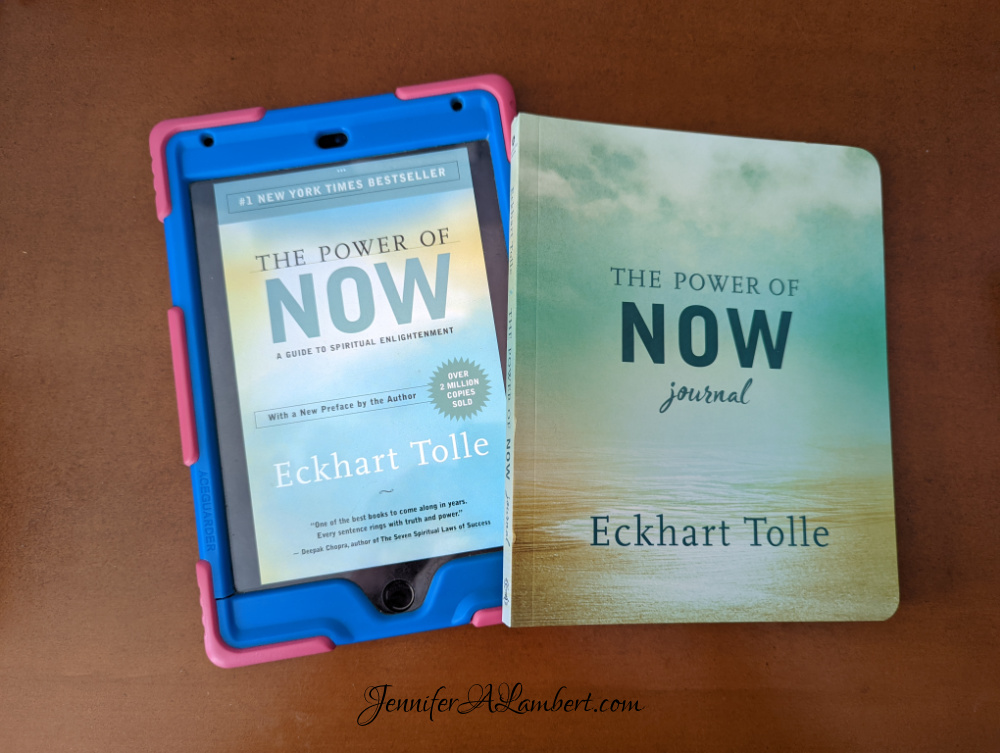
Chapter Four: Mind Strategies for Avoiding the Now
Favorite quotes:
To be free of time is to be free of the psychological need of past for your identity and future for your fulfillment.
Most humans alternate not between consciousness and unconsciousness but only between different levels of unconsciousness.
What I call ordinary unconsciousness means being identified with your thought processes and emotions, your reactions, desires, and aversions. It is most people’s normal state. In that state, you are run by the egoic mind, and you are unaware of Being. It is a state not of acute pain or unhappiness but of an almost continuous low level of unease, discontent, boredom, or nervousness — a kind of background static.
In ordinary unconsciousness, habitual resistance to or denial of what is creates the unease and discontent that most people accept as normal living.
Why are you always anxious? Jesus asked his disciples. “Can anxious thought add a single day to your life?” And the Buddha taught that the root of suffering is to be found in our constant wanting and craving.
Resistance to the Now as a collective dysfunction is intrinsically connected to loss of awareness of Being and forms the basis of our dehumanized industrial civilization.
This collective dysfunction has created a very unhappy and extraordinarily violent civilization that has become a threat not only to itself but also to all life on the planet.
Make it a habit to monitor your mental-emotional state through self-observation. “Am I at ease at this moment?” is a good question to ask yourself frequently. Or you can ask: “What’s going on inside me at this moment?” Be at least as interested in what goes on inside you as what happens outside. If you get the inside right, the outside will fall into place. Primary reality is within, secondary reality without.
The pollution of the planet is only an outward reflection of an inner psychic pollution: millions of unconscious individuals not taking responsibility for their inner space.
If you had a choice, or realized that you do have a choice, would you choose suffering or joy, ease or unease, peace or conflict? Would you choose a thought or feeling that cuts you off from your natural state of well-being, the joy of life within?
it is certainly true that when you accept your resentment, moodiness, anger, and so on, you are no longer forced to act them out blindly, and you are less likely to project them onto others.
To complain is always nonacceptance of what is. When you complain, you make yourself into a victim. When you speak out, you are in your power. So change the situation by taking action or by speaking out if necessary or possible; leave the situation or accept it.
Are you resisting your here and now? Some people would always rather be somewhere else. Their “here” is never good enough. If you find your here and now intolerable and it makes you unhappy, you have three options: remove yourself from the situation, change it, or accept it totally. If you want to take responsibility for your life, you must choose one of those three options, and you must choose now. Then accept the consequences. No excuses.
Surrender is not weakness. There is great strength in it. Only a surrendered person has spiritual power.
Stress is caused by being “here” but wanting to be “there,” or being in the present but wanting to be in the future.
Is your goal taking up so much of your attention that you reduce the present moment to a means to an end? Is it taking the joy out of your doing? Are you waiting to start living?
Your life’s journey has an outer purpose and an inner purpose. The outer purpose is to arrive at your goal or destination, to accomplish what you set out to do, to achieve this or that, which, of course, implies future…the journey’s inner purpose, which has nothing to do with where you are going or what you are doing, but everything to do with how.
What is the power of Now? None other than the power of your presence, your consciousness liberated from thought forms.
We don’t have to live with excuses.
We can have freedom from unhappiness.
It’s interesting to read this book through the lens of Christianity and with the axioms of all Jesus taught, along with all the knowledge I’ve gleaned from other religious texts and teachers through the years.
There’s nothing really new in this book. It repeats and quotes and emphasizes the same concepts that have been known by spiritual masters for centuries. But I love the format and simplicity.
I am also reminded by the teachings of Richard Rohr in the two halves of life in Falling Upward. In the first half, we are often constrained by rules and outside influences. In the second half, we become more mature, more open-minded, and more able to listen to that inner stillness or be in The Now.
I am realizing more and more as I get older. I turn 46 next week! I am encouraging my teens not to sweat the small stuff. Everything is a crisis to young people! I realize how it feels to them, but that it won’t really matter in the long run. It’s a delicate balance to respect their feelings while trying to guide them into The Now.
We can escape the background static of perpetual discontent.
Other posts:


Leave a Reply