Jennifer Lambert

A Sacred Balance

Visit Us On FacebookVisit Us On PinterestVisit Us On InstagramVisit Us On Linkedin
  • Homeschool
    • Book Lists
    • How Do We Do That?
    • Notebooking
    • Subjects and Styles
    • Unit Studies
  • Travel
    • Europe
      • Benelux
      • France
      • Germany
      • Greece
      • Ireland
      • Italy
      • London
      • Porto
      • Prague
    • USA
      • Chicago
      • Georgia
      • Hawaii
      • Ohio
      • Utah
      • Yellowstone and Teton
  • Family
    • Celebrations
    • Frugal
  • Military Life
    • Deployment
    • PCS
  • Health
    • Recipes
    • Essential Oils
    • Fitness
    • Mental Health
    • Natural Living
    • Natural Beauty
  • Faith
  • About Me
    • Favorite Resources
    • Advertising and Sponsorship
    • Policies
  • Reviews

© 2025Jennifer Lambert · Copyright · Disclosure · Privacy · Ad

How I Plan Our Homeschool Year

This blog may contain affiliate links: disclosure.
Please see my suggested resources.

March 8, 2016 By Jennifer Lambert 12 Comments

It gets easier each year.

Planning our homeschool year is so much less stressful than when I had to submit annual lesson plans as a public school teacher.

I plan our homeschool year every spring and we school year-round.

First, I pray for discernment and guidance. I keep a prayer journal where I record which goals and milestones I hope to achieve personally and with each of my four kids. I also write about heart issues and pray through tough times. It’s such a blessing to be able to go back through and write the date when a prayer is answered!

How I Plan Our Homeschool Year

Our main curriculum is Tapestry of Grace which encompasses the bulk of our studies: social studies (including history, geography, and government), literature, and religion (including Biblical worldview, church history, and philosophy).

We’ve completed the history cycle twice now with my eldest, Elizabeth. Going through the cycle a third time, it’s finally feeling like it runs smoothly. It doesn’t require a lot of planning on my part, with weekly lessons mapping out the threads. It’s a great color-coded visual. I love the book lists and I love reading and learning along with my children.

We also use The Story of the World as a spine text with our younger three kids. It’s easy enough for them to read on their own. It offers a narrative view of chronological history.

Planning History and Literature

What I do first:

I gather our main books from our shelves for each unit, check the library to reserve supplemental books each week, and gather other materials as needed. I keep articles saved on Pinterest so I can refer to these ideas each year and match them to my kids’ abilities and interests.

Each year, I loosely plan out four main units around the topics listed in our curriculum.

Each unit is nine weeks to follow a 36-week “school year.” Sometimes I spend more or less time on certain time periods, socio-economic issues, or events I want to focus on. Some lessons we skip entirely until the next cycle.

I print relevant notebooking pages for the people, places, and events we’re studying.

I try to coincide our art lessons, nature study, field trips, and even science topics to our studies when possible.

How do I coincide science and history?

  • Astronomy fits in well with Ancient Studies.
  • We love studying Botany when we learn about the Middle Ages.
  • Zoology is a good choice during the Renaissance period.
  • Physics and Chemistry work well during the Renaissance, the Industrial Revolution, and Modern Times.

We love reading biographies about scientists and mathematicians. We always include living books when we learn about science and history. It makes it more real.

I add in the ancient and modern foreign languages we learn each year.

Math just flows on its own, usually a lesson per day with Singapore math workbooks. We also love reading Life of Fred. We use Videotext for high school. As the kids get into more advanced math, my husband, Aaron, takes over teaching the kids in the evenings a few days per week. Whew! We also do lots of practical math with cooking and everyday activities.

We take breaks from academics as needed, traveling frequently and relaxing around various holidays.

We love to explore places we learn about. Sometimes, these are spur of the moment field trips and other times, they are longer – day trips, weekend getaways, or weeklong vacations, well-thought-out and planned.

We visited the Bodyworlds exhibit after studying human anatomy.

We’ve been to Greece, Rome, and Ireland for ancient studies this last year.

We recently traveled to Florence, Italy, for Renaissance studies.

We’d love to go to Wittenberg, Germany, to learn about Martin Luther during our Reformation unit.

Exciting trips to London, Paris, and Venice are planned for fall 2016! The kids loved learning about Shakespeare.

Last spring, we took a road trip to Normandy, France, to tour the D-Day sites, see the Bayeux Tapestry, and Joan of Arc monuments and museum.

We often take a SUN day, putting aside the books and rushing outside to enjoy the sunshine since it’s so rainy and cloudy here. We don’t keep to a traditional school year schedule: September to May. We often begin a “new” school “year” in March as we complete the last “year’s” curricula. We take plenty of time off to relax in summer, staying up late and playing outside when the sun stays out until 10. We still read lots. We complete the bare minimum of school work, often rushing through lessons during the heat of the day when it’s too hot to do much else.

The girls are learning to budget their time with student planners I created for them.

Planning Our Homeschool Year

I fill out the planner for my teen with her reading assignments each week so she has no excuses to fall behind and it helps me keep track and prepare.

She volunteers in the hospital maternity ward on twice a week, so those days are blank. She usually does physics and geometry with her dad in the mornings those days. We actually fill in the lessons completed after she does them so I can keep a record.

High School Planner

I make sure the kids have plenty of free time to play, create, and ponder.

All my kids love to read and our trips to the library are almost a chore due to the amount of books (for school lessons and fun reading) that we return and check out! I think I need a trolley or something to haul them all to/from the minivan.

I encourage my children to create freely and keep plenty of supplies around for their art and handiwork projects. My teen loves to crochet and the middle girls are learning embroidery and cross-stitch. The three younger kids are loving weaving yarn with this loom.

Almost every day (even in “bad” weather), they go outside for at least 30 minutes. It is very important to stay connected to nature, set their body clocks, get fresh air and vitamin D. They need the exercise. They ride bikes or go to the village playground. They know they can hike the circular forest trail around our village. It’s ok for them to get bored. They watch clouds, airplanes, the wind in the trees. They learn to be imaginative, making up worlds and vivid characters in games. They explore and discover and bring home treasures they find – flower and leaves, eggshells, rocks, even “rubbish” they find interesting. I don’t want my kids to have nature-deficit disorder. I often join them on more specific nature hikes further into our forest.

We don’t participate in a co-op because they just don’t work for us. I’m flexible with our schedule since we school year-round. We’ve even homeschooled during a PCS.

We wind down in the evenings and limit screen-time before bed. We read and pray together as a family. The kids are off to bed most nights by 9-10 PM. This is a good routine. They’re often tired, but perhaps not incredibly sleepy. I remember lying in bed awake, as a girl (it seemed like hours) and I still do it most nights – pondering about books I’ve read, thinking about the future, replaying conversations and events in my head. We need this quiet time to assimilate information we learn.

I stay flexible and observe my children’s interests, abilities, and progress closely. We review material and take breaks as necessary to make our homeschool a healthy and happy one.

Share
Pin4
Share
4 Shares
You might also like:

Filed Under: Homeschool Tagged With: back to school, homeschool, planning

Are You Prepared for the Future?

This blog may contain affiliate links: disclosure.
Please see my suggested resources.

February 10, 2014 By Jennifer Lambert Leave a Comment

When I was in college, I worked as an administrative assistant for several insurance agents at two different companies. I learned lots and got to wear cute office clothes and take the MARTA downtown. I felt grown up working alongside adults in a workplace with few women and fewer young women. I could have stayed there forever, working my way up the corporate ladder.

I saw the agents advise policies to their clients and sometimes later, I saw clients panic, out of control, regretting their decisions and desiring changes.

During a two-week stint working for an estate lawyer, I witnessed relatives lost and forlorn over the lack of insurance and benefits they expected to come to them to pay expenses for their deceased loved one.

My parents are big planners and they have everything organized and filed just in case. I am thankful they aren’t embarrassed or upset by planning important decisions involving finances and their eventual passing.

I am thankful for the benefits my husband and I have through his career with the Air Force. We were advised to purchase life insurance for our babies for them to retain when they come of age. We long to provide a financial legacy for our children as they begin their adult lives so they are wise and prepared.

We live in a region where our neighbors stockpile and are required to have a year’s supply of necessities in case of disaster. I agree in planning for tragedy. I know we’re in God’s hands and He will care for my children if something were to happen to my husband or to me. I love Psalm 39:4 and the ant verses in Proverbs 6.

I live with the hope that He will let me see my kids grow up and let me be the one caring for their needs, but we want to be as prepared as we can be. Just in case.

Do you have life insurance? What is life insurance for?

Common Uses of a Life Insurance Pay Off

In many cases, life insurance acts as a financial safety net for a family who has lost the breadwinner of the household. A life insurance pay off is dedicated to different things depending on the needs of a family. For instance, some families use life insurance money to pay off the mortgage on their home. Since the primary earner has passed away, the family chooses to pay off the home in order to feel more secure about their situation. By doing this, they also free themselves of a monthly mortgage payment. Here are some other common ways that people use the pay off on a life insurance policy.

Sometimes life insurance money is used to pay off school debt. A member of the family may have gone to college years ago and is still carrying his or her tuition debt. Paying off that debt means that the family can funnel those monthly loan payments into other parts of the budget. They may use the extra money for regular expenses or perhaps put it away in a savings account. Either way, family has a little more leeway with its finances once school debt is paid off. Someone who is interested in getting life insurance may want to check with an insurance agency in Atlanta.

A family may use the money to move to another city. They may feel that they need a change after the loss of a loved one. The life insurance money could go toward the down payment on a home or used to buy a house outright. A change of scene is something that many people appreciate after the loss of a family member. The life insurance pay off gives them a chance to start fresh in another location.

A life insurance pay off is sometimes put away in a child’s college savings account. If the child is very young, the money will help him or her to have enough for college tuition when the time comes. The money from the life insurance pay off can really help a family to get ahead on its college savings efforts.

Finally, some families use life insurance pay offs to purchase a new car. Perhaps the family has an older, unreliable car that needs a lot of repairs. They may buy a new one to avoid paying expensive repair bills. Getting a new car is a practical way to spend the pay off on a life insurance policy.

While we often put off the inevitable and don’t want to think of the future and it’s possibilities, there are important decisions that parents should make. Discuss estate planning with your family.

There are billboards on the expressways here that show a confused man and the text says: “Your In-Laws Are Not a Retirement Plan.” I LOL’ed the first time I saw one, but then it got me thinking. I think it packs a powerful message.

Share
Pin
Share
0 Shares
You might also like:

Filed Under: Family Tagged With: finance, future, insurance, planning

5 Days of Homeschooling Essentials {Day 1: Planning}

This blog may contain affiliate links: disclosure.
Please see my suggested resources.

January 20, 2014 By Jennifer Lambert 6 Comments

5 Days of Homeschooling Essentials.

Sure, we need to plan.

We need to know ourselves, our strengths and weaknesses.

We need to know our enemy.

We need supplies. But more than paper and pencils, books and crayons.

And sometimes we need to know when to let go.

Planning. I am SO great at planning. Not so much at implementing.

In a way, I’m an unschooler at heart. I love the idea of schedules, but I really like to just gather lots of papers and books and resources along a theme – weekly, monthly, semesterly (Is that a word? Well, it is now!).

But for all homeschoolers – beginners and veterans and everyone in between – we need planning and evaluation at the start, midpoint, and end of each year.

In addition to all the homeschool planning we do (and that’s the easy part, I think), we need to plan out our spiritual goals for our children. It’s much simpler to plan out curriculum, complete with projects and field trips, than it is to plan out heart training.

Do you know when there will be a snow day or sick day or day-where-the-hot-water-heater-bursts-and-leaks-all-over-the-cellar? Do you know when you will have to stray from the lesson plan to teach about bullies because a child at church made fun of her or begin preliminaries for The Talk because your child heard something disturbing on Christian radio news?

Of course we can’t plan for those events. But we can be prepared.

Mamas, we need to be proactive and plan ahead for surprises and the inevitable. Our babies are growing up, underneath our very noses, despite our efforts to shelter.

They are not our own. We cannot control them. Give them to God and pray.

What is the purpose for your homeschool? What do you purpose to accomplish in your children before they reach adulthood?

Set goals with your endpoint in mind. Math and reading and this science experiment and that art project are all secondary to heart training.

What good is it for someone to gain the whole world, yet forfeit their soul? ~Mark 8:36

Almost all curriculum comes with a schedule and a plan and now common-core alignment. God has a plan for each of His children. Does your homeschool align with Him?

Plan for their character development. In which direction do you want your children guided? What regrets do you want your kids not to have?

I recently conversed with some moms about how our parents taught (or didn’t teach) about sex and the lack of biblical education in this area was saddening to me.

I know I want my kids to be the ones who step up proudly to say that they were taught well from Scripture and biblical principles. I want to protect their worldview and show them Jesus in all we learn in our homeschool.

It’s all about planning. What’s your scope and sequence?

Tweetables:

  • Forget common-core. God has a plan for His children. Does your homeschool align with Him? 
  • What regrets do you want your kids not to have? Which direction do you want your children guided? 
Share
Pin100
Share
100 Shares
You might also like:

Filed Under: Homeschool Tagged With: back to school, character, planning

Curriculum Planning with Multiple Kids

This blog may contain affiliate links: disclosure.
Please see my suggested resources.

June 13, 2013 By Jennifer Lambert 11 Comments

Welcome back to the How to Begin Homeschooling series!

Did you miss anything?

See Part 1: Getting started with homeschool or

Part 2: Determine your teaching method and your kids’ learning styles!

Here’s Part 3: Curriculum planning with multiple kids

Coming up! Part 4: Homeschooling as a lifestyle

how-to-begin-homeschooling.jpg

My kids are 12, 7, 6, and 3.

When it was just Elizabeth for our first and second years of homeschooling, it was fun and new and we could do anything we wanted! I was pregnant with Victoria and then she was a great easy baby so we could take her anywhere anytime.

Having one or two kids is a piece of cake. After three or more kids, then they outnumber you and can plan an ambush. Therefore, you must be proactive and plan your attack or you will lose.

After having Kate, it all fell apart. I couldn’t keep the house spotless anymore {I’ll have to tell you about that phase!}. I struggled with schedules and I was late to everything.

Later, Alex came along, but by then, I had come to terms with our life.

We follow a classical school method.

It keeps me sane. We veered off a bit the last couple years, but we’re back to classical and it feels good.

So, where to begin with so many curriculum and scheduling options?

When Elizabeth was 4-going-on-15, I discovered The Well-Trained Mind. I read that book cover to cover and adored it. I thank God I found something so comprehensive right away and could latch onto that and run with it.

I realize it might not work for everyone, but it’s a great launch point. It has recommended schedules so you can judge if you’re doing too much or too little for each age.

Obviously, after you’ve determined your favorite teaching methods and your children’s learning styles, you can search for resources that fit those.

I love reading lists. Since our homeschool is based on history and literature, I acquire lots and lots of books and request a gazillion at a time from our library.

And there will be loss and prayer and tears and searching until you find what exactly works for everyone. Just pray it through. It’s a journey. It’ll be ok.

My husband worried about all the tries and fails of our curriculum over the years. But if it doesn’t work, I won’t force the issue. Why should I when there are so many wonderful options out there? We’re at a time in such freedom of homeschooling and the wonders of technology that we literally have the world at our fingertips and we can and should utilize everything we can to educate our children to the best of our ability.

We’ve finally gotten to a point of comfort and confidence in our homeschool. I pray that you do too! {I fear Alex may throw a monkey wrench in the whole mess! His personality is very different from the girls’.}

How do we function with multiple age children?

Do you ever wonder about the little red school house idea? Remember the school in Little House on the Prairie? How did they do it?

Do school together as much as possible!

Bible, art, history, and science work well for this. And schedule, schedule, plan, and schedule! {But be flexible!}

What about subjects that aren’t so easy to do as a family? Schedule those in so you can work with a child while others are doing assignments on their own.

Here are some of our fails and successes. Of course, what doesn’t work for our family may be perfect for yours!

Bible

We really enjoy Studying God’s Word during her grammar years. They offer workbooks from pre-school to high school.

We loved Grapevine Studies and We Choose Virtues when the kids were young.

The girls liked the comic-book style activity pages in Bible Study Guide.

We’ve read through Hero Tales and The Dig for Kids. Copywork is great for these!
What is your favorite Bible study for your family or homeschool?>

History

See our detailed post about our history studies.

We love Story of the World for elementary ages. We’re now using Tapestry of Grace since we complete so much of the whole cycle the first time ’round.
I love the chronological study of history that our social studies and language arts centers around. It’s great. It takes lots of pressure off and the read alouds are perfect for the whole family. Even my husband loves it after dinner.

We’re flexible and don’t always keep to the weekly schedule {gasp!} Sometimes, we’ll take more or less time depending on interest. Especially since we cycle through several times, so it’s easy to move on if we’re not completely finished with the unit.

Liz really can’t stand to do the projects and the girls love those. They’re finally getting old enough that I can just advise and monitor and they can complete them on their own.

We use notebooking from Notebooking Pages or we make our own with Notebooking Publisher. Sometimes, I use the pages Tapestry of Grace provides.

Science

We especially love Apologia Science – and have never really used anything else since it suits all our needs perfectly. The elementary series is great for the whole family – and the junior high and high school books are comprehensive and fun too!

Math

See our detailed post about how we study math.

We do utilize math journals and notebooking. We focus on a math concept together periodically. We love Life of Fred and the whole family loves the stories. It’s sneaky math. Khan Academy is a good supplement. We’ve used and loved Singapore Math for elementary, but are currently facing a dilemma for upper level math.

Language Arts

See how I don’t teach English.

Following a classical method for English language study begins with First Language Lessons. There are multiple volumes that include all language arts you need!

All About Learning has great reading and spelling programs.

Logic of English is a great comprehensive ELA program. We reviewed IEW. I’m not a huge fan of workbooks, but there are some options that kids just love.

There are many great notebooking tools for grammar and writing. We just read LOTS and narrate it – orally, artistically, or in writing. Older kids reading to the younger ones cheers my heart.

Foreign Language

We focus on Latin ‘round here.

We also have ASL, Spanish, French, and German each week. The kids love it! It’s fun to learn language together. I am amazed by how they soak it up like sponges.

All Those Extras

How in the world do we fit in the extra things?

Music, art, nature study, exercise…

Liz took formal piano lessons from a wonderful teacher who lives down the street. Tori takes guitar and Katie takes piano. I’m sure Alex will eventually take some music lessons.

We love love love ARTistic Pursuits ! We love composer and artist studies and try to do something weekly. And we currently use art and music units from Harmony Fine Arts.

We are very interested in this new music appreciation study: SQUILT.

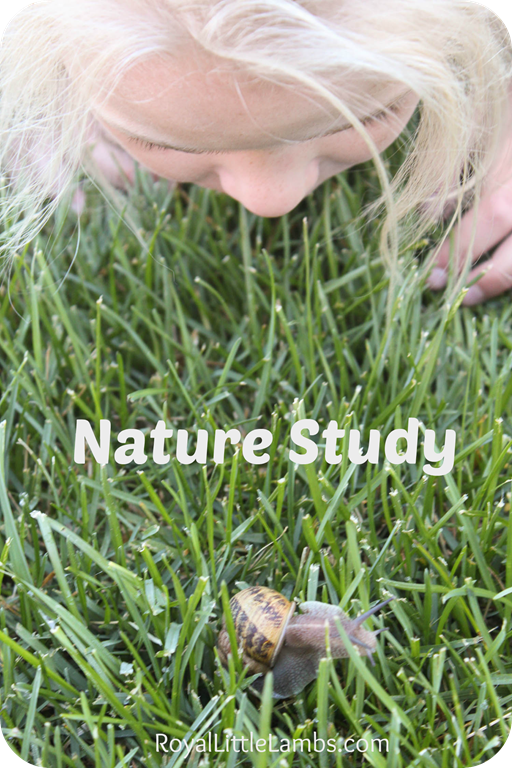
As for nature study, we love Handbook of Nature Study. The End.

My kids love living books for nature and animals and biographies about musicians and artists.

nature-study

Exercise or PE? Tori, Kate, and Alex take gymnastics classes each week. Tori is quite the little track star, running 2 5K’s with Dad this spring. Kate loves soccer in the fall. Liz is in Civil Air Patrol and must keep up with PT scores each month.

And get ’em outside to play! Schedule this into your day. Sunshine and fresh air are important! Go to parks. Go on hikes. Go to pools. Play ball. Organize a weekly homeschool play group with some of your friends. Our kids also join Dad in the gardening and yard work. It counts!

What About the Littles?

Babies are easy and older children are often very forgiving. But when they become toddlers and preschoolers, you have to get proactive and occupy those little monsters. And keep the older sibs’ history projects and science experiments well out of reach. {Who knew they could reach that far?!}

Check out my beginning homeschool post!

I’ve known families with littles who didn’t schedule or plan and just allowed for free play until school age, and that may work for you, but I think everyone misses out on so much in that environment. My kids are often bored or destructive if they don’t have some direction. Weekends are crazy for that very reason.

With so many wonderful Montessori and Tot School resources floating around on blogs and websites, you’re doing a disservice to your family if you leave that baby or toddler to him or herself. And you’ll have so many more messes to clean up. Also, schedule for older siblings to spend “baby time” as part of school time. Train your older children to be a “mama’s helper” and this will benefit all.

More on that in our next post!

Organizing

  • Circle Time

We do “circle time” together most mornings. All of us together…we do our Bible lesson and read alouds, focusing on memorization, recitation, narration. The littles learn so much during this time. We also work on calendar notebooks, sing our morning songs, and love on each other. Sometimes we do yoga together. We learn facts together with occasional calendar themes. We discuss science, literature, and history we’re studying. This often just transitions into regular assigned work so smoothly. Liz has gotten to where she doesn’t participate as much with circle time. After Bible, she uses the time to get ’er done since they’re all occupied.

  • Workboxes

We have used several different workbox systems over the years. It’s great for planning, visualizing what needs to be accomplished, and what has been completed.

Sue set up the workboxes for her autistic son to visualize his work. Her system calls for 12 plastic shoeboxes on a wire rack, but why not beautify it? No space? I’ve seen work folders that follow the same concept. I’ve seen some gorgeous examples of shelving and bins that could work with any budget. Google “workboxes” because I can’t list them all here. Also, you can find great free cards for labeling if you so choose. We don’t really label anymore.

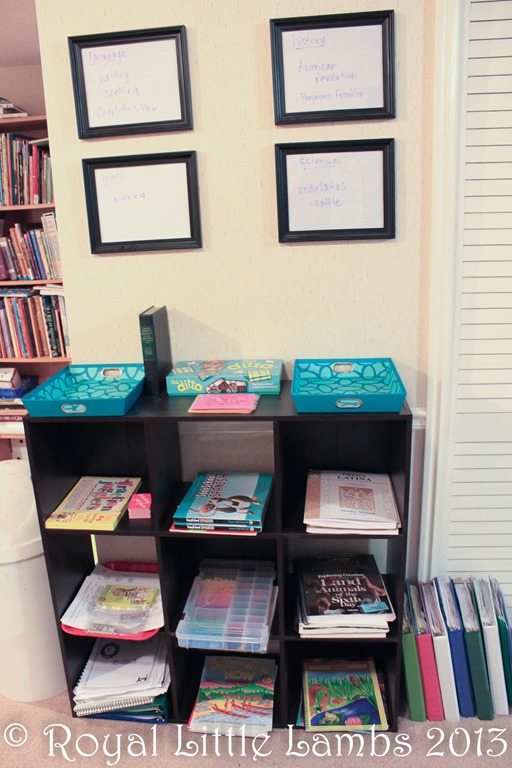
Right now, we have 9-cube units from Target that work as our “boxes.” I put baskets, trays, activities, or books into the cubes and that’s what the kids work on for each week. They choose the order they do their assignments. I monitor to make sure they do what they need to do. Otherwise, Kate would do all the science and Latin and Tori would do all that math and they wouldn’t ever get to history or writing.

This is what Tori’s and Kate’s cubes look like this week. They do the same work, so I just double up in the cubes. They’re the perfect size.

Top row: We have fractions. Then Spanish and Latin.

Middle row: I have some money cards and money math pages. Then I have a Montessori letter tray and activities. We’re finishing up Land Animals science.

Bottom row: Then our Harmony Fine Arts notebooks and art journals. We have Draw Write Now. Last, we have life cycles and Charlotte’s Web unit (review soon!).

girls cubes

The girls place any completed pages in the trays on top. The frames on the wall are to keep me on track with weekly themes. Their notebooks are propped on the floor beside the unit. We got through and place their pages in the notebooks when the trays are full.

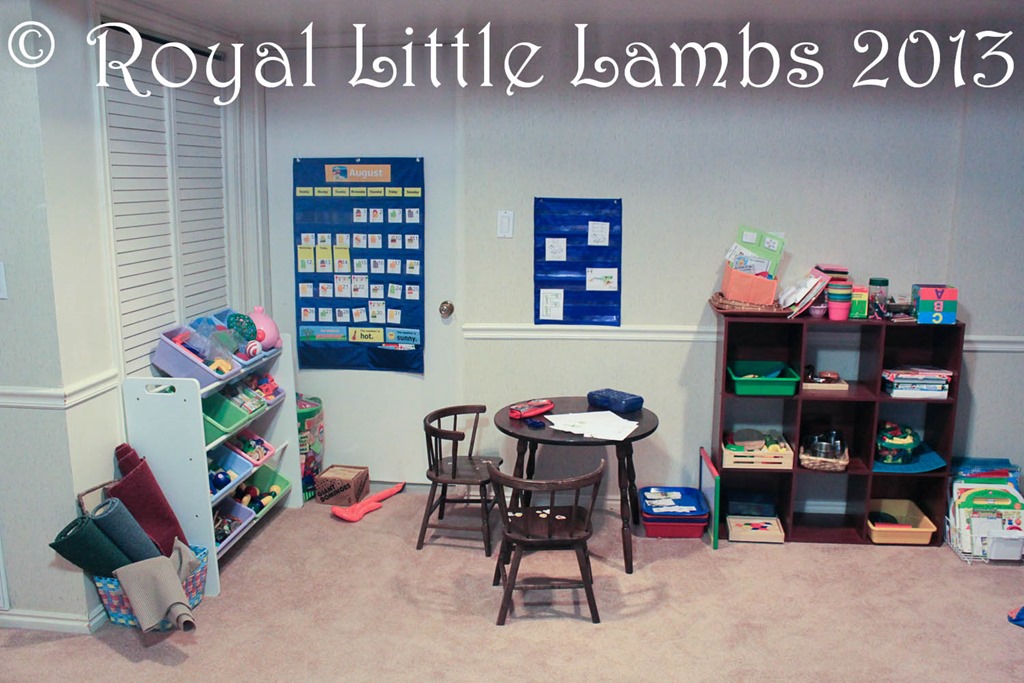
Alex has a unit too with preschool activities. Toys are in the plastic bins and he lays out his Montessori rugs for his activities to stay contained.

I have a bigger red pocket chart now that we put up all our week’s work.

preschool room

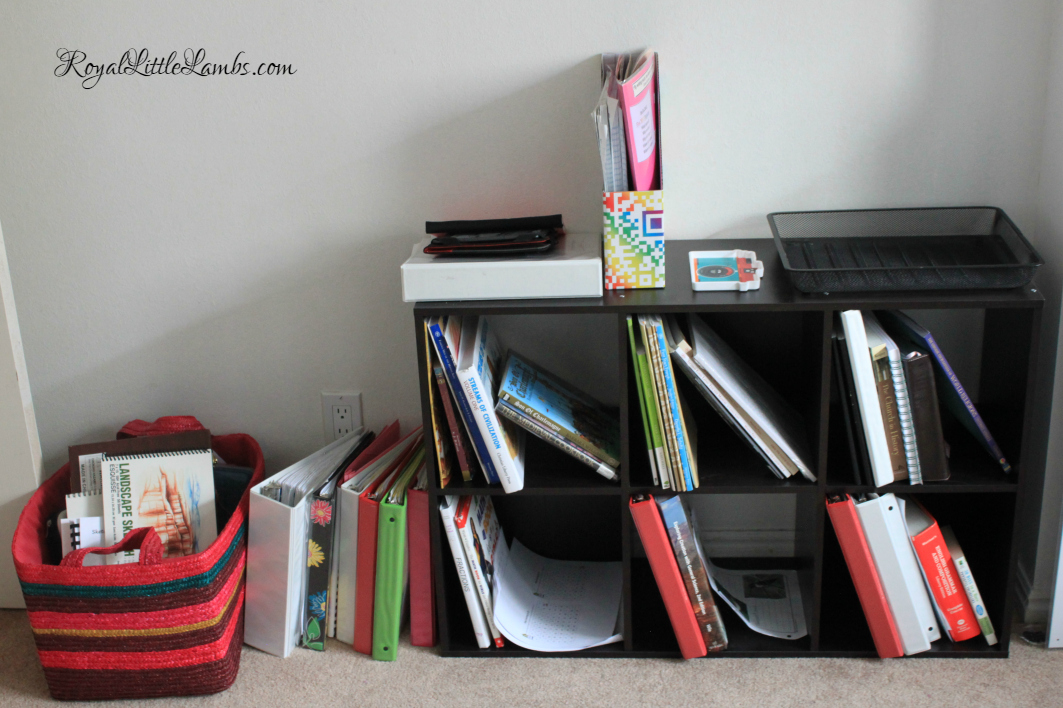
Liz has a 6-cube unit laid horizontally so she has a big shelf on top for her desk supplies. She has one cubby for every subject (science, math, history, language arts, Bible, Latin) and a big lovely thrifted basket beside it for art. Her notebooks are propped up beside her unit and she organizes her own now when her tray gets full. I give her a printable checklist each week.

tween cubes

See how we homeschool high school?

The girls have homeschool planners to learn time managment.

See how I plan a homeschool year.

How do you stay organized or schedule many children?

Stay tuned for part 4.

Share
Pin1
Share
1 Shares
You might also like:

Filed Under: Homeschool Tagged With: back to school, curriculum, homeschool, large family, planning

Suggested ResourcesGrammarly Writing SupportNotebookingPages.com LIFETIME Membership

Archives

Popular Posts

10 DIY Gifts with Essential Oils10 DIY Gifts with Essential Oils
Natural Remedies for HeadacheNatural Remedies for Headache
10 Natural Remedies to Keep on Hand10 Natural Remedies to Keep on Hand
Henna Hands CraftHenna Hands Craft
Homemade Turkey Divan CasseroleHomemade Turkey Divan Casserole
This website uses cookies to improve your experience. We'll assume you're ok with this, but you can opt-out if you wish.Accept Reject Read More
Privacy & Cookies Policy

Privacy Overview

This website uses cookies to improve your experience while you navigate through the website. Out of these, the cookies that are categorized as necessary are stored on your browser as they are essential for the working of basic functionalities of the website. We also use third-party cookies that help us analyze and understand how you use this website. These cookies will be stored in your browser only with your consent. You also have the option to opt-out of these cookies. But opting out of some of these cookies may affect your browsing experience.
Necessary
Always Enabled
Necessary cookies are absolutely essential for the website to function properly. This category only includes cookies that ensures basic functionalities and security features of the website. These cookies do not store any personal information.
Non-necessary
Any cookies that may not be particularly necessary for the website to function and is used specifically to collect user personal data via analytics, ads, other embedded contents are termed as non-necessary cookies. It is mandatory to procure user consent prior to running these cookies on your website.
SAVE & ACCEPT