Jennifer Lambert

A Sacred Balance

Visit Us On FacebookVisit Us On PinterestVisit Us On InstagramVisit Us On Linkedin
  • Homeschool
    • Book Lists
    • How Do We Do That?
    • Notebooking
    • Subjects and Styles
    • Unit Studies
  • Travel
    • Europe
      • Benelux
      • France
      • Germany
      • Greece
      • Ireland
      • Italy
      • London
      • Porto
      • Prague
    • USA
      • Chicago
      • Georgia
      • Hawaii
      • Ohio
      • Utah
      • Yellowstone and Teton
  • Family
    • Celebrations
    • Frugal
  • Military Life
    • Deployment
    • PCS
  • Health
    • Recipes
    • Essential Oils
    • Fitness
    • Mental Health
    • Natural Living
    • Natural Beauty
  • Faith
  • About Me
    • Favorite Resources
    • Advertising and Sponsorship
    • Policies
  • Reviews

© 2025Jennifer Lambert · Copyright · Disclosure · Privacy · Ad

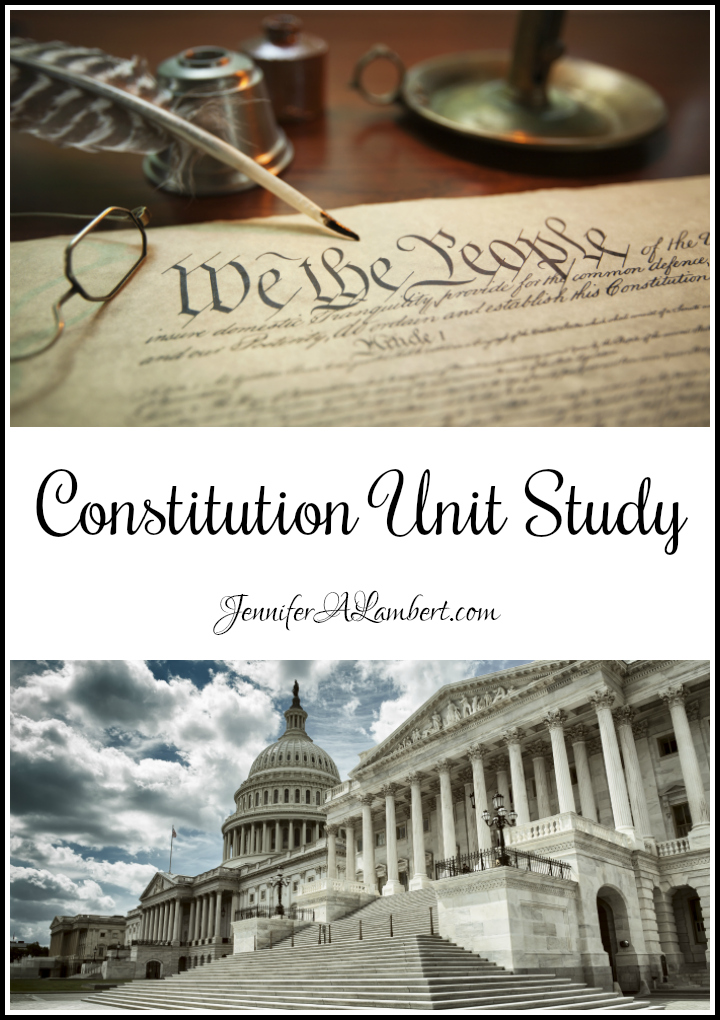
Constitution Unit Study

This blog may contain affiliate links: disclosure.
Please see my suggested resources.

September 7, 2020 By Jennifer Lambert 11 Comments

I want to teach my kids US history, government, citizenship.

I don’t want the US government curriculum to be nationalist, fundamentalist, or evangelical.

I’m not sure when many Americans began equating white Republican Jesus with the white male president, right wing government officials, and media, with removing or reducing social programs, but that’s not my religion.

I want unbiased materials and we’re leaning more and more towards secular curriculum to get the true picture of history.

On September 17, 1787, the Founding Fathers signed the most influential document in American history, the United States Constitution.

As we approach Constitution Week, September 17-23, here are some fun educational materials available at no cost to homeschoolers.

A More or Less Perfect Union is a three-part PBS series hosted by Senior Federal Appeals DC Circuit Court Judge Douglas Ginsburg. The series features 17 Constitutional experts weighing in on hot button topics around the document that governs those who govern us.  It aired earlier this year and is schedule to re-air on public television on Sept. 13 at 9 p.m. ET. It is also available on Amazon Prime and PBS.org, if you are a member. It can be watched for free now. It is best suited for high school level students.

Imagine having a discussion with George Washington and Ben Franklin today. Judge Ruth Bader Ginsburg sat down with each historic figure to discuss the Constitution, what succeeded and what failed, slavery, education, and even air conditioning and deodorant! Meet the Framers are fascinating, educational and entertaining conversations that shouldn’t be missed.

Judge Ginsburg worked with izzit.org, an online teacher resource, to develop civics educational materials to teach about the Constitution.   The materials include a week-long course on The U.S. Constitution & Black History, a 16-minute teaching unit, Becoming Equal Under the Law, and a number of Teachable Moments (short video clips designed to encourage discussions).

For younger students, the Pups of Liberty series (The Boston T-Bone Party  and The Dog-claration of Independence) are delightful.

A new teaching unit on the First Amendment is recently released.

This is all available to educators at no cost!

Constitution and Government Resources

  • Zinn Education Project
  • Bookshark Constitution unit study (must input an email address to receive)
  • Sonlight Election Day Unit Study (must input an email address to receive)
  • Election Unit Study from My Little Poppies
  • US Constitution Unit Study from The Homeschool Mom
  • Constitution Unit Study from HEAV
  • Constitution Lesson Plan from Homeschool Lessons
  • Constitution Day Unit from DIY Homeschooler
  • Constitution Week Lessons from Homeschool.com
  • Constitution Copywork and Printable Activities from Homeschool Creations
  • Preamble to the Constitution Copywork from Cynce’s Place
  • Preamble to the Constitution File Folder Game from The Wise Nest
  • US Constitution Lapbook from Homeschool Helper
  • Constitution Writing Activities from In All You Do
  • US Constitution Lesson Plans from The Clever Teacher
  • Celebrating the Constitution from Hip Homeschool Moms
  • ConstitutionFacts.com
  • iCivics
  • US Government Unit Study from Our Journey Westward
  • Unit Study: American Government & Elections from Home Schoolroom
  • United States resources from The Homeschool Den
  • My 4th of July unit
  • My Revolutionary War unit
  • Liberty’s Kids
  • Schoolhouse Rock!
  • Schoolhouse Rock!: Election Collection
  • This is America, Charlie Brown
  • Animaniacs: Season 3, Episode 75 (The Presidents Song)
  • Elmo the Musical: First Monster President

Favorite US History Books

  • A People’s History of the United States by Howard Zinn
  • A Different Mirror by Ronald Takaki  
  • An African American and Latinx History of the United States by Paul Ortiz 
  • A Black Women’s History of the United States by Daina Ramey Berry and Kali Nicole Gross 
  • An Indigenous Peoples’ History of the United States by Roxanne Dunbar-Ortiz  
  • A Disability History of the United States by Kim E. Nielsen  
  • A Queer History of the United States by Michael Bronski  
  • Lies My Teacher Told Me: Everything Your American History Textbook Got Wrong by James W. Loewen
  • A History of US: Eleven-Volume Set by Joy Hakim
  • Life: Our Century In Pictures by Richard B. Stolley
  • The Century for Young People by Peter Jennings

Should we revise or rewrite our constitution to better suit our society?

Share
Pin74
Share
74 Shares
You might also like:

Filed Under: Homeschool Tagged With: history, homeschool, unit study

Labor Day Unit Study

This blog may contain affiliate links: disclosure.
Please see my suggested resources.

August 24, 2020 By Jennifer Lambert 5 Comments

Labor Day is not just the official end of summer.

Labor Day is a federal holiday in the United States celebrated on the first Monday in September to honor and recognize the American labor movement and the works and contributions of laborers to the development and achievements of the United States.

The first Labor Day holiday was celebrated on Tuesday, September 5, 1882, in New York City, in accordance with the plans of the Central Labor Union. The Central Labor Union held its second Labor Day holiday just a year later, on September 5, 1883.

By 1894, 23 more states had adopted the holiday. Congress passed an act making the first Monday in September of each year a legal holiday in the District of Columbia and the territories. On June 28, 1894, President Grover Cleveland signed a law making the first Monday in September of each year a national holiday.

All labor that uplifts humanity has dignity and importance and should be undertaken with painstaking excellence.     

Martin Luther King, Jr.

Because we have suffered, and we are not afraid to suffer in order to survive, we are ready to give up everything — even our lives — in our struggle for justice. We draw our strength from the very despair in which we have been forced to live. We shall endure. When a man or woman, young, or old, takes a place on the picket line for even a day or two, he will never be the same again.  

Cesar Chavez

Topics for Discussion

  • The Modern Labor Rights Movement
  • The Power Of Agitating & Organizing
  • Child Labor
  • Minimum Wage
  • Maternity/Paternity Leave
  • The Gender & Race Wage Gap: Glass Ceilings
  • The US Economy Runs On The Backbone of Exploited Black Labor
  • The Effect of Exploitative Migrant Labor On Families

Resources

  • Have we forgotten the true meaning of Labor Day?
  • Why Do We Celebrate Labor Day? by History.com
  • Labor Day Lesson Plan from PBS Media
  • Beyond the BBQ by Miss Humblebee
  • Labor Day Unit from Homeschool.com
  • Labor Day Activities from Time4Learning
  • 36 Labor Day Activities for Kids from Homeschool Superfreak
  • Labor Day Resources from Homeschool Helper Online
  • PreK Labor Day Resources from Simply Kinder
  • Labor Day Emergent Reader from The Barefoot Teacher
  • Printable Labor Day Lesson by Create by Faith

Book List

  • Click, Clack, Moo by Doreen Cronin
  • The Day the Crayons Quit by Drew Daywalt  
  • I Like, I Don’t Like by Anna Baccelliere 
  • Shining Star: The Anna May Wong Story by Paula Yoo 
  • How Mamas Love Their Babies by Juniper Fitzgerald 
  • Brick by Brick by Charles R. Smith Jr.
  • Gordon Parks: How the Photographer Captured Black and White America by Carole Boston Weatherford 
  • Kids on Strike! Susan Campbell Bartoletti
  • Kids at Work by Russell Freedman and Lewis Hine
  • Growing Up in Coal Country by Susan Campbell Bartoletti
  • Breaker Boys: How a Photograph Helped End Child Labor by Michael Burgan
  • Which Side Are You On? The Story of a Song by George Ella Lyon 
  • The Golden Thread: A Song for Pete Seeger by Colin Meloy  
  • Brave Girl – Clara and the Shirtwaist Makers’ Strike of 1909 by Michelle Markel
  • Fannie Never Flinched: One Woman’s Courage in the Struggle for American Labor Union Rights by Mary C. Farrell
  • On Our Way to Oyster Bay: Mother Jones and Her March for Children’s Rights by Monica Kulling
  • Counting on Grace by Elizabeth Winthrop
  • Lyddie by Katherine Paterson 
  • Bread and Roses, Too by Katherine Paterson 
  • Bread and Roses: Mills, Migrants, and the Struggle for the American Dream by Bruce Watson
  • Flesh & Blood So Cheap: The Triangle Fire and Its Legacy by Albert Marrin
  • The Circuit: Stories from the Life of a Migrant Child by Francisco Jiménez
  • Harvesting Hope: The Story of Cesar Chavez by Kathleen Krull
  • Dolores Huerta: A Hero to Migrant Workers by Sarah E. Warren
  • Side by Side/Lado a Lado: The Story of Dolores Huerta and Cesar Chavez/La Historia de Dolores Huerta y César Chávez by Monica Brown  
  • César Chávez: A Triumph of Spirit by Richard A. Garcia and Richard Griswold del Castillo
  • Roses for Isabella by Amy Córdova and Diana Cohn
  • Joelito’s Big Decision/La Gran Decisión de Joelito by Ann Berlak 
  • Me and Momma and Big John by Mara Rockliff
  • Undocumented: A Worker’s Fight by Duncan Tonatiuh  
  • ¡Si, Se Puede! / Yes, We Can!: Janitor Strike in L.A. by Diana Cohn
  • Memphis, Martin, and the Mountaintop: The Sanitation Strike of 1968 by Alice Faye Duncan
  • A Long Hard Journey: The Story of the Pullman Porter by Fredrick McKissack and Patricia McKissack
  • The Jungle by Upton Sinclair
  • Civil Rights Unionism: Tobacco Workers and the Struggle for Democracy in the Mid-twentieth-century South by Robert Korstad

Labor Day movies

  • Norma Rae
  • Blue Collar
  • North Country
  • Harlan County, U.S.A.
  • Matewan
  • Salt of the Earth
  • Silkwood
  • The Pursuit of Happyness
  • Cesar Chavez
  • Bound for Glory
  • The Grapes of Wrath
  • On the Waterfront
  • Measure of a Man
  • The Wages of Fear
  • The Organizer
  • Metropolis
  • Newsies
  • Erin Brockovich
  • 9 to 5
  • Working Girl
  • Tootsie
  • Support the Girls
  • Made in Dagenham
  • Mr. Mom
  • The Company Men
  • The Hudsucker Proxy
  • Glengarry Glen Ross
  • Outsourced
  • Swimming With Sharks
  • Boiler Room
  • Night Shift
  • Horrible Bosses
  • Office Space
  • Trading Places
  • The Proposal
  • Picnic

I learned the value of hard work by working hard.

Margaret Mead

How can you support workers?

No one really cares what you post on social media or clapping or being honored at a parade or event. Workers need and want tangible rewards for doing what they do – better conditions, higher pay, protections for illness or injury, security. Respect their dignity.

Make sure you tip well. More than 20%. Don’t be insulting or rude. Service is a very difficult job.

Gifts for the services you use and appreciate most. Keep in mind that most workers can technically only accept gifts equally up to $20 or less. Don’t embarrass them or put them in an awkward position. A gift card, a homemade treat, a caffeine drink, a token is much appreciated.

Vote. Protest. Support public officials, government agencies, and private organizations who protect wage workers and their benefits.

Speak up and teach. Our kids need to see us fighting injustice. They need to know we are not silent and complicit.

Remember the history of Labor Day!

Share
Pin70
Share
70 Shares
You might also like:

Filed Under: Homeschool Tagged With: homeschool, labor, unit study

High School Homeschool

This blog may contain affiliate links: disclosure.
Please see my suggested resources.

August 17, 2020 By Jennifer Lambert 6 Comments

I graduated my eldest daughter from our homeschool a few years ago.

Her homeschool high school years were exciting for us all, and unique since we lived in Germany at the time.

My two middle girls are entering their high school years.

I feel a little more comfortable for our second round.

We’re adding more multicultural and social justice books to our reading lists. I am much more relaxed.

More and more, I am watching them walk away from me.

What Homeschool High School Looks Like for Us the Second Time

We’re trying to max out their academic transcripts with 4 English, 4 Social Studies, 4 Math, and 4 Science.

My girls have already completed General science, Physical science, and Biology from Apologia.

We use Tapestry of Grace for humanities with a 4-year history cycle. Tapestry of Grace offers lovely descriptions for each thread to help with transcripts.

Electives are religion, art, cooking, sports, and foreign language.

My girls are 13 and 14 this year and we homeschool year-round so we don’t have to rush.

They expect to complete all my requirements around age 16, like their older sister did. They want to get part-time jobs, volunteer, explore hobbies, perhaps pursue dual college enrollment locally until beginning college full-time. And we don’t pressure about college.

9th grade curriculum

  • Ancient world literature
  • Ancient world history
  • Ancient world geography, philosophy, government
  • Ancient religion and Bible history
  • Algebra I (Life of Fred, VideoText, OpenStax)
  • Astronomy and Microbiology from OpenStax

10th grade

  • Middle Ages world literature
  • Middle Ages world history
  • Middle Ages world geography, philosophy, government
  • Middle Ages world religion and Bible history
  • History of language – King Alfred’s English
  • Algebra II (Life of Fred, VideoText, OpenStax)
  • Chemistry (either Apologia or OpenStax)

11th grade

  • Renaissance-Industrial Revolution world literature
  • Renaissance-Industrial Revolution world history
  • Renaissance-Industrial Revolution world and US geography, philosophy, government
  • Renaissance-Industrial Revolution world religion and Bible history
  • US History from OpenStax
  • Geometry (Life of Fred, VideoText, OpenStax)
  • Physics (either Apologia or OpenStax)

12th grade

  • Modern and Contemporary world literature
  • Modern and Contemporary world history
  • Modern and Contemporary world and US geography, philosophy, government
  • Modern and Contemporary world religion and Bible history
  • US History from OpenStax
  • Trig/Calc from OpenStax
  • Psychology and/or advanced science from OpenStax

Pinterest Boards

  • US History
  • Year 1 History
  • Year 2 History
  • Year 3 History
  • Year 4 History
  • Art
  • Language
  • Religion

High School Homeschool Resources:

  • Graduating Homeschool High School
  • Health Credit
  • Transcripts and Credits
  • Homeschool Planner Printables
  • Civil Air Patrol as Elective
  • Homeschool Electives
  • How we do Art
  • How we do History
  • I Don’t Teach English
  • How I Teach Religion
  • How we do Math
  • Foreign Language
  • How we do Science
  • Preparing for After High School
  • 5 Best Life Skills Books for Teens

How do you homeschool high school?

Linking up: Random Musings, Mostly Blogging, Anita Ojeda, Welcome Heart, April Harris, Marilyn’s Treats, Little Cottage, Kippi at Home, LouLou Girls, Home Stories, InstaEncouragements, Purposeful Faith, Our Three Peas, Grandmas Ideas, Anchored Abode, Soaring with Him, Ducks in a Row, Girlish Whims, Fluster Buster, Ginger Snap Crafts, Katherine’s Corner, Penny’s Passion, Debbie Kitterman, CKK, Imparting Grace, Ridge Haven Homestead, Apron Strings, Life Beyond the Kitchen, Create with Joy,

Share
Pin45
Share
45 Shares
You might also like:

Filed Under: Homeschool Tagged With: back to school, high school, homeschool, teen

Quarantine Schooling

This blog may contain affiliate links: disclosure.
Please see my suggested resources.

August 10, 2020 By Jennifer Lambert 6 Comments

I taught school for about ten years, and always homeschooled my four kids, so I have a bit of a different philosophy towards education than many.

Around March 2020, may families found themselves in awkward situations. Many parents worked from home while children completed their school year online. Teachers scrambled to prepare online lessons for hundreds of students. It was stressful.

Many families and the media call this homeschooling.

Narrator: “This was not, in fact, homeschooling.”

Now the word “homeschooling” has evolved over the years and used to have different connotations than it now does. It’s not such a weighted or negative word as it used to be.

The word often conjured images of denim jumper dress-wearing evangelical fundamentalist Christian families. And that certainly is still a subculture within homeschooling communities.

While it is still difficult to find secular and liberal homeschoolers in many areas, it is becoming more widely acceptable for many families to home educate their children in different ways.

Homeschool choices are almost limitless. Many states and school districts provide online or video lessons. There are secular and Christian curriculum options. Parents can create an eclectic mix of academics and hobbies for kids to explore.

Many families are concerned about safety, continuity, and consistency for this next school year.

Some schools are closed, some offer part time or staggered attendance, some are going completely online. I am not here to judge parents whose choices are impossible during these circumstances. I realize many parents must work outside the home and need childcare. Our society expects schools to provide education and care during working hours.

Teachers are facing impossible situations. Required to teach in person or prepare and teach engaging lessons online, risking their health or their careers. I can’t imagine making these hard choice if I were still a classroom teacher.

I understand that it’s overwhelming to suddenly homeschool kids who expect to attend school. It’s a completely different lifestyle for many families and the unknown is scary.

It took me a few years to adjust as a reluctant homeschooler.

For first time homeschoolers, pandemic/quarantine/crisis homeschoolers, reluctant homeschoolers, even veteran homeschoolers:

Some things to think about school at home:

What is your focus?

Search your heart for what you want this school year to look like for your family. Use this time to learn about your children – their hopes, dreams, preferences. Don’t just think this is about academics. This is about relationship. This is about making memories. What do you want your family to look back on during this time and remember fondly?

Ease into it.

It’s often best to start with the bare bones. Fun, fun, fun. Outside time. Hiking. Nature exploration. Learn about your backyard nature. Fall in love with learning. Maybe just begin with reading, writing, arithmetic. Have story time and talk about the book afterwards or make art. Do kitchen math with delicious recipes. You don’t have to recreate a classroom school environment in your kitchen, dining room, living room, or basement. You don’t have to spend hundreds of dollars on curriculum, books, computer programs.

Keep records.

Records, portfolio, book lists, field trips are handy to have if you plan to send kids back into public or private school attendance at any point. It’s also nice to look back over what was accomplished on the days when you feel like nothing ever got done. I often enlist the kids to help make their notebooks or portfolios. It’s a great family project! Many homeschoolers must submit curriculum lists at the beginning of each school year with their intent letter and provide a portfolio or test score at the end of the year. Keeping records as you go makes this easier than scrambling last minute. It’s good to have a scrapbook or journals for kids to look back on too.

Take it slow.

You will have bad days. Keep your cool as the adult when things fall apart. Don’t think of it as a failure. Think of the unpleasant moments as opportunities to learn how to do better. No one is falling behind. You’re not competing with anyone. You don’t need a strict color-coded schedule for every minute of every day. You don’t have to know how to do everything, teach every subject, or complete every lesson. There is a plethora of resources out there to help. Screentime is ok. Sleeping in is ok. Meal times are arbitrary. Later bedtimes are ok. I realize this is a stressful time for everyone, even veteran homeschoolers who usually participate in lots of activities with others.

Keep in touch.

It’s important to allow kids to keep in touch with friends until it’s safer for in person meetups and play dates and group activities. We live in a brave new world with so much technology allowing us to communicate any time, anywhere, with almost anyone. My kids have iPads and/or smartphones with Discord, messenger apps, social media. We find it difficult to find other kids whose parents trust them to use these services. It makes it more difficult for my kids to keep in touch with their friends.

Start a new tradition.

Breakfast announcements. Morning message before beginning seatwork. Weekly tea time (it doesn’t even have to include tea!) with fun snacks and music or poetry. Friday free days (or afternoons) for playing outside. Friday pizza nights with movies. Saturday dance parties. Sunday hiking.

Resources:

  • NOT Back to School
  • Homeschooling in Quarantine
  • Lessons from Quarantine
  • Quarantine with Kids
  • Prayer for Quarantine
  • Do Not Fear
  • Apocalyptic Media to Binge
  • Secular Curriculum
  • New to Homeschooling?
  • Realistic Homeschool Schedule
  • How I Plan Our Homeschool Year
  • Homeschool for Free
  • Five Languages of Learning
  • Learning Styles and Personality Types
  • How We Learn
  • Top 10 Books for Homeschoolers
  • 12 Things Homeschoolers Don’t Have to Do
  • We Don’t Do a Homeschool Co-op
  • We Don’t Do Testing
  • High School Credits and Transcripts
  • My Thoughts on Socialization
  • Stop Making Everything So Educational

What does this school year look like for your family?

Linking up: Random Musings, April Harris, Marilyn’s Treats, Little Cottage, Kippi at Home, Create with Joy, Mostly Blogging, OMHG, Home Stories, Purposeful Faith, InstaEncouragements, LouLou Girls, Grandma’s Ideas, Welcome Heart, Ducks in a Row, Girlish Whims, Fluster Buster Ginger Snap Crafts, Katherine’s Corner, Penny’s Passion, Debbie Kitterman, Slices of Life, CKK, Imparting Grace, Life Beyond the Kitchen, Ridge Haven Homestead, Simply Sweet Home, Momfessionals, Answer is Choco, Embracing Unexpected, CWJ, Serenity and Harmony, Grammy’s Grid, Anita Ojeda,

Share
Pin32
Share
32 Shares
You might also like:

Filed Under: Homeschool Tagged With: homeschool, quarantine

Not Back to School

This blog may contain affiliate links: disclosure.
Please see my suggested resources.

August 3, 2020 By Jennifer Lambert 24 Comments

Homeschoolers often celebrate “back to school” with fun and different traditions than other families whose children attend school.

Homeschoolers also do many of the same things as school families. We buy new supplies and clothes with all the sales, tax-free days, and coupons. We like the first day photos.

Homeschoolers look forward to the day when school kids go back to classrooms and all the fun places we love to frequent aren’t busy with summer crowds anymore. But even homeschoolers aren’t gathering or doing co-ops or meeting up this fall.

My kids used to wave goodbye to their neighborhood friends who rode the bus to school while we began our homeschool day. They often waited for their bus at the end of the day to greet their friends again.

This school year looks very different for many families. Some school districts are offering options for in person full or part time attendance, or online remote classes.

No matter what kind of school year our kids are beginning, making the first day of the new school year a special day may help ease jitters or disappointments. We need to make great memories with our kids.

Celebrating Not Back to School

  • Night before school party
  • Special breakfast or dinner night before
  • Pictures to commemorate the new year (preferably with their consent to post online)
  • Memory board or interview page
  • Gifts or treats
  • Look through new school materials and books together to get familiar.
  • Set up a work area for each child to complete assignments.
  • Special back to school books. It’s hard to find books celebrating homeschool.
  • New clothes fashion show. It could be new loungewear or pajamas!
  • Schultüte – traditional school cones for 1st graders in Germany. Another Schulüte DIY idea here. DIY auf Deutsch hier.
  • Ice cream!!!
  • Chalk drawings in the driveway or sidewalk
  • Fresh flowers, especially roses for new schoolers! I love the Waldorf rose ceremony.
  • Discuss plans, desires, and dreams for the year
  • Make calm jars with glitter, oil, food coloring, and water.
  • Make tie-dye shirts or bags.
  • Go hiking or do a nature scavenger hunt.
  • Picnic lunch
  • Bowling
  • Pool or lake party
  • Parties with a fun theme, even if it’s just immediate family
  • Movie night

My kids are older now and we still try to do fun things, but we don’t even really have one single official back to school day. We just kind of ease into it sometime the end of August, transferring from one history cycle to the next and new math books and maybe new science and foreign language.

You might also like:

  • New to Homeschooling?
  • Our Top Ten Homeschool Items
  • Top Ten Books for Homeschoolers
  • My Top 40

How do you make the first day of school special?

Linking up: Grammys Grid, Pinch of Joy, Eclectic Red Barn, House on Silverado, Jenerally Informed, Stroll Thru Life, OMHG, CWJ, Shelbee on Edge, LouLou Girls, April Harris, Suburbia, Random Musings, Anita Ojeda, Jeanne Takenaka, InstaEncouragements, Blue Sky at Home, Soaring with Him, Anchored Abode, Ducks in a Row, Fluster Buster, Ridge Haven, Ginger Snap, Try it Like it, Artful Mom, Penny’s Passion, Slices of Life, Simply Beautiful, Modern on Monticello, Everything, Create with Joy, Books and More, Simply Sweet Home, Answer is Choco, Being a Wordsmith, Cottage Market, Oak Hill,

Share
Pin62
Share
62 Shares
You might also like:

Filed Under: Homeschool Tagged With: back to school, homeschool, quarantine

Our Curriculum for 2020-2021

This blog may contain affiliate links: disclosure.
Please see my suggested resources.

August 3, 2020 By Jennifer Lambert Leave a Comment

I’ve been homeschooling my four kids for about sixteen years now. My younger three have never attended school. My eldest attended day care, preschool, and one month of third grade at a DoD school.

We learn year-round and love having freedom to learn when and how and what we want. We love being able to take breaks for field trips, extended travel just for fun or educational purposes, sun days, snow days, movie days, game days, park days.

Most of the anxiety I had in the beginning years has faded away and I am mostly in awe of my kids’ abilities and interests. I learn so much from watching and learning with them.

I highly recommend the books by Louise Bates Ames. A good guide to follow are the What Your ?-Grader Needs to Know by E.D. Hirsch, Jr. His books have some problems, but it’s a great jumping off point.

My eldest daughter is taking a break from college and working full time.

6th Grade

My son is starting middle school! It’s a lot more writing and independent work than he’s used to, but we will ease into it. I love this age! It’s so exciting to see all the changes and connections.

  • finishing Apologia Anatomy and journal
  • Apologia General and journal
  • Singapore math 6A and 6B
  • Latina Christiana II
  • Spelling Workout D
  • Studying God’s Word F
  • baseball and ninja training

9th Grade

My two middle girls are officially in high school!

I’m keeping track of their credits in a transcript for their future needs. Our high school goals are four full year credits of English, math, science, social studies, with two full year credits of foreign language, and multiple electives for creative arts and physical activity.

Some electives the girls are pursuing in addition to their sports are cooking/baking, creative writing, drawing/animation, jewelry making.

Ohio doesn’t allow students to work until age 15, and my girls are already looking forward to their first part time job in a year or two – maybe at our Dairy Queen around the corner or a locally owned shop or volunteering with the Red Cross.

  • Astronomy and Microbiology from OpenStax
  • VideoText Algebra
  • Tori is continuing Russian and Greek
  • Tori continues aerial arts and is beginning lyrical dance
  • Katie is continuing German
  • Katie is participating in a virtual Dungeons and Dragons weekly game

Together

We still do lots of morning read alouds together for Bible, church history, natural history, world and American history, and lots of multicultural literature.

We are currently finishing up reading Life of Fred pre-Algebra 2 with Economics. We also have Life of Fred Financial Choices. We will soon start Beginning Algebra. My son may not be quite ready for it yet.

We’re starting over again in our history cycle with Year 1. It will be my last history cycle with my girls and I feel so sad. I will update as we continue to add better book selections to our repertoire. Libraries still aren’t open except for requests by appointment.

Our main text this year is The History of the Ancient World: From the Earliest Accounts to the Fall of Rome by Susan Wise Bauer. I just purchased the Study and Teaching Guide: The History of the Ancient World by Julia Kaziewicz. My girls are completing the critical thinking questions for each chapter.

Also The Philosophy Book: Big Ideas Simply Explained by DK and The Story of Science: Aristotle Leads the Way by Joy Hakim are daily read alouds.

I look forward to studying in depth ancient art history!

See how we do history. Our main curriculum Tapestry of Grace (and the way I supplement it each year) covers all the humanities – history, literature, art, music, philosophy, government.

My kids are very active with skating/roller blading, cycling, hiking, walking, playing the Wii, in addition to their classes and rec sports.

I love seeing my kids get creative with floral arranging, jewelry making, various arts and crafts, cooking, writing, map drawing, herbology and foraging. We will discuss elective transcript credit for various hobbies if they complete enough or do a big, long project.

How is your new homeschool year looking?

Share
Pin30
Share
30 Shares
You might also like:

Filed Under: Homeschool Tagged With: back to school, curriculum, homeschool

Secular Curriculum

This blog may contain affiliate links: disclosure.
Please see my suggested resources.

July 26, 2020 By Jennifer Lambert 2 Comments

I have come full circle, back to the views I had during our first year of homeschooling.

We began homeschooling for academic reasons.

I got confused, sidetracked, shamed, humiliated, and lost with all the religious homeschool groups, sites, curriculum.

I am a trained English teacher who has taught public, private, middle, high, college, and tutoring – but I questioned my abilities to homeschool my children well.

Homeschoolers, groups, and co-ops are only too happy to jump in to offer advice and help to new homeschoolers. But it seems to come with a catch. Many homeschoolers meetup or co-op through their churches. There is still a large percentage of homeschoolers who are conservative Christian and they feel this is the only way. They ostracize anyone who doesn’t conform.

Do a web search about the origins, beliefs, and requirements for Classical Conversations, HSLDA, many homeschool conferences, and other large homeschool organizations. They’re certainly not secular or even welcoming.

I didn’t even grow up Christian. Not evangelical at all, not going to church except with my Lutheran grandma who visited two-three times a year. I was never confirmed. I had been christened as an infant at the bequest of the grandma and I said meal blessings and bedtime prayers, but that was the extent of my religious upbringing until I met my first husband.

Growing up in the Bible belt of Georgia, I was odd. I always felt out of place. I didn’t understand the Christianese language.

Many homeschoolers don’t identify as evangelical Christians. There are Catholics, Jewish, Muslims, and other faiths (or no religion or faith group) who homeschool their children and would like secular or faith neutral materials and curriculum or something designed just for them. It’s really hard to find.

We started off with The Well-Trained Mind and I found it (and still find it, mostly) to be respectful regarding those other than the evangelical Christian faith. We began with the materials suggested for first grade.

Having four kids, we reuse curriculum each year. It saves us money. So, we own the entire Apologia science curriculum. They have since separated from Dr. Jay Wile and and he wrote and sells new texts while Apologia commissioned another author to recreate their middle and high school science texts. I think their quality has deteriorated, so we continue with what we’ve always done. The science hasn’t greatly changed.

We bought all four years of Tapestry of Grace online. It was great our first couple years, for the most part. As my eldest daughter went through the dialectic stage for high school, we didn’t buy some of the book selections, and very few of the religious texts recommended.

As the kids and I grow, we tend to edit out much of the religion in our curriculum and it can be tiresome. The science books are still solid for the academic lab science and we just skip the weird Bible parts. We don’t read a lot of the religious selections from the Tapestry of Grace humanities book lists. I supplement church and religion history lessons from better books when I feel it’s appropriate.

If I were beginning our homeschool journey now, I would choose more secular materials. I wish there were any complete affordable science lab homeschool curriculum good enough for high school credit, but I have yet to really find any we’re happy using.

I have found many Waldorf sites and curriculum is sometimes secular or very respectfully spiritual.

Secular Curriculum

I haven’t used all or even a lot of these. Some we reviewed when my kids were younger. Some of the materials for middle and high school may or may not meet standards in my opinion. My kids are all 10+ now and we are mostly finished buying curriculum and making do with what we have.

Complete or All in One Curriculum

  • Oak Meadow
  • Torchlight
  • Bookshark (faith neutral claim)
  • Timberdoodle
  • Moving Beyond the Page – Read our review.
  • Time4Learning
  • Khan Academy
  • Blossom and Root
  • Build Your Library
  • Global Village School

Science

See how we do science in our homeschool.

  • The Story of Science: Aristotle Leads the Way by Joy Hakim. Find lesson plans here.
  • The Story of Science: Newton at the Center by Joy Hakim
  • The Story of Science: Einstein Adds a New Dimension by Joy Hakim
  • Little Passports Science Expedition
  • Building Foundations of Scientific Understanding
  • Classic Science
  • Elemental Science
  • REAL Science Odyssey
  • Real Science 4 Kids
  • Home Science Tools
  • Supercharged Science. See our review.
  • Big History Project
  • Miller & Levine texts

English and Language Arts

See how my kids learned to read. I don’t teach English in our homeschool.

  • All About Learning – Reading and Spelling. Read our review.
  • Logic of English – Read our review. Our Foundations review.
  • Writeshop (some)
  • Progressive Phonics
  • Hooked on Phonics
  • LeapFrog games, DVDS, books, and toys
  • Reading Kingdom. See our review.
  • Reading Eggs
  • ABC Mouse
  • Explode the Code
  • Starfall
  • Literary Adventures for Kids
  • The Giggly Guide to Grammar
  • Easy Grammar. I used to use these drills as a classroom teacher.
  • Grammar Galaxy
  • Jack Kris Publishing
  • Barton Reading and Spelling
  • Essentials in Writing

History

See how we do history in our homeschool.

  • A History of US: Ten-Volume Set by Joy Hakim. Find lesson plans here.
  • A People’s History of the United States by Howard Zinn. Also Young People’s History and Zinn Education Project.
  • Little Passports – Early Explorers, World, USA
  • History Odyssey
  • Girls of American History. We reviewed this ages ago, and I imagine it’s improved a lot since it’s quite pricey now.
  • Building Great Minds
  • Story of the World Series by Susan Wise Bauer (for elementary school age)
  • The History of the World Series by Susan Wise Bauer (for high school)

Math

See how we do math in our homeschool.

  • VideoText Interactive See our review.
  • Life of Fred (not entirely secular or faith neutral.) Also reading and English texts.
  • Singapore Math. We’ve always used this K-8th!
  • TouchMath. See our review.
  • Eureka Math
  • RightStart Math
  • Teaching Textbooks
  • Art of Problem Solving
  • CTC Math
  • Math Mammoth
  • Miquon Math
  • Saxon Math
  • Shiller Math. also English.
  • ALEKS
  • Wild Math
  • Thinkwell
  • Mr. D Math

Fine Arts

See how we do art in our homeschool. See how we do music and cinema in our homeschool.

  • ARTistic Pursuits
  • Discovering Great Artists and more. See our review of Global Art.
  • Draw WRITE Now
  • Drawing with Children
  • MusIQHomeschool. See our Adventus piano review.
  • HomeSchoolPiano. See our review.

Foreign Languages

See how we do foreign languages in our homeschool.

  • Memoria Press Latin. (not exactly secular) See our review.
  • Elementary Greek (not exactly secular)
  • The Everything Learning Russian Book with CD
  • German DeMYSTiFieD
  • First Start French
  • Song School Latin
  • Song School Spanish. See our review.
  • Rosetta Stone
  • Mango Languages. See our review.
  • Transparent Language
  • Duolingo
  • Muzzy

Other

See how we do health and PE in our homeschool.

  • KidzType
  • Typing Instructor
  • Kidware Software Computer Science. See our review.
  • CompuScholar Web Design. See our review.

Secular Sites

Some of my favorite secular homeschooling and parenting sites:

  • Secular Homeschooling
  • SEA Homeschoolers
  • Up Above the Rowan Tree
  • Homeschool Unrefined
  • Planet Schooling
  • Parenting Forward
  • Parenting Decolonized
  • Raising Wildflower Kids
  • Happiness is Here
  • Laura Grace Weldon
  • Racheous
  • Look, We’re Learning!
  • Education Possible
  • Middleway Mom
  • Forgetful Momma
  • Starts at Eight
  • My Little Poppies
  • Tina’s Dynamic Homeschool Plus
  • Mama Teaches
  • Teach Beside Me
  • Far From Normal
  • Hustle Homeschool
  • Living Well+Learning Well
  • Royal Baloo
  • Gameschooling

What’s your favorite secular curriculum?

Share
Pin25
Share
25 Shares
You might also like:

Filed Under: Homeschool Tagged With: curriculum, homeschool

Japan Unit Study

This blog may contain affiliate links: disclosure.
Please see my suggested resources.

June 8, 2020 By Jennifer Lambert Leave a Comment

We love learning about other cultures.

We review history and geography each cycle/year and assimilate our learning with current events.

I want to learn real history along with my kids, not just an American perspective.

Japan Unit Study

Topics

  • Feudalism
  • Samurai
  • Imperialism
  • WWII
  • Anime
  • Technology

Book List

  • Born in the Year of Courage by Emily Crofford
  • A Pair of Red Clogs by Masako Matsuno
  • The Samurai’s Tale by Erik C. Haugaard
  • A Samurai Castle by Fiona MacDonald 
  • Black Belt
  • The Drums of Noto Hanto
  • The Inch-High Samurai
  • The Samurai’s Daughter
  • Sword of the Samurai
  • Three Samurai Cats
  • The Origami Master by Nathaniel Lachenmeyer
  • Yuki and the One Thousand Carriers by Gloria Whelan
  • The Invisible Seam by Andy William Frew
  • Sadako and the Thousand Paper Cranes by Eleanor Coerr
  • A Carp for Kimiko by Virginia Kroll
  • The Old Man Mad about Drawing: A Tale of Hokusai by Francois Place
  • Commodore Perry in the Land of the Shogun and Shipwrecked!: The True Adventures of a Japanese Boy by Rhoda Blumberg
  • Kazunomiya: Prisoner of Heaven, Japan 1858 by Kathryn Lasky
  • The Big Wave by Pearl S. Buck
  • So Far from the Sea by Eve Bunting
  • Year of Impossible Goodbyes by Sook Nyul Choi
  • So Far from the Bamboo Grove and My Brother, My Sister, and I by Yoko Kawashima Watkins
  • Hiroshima by Laurence Yep
  • Passage to Freedom and Baseball Saved Us by Ken Mochizuki
  • How My Parents Learned to Eat by Ina R. Friedman
  • ALL THE BOOKS by Allen Say
  • Japanese Children’s Favorite Stories by Florence Sakade

Movies

Use discretion. Some of these films are just ridiculous.

  • Seven Samurai by Akira Kurosawa
  • The Last Samurai
  • 47 Ronin
  • Godzilla
  • Pokémon
  • Dragon Ball Z
  • Yu-Gi-Oh!
  • Death Note
  • Hayao Miyazaki and Studio Ghibli
  • The Tale of The Princess Kaguya
  • Grave of the Fireflies
  • In This Corner of the World
  • Lost in Translation
  • Black Rain
  • The Fast and the Furious: Tokyo Drift
  • The Wolverine
  • Unbroken
  • Pearl Harbor
  • Hacksaw Ridge
  • Letters from Iwo Jima
  • Flags of Our Fathers
  • Windtalkers
  • Emperor
  • Midway

Resources: Printables, Units, Lessons

  • Confessions of a Homeschooler
  • The Homeschool Mom
  • Happy Homeschool
  • Unlikely Homeschool
  • Living Montessori Now
  • Homeschool Share
  • The Momma Knows
  • Homeschool Den
  • Snowden
  • Happy Brown House

We would love to visit Japan someday!

Country Study Notebooking Pages
Share
Pin67
Share
67 Shares
You might also like:

Filed Under: Homeschool Tagged With: Asia, geography, history, homeschool, Japan, military, unit study

Homeschooling During Quarantine

This blog may contain affiliate links: disclosure.
Please see my suggested resources.

April 27, 2020 By Jennifer Lambert 6 Comments

Ohio has been in quarantine lockdown since April 1.

Many parents are working from home and school are closed so life looks a little different.

But many families are in crisis, wondering how they will pay their bills. Those stimulus checks won’t last long.

The families forced into quarantine when the schools closed are not homeschooling.

It’s crisis schooling. It wasn’t a decision. It was forced. Most are miserable, confused, scared.

My parents live in Georgia and they were only on lockdown for a couple weeks and it’s worrisome.

Stores and services are reopening, but not schools. Maybe next fall. And it’s probably too soon. Many families are planning to keep their kids home and accept the offer for online options from the public schools. They may find that successful, preferable, or they may realize there are other ways to learn.

I know our friend down the street loved completing his lessons super fast online and having free time.

Being a homeschool family doesn’t mean this isn’t hard.

Being introverted doesn’t mean this isn’t hard.

Even though our lifestyles don’t look that much different at this time, it’s still stressful.

We’re used to having the freedom to do what we want, when we want. We used to go where we want, not relying on traditional school schedules. We like to avoid crowds.

Libraries are closed and we miss it.

Local parks and playgrounds are closed and we miss it.

Sports and extra activities are canceled and we miss it.

We missed Easter. We had just started attending a new church.

My college daughter’s classes all went online. It’s hard because the professors aren’t used to that so they simplified the assignments and made grades easier. She misses her friends and freedom. We worry about fall semester and are noticing some small colleges are closing forever. She works part time at a bank and only their drive-thru is open. She realizes she is fortunate to be an essential employee.

The lovely spring weather beckons and we play in the yard and driveway. We explore our backyard woods and creek. My son rides his bike or scooter. The girls rollerblade and skate.

We’ve quietly celebrated four birthdays – mine and three of the kids. Homemade cake, favorite breakfasts and dinners, presents and movies. We don’t do big parties, so this is just our normal.

We’re finishing up our books and regular curriculum and we are getting bored.

There’s nothing to look forward to.

If it were winter, we probably wouldn’t do much different. Since we’re finishing up our formal lessons for the year and heading towards summer, we have to find creative ways to occupy our time. We used to do formal school year-round, but the kids like to have a month or so of a break these last few years. It’s becoming very hard with everything canceling through summer now.

I’ve never liked the word “homeschooling” because how we learn and live looks so little like school.

We just live life, learn what’s interesting, focus on fun activities and skills. We can do and learn the things we’ve only talked about and never found the time.

Academics are not as important as relationship.

We’re disappointed with all the neighborhood kids playing together like they’re on holiday. We wonder what their family’s narrative is for why school and work are canceled, stores are closed, people wearing masks. Do they think this is a hoax? Those public and private school kids and parents are exposing all those families while we the homeschoolers are following the rules and social distancing from everyone who doesn’t live in our house. It’s very frustrating.

My kids haven’t been out since March. I see lots of children in stores with their parents and while I realize child care is often an issue, I worry they’re being exposed or exposing others to illness.

Homeschooling during Quarantine

  • Learning new recipes
  • Playing games – online, board and card, video. We have a Wii and Switch.
  • Watching movies and shows on Netflix, Amazon, Hulu.
  • Arts and crafts
  • Deep cleaning each room
  • Painting or refinishing furniture
  • Organizing and minimizing – although we can’t donate anything right now.
  • Getting outside as much as possible while keeping social distance from other families and individuals
  • Nature study
  • Gardening
  • Yard work
  • Exercise
  • Online classes
  • Bible study
  • Literature unit
  • Foreign language study
  • Electives
  • Read, READ, read

Is there a lesson in quarantine? What is the lesson in all this?

Also, we’re bingeing apocalyptic media. Because that’s our style of humor and memes are therapy.

How is your schedule or lifestyle different during quarantine?

Share
Pin42
Share
42 Shares
You might also like:

Filed Under: Homeschool Tagged With: health, homeschool, quarantine

Math Stories

This blog may contain affiliate links: disclosure.
Please see my suggested resources.

April 13, 2020 By Jennifer Lambert 5 Comments

Doing math drills is not my idea of fun. I don’t want to inflict that upon my children.

While we complete Singapore math workbooks and VideoText for high school, we really love reading about math in a fun way.

I love books and words and beautiful illustrations.

We love to read living math book or math stories that bring the numbers and equations to life in applied ways.

Life of Fred

We read a chapter of Life of Fred everyday with our morning read alouds.

I enjoy Life of Fred math books immensely and have learned so much more math than I did in Georgia public school. It’s really easy to understand and remember and apply.

We’re on Physics now with my kids – ages 10, 13, and 14.

Elementary Mathematics:

These ten books are designed to be used in alphabetical order as listed and cover grades 1-4.

  1. Apples
  2. Butterflies
  3. Cats
  4. Dogs
  5. Edgewood
  6. Farming
  7. Goldfish
  8. Honey
  9. Ice Cream
  10. Jellybeans

Middle Grades:

Intermediate Series 3-Book Set: Kidneys, Liver, and Mineshaft

Fractions to Pre-Algebra 5-Book Set: Fractions, Decimals and Percents, Pre-Algebra 0 with Physics, Pre-Algebra 1 with Biology, and Pre-Algebra 2 with Economics

High School and Beyond:

High School Set 1: Beginning Algebra and Advanced Algebra

High School Set 2: Geometry and Trigonometry

Financial Choices

Logic

College Set of 5 Books: Calculus, Statistics, Linear Algebra, Five Days, and Real Analysis

Chemistry

Living Math Books (Stories)

  • One Grain Of Rice: A Mathematical Folktale by Demi
  • Math Curse by Jon Scieszka
  • A Remainder of One by Elinor J Pinczes
  • One Hundred Hungry Ants by Elinor J Pinczes
  • Inchworm and A Half by Elinor J Pinczes
  • The Librarian Who Measured the Earth by Kathryn Lasky
  • Mathematicians Are People, Too: Stories from the Lives of Great Mathematicians
  • Mathematicians Are People, Too: Stories from the Lives of Great Mathematicians, Vol. 2
  • The Man Who Counted: A Collection of Mathematical Adventures by Malba Tahan
  • The Number Devil: A Mathematical Adventure by Hans Magnus Enzensberger
  • The Adventures of Penrose the Mathematical Cat by Theoni Pappas
  • The Joy of Mathematics: Discovering Mathematics All Around You by Theoni Pappas
  • Fractals, Googols, and Other Mathematical Tales by Theoni Pappas
  • Ada Byron Lovelace & the Thinking Machine by Laurie Wallmark
  • Grace Hopper: Queen of Computer Code by Laurie Wallmark
  • Numbers in Motion: Sophie Kowalevski, Queen of Mathematics by Laurie Wallmark
  • Billions of Bricks: A Counting Book About Building by Kurt Cyrus
  • Inch by Inch by Leo Lionni
  • The Grapes Of Math by Greg Tang
  • Math-terpieces: The Art of Problem-Solving by Greg Tang
  • The Best Of Times by Greg Tang
  • Math Fables by Greg Tang
  • Math Potatoes by Greg Tang
  • Math for All Seasons by Greg Tang
  • Infinity and Me by Kate Hosford
  • Nothing Stopped Sophie: The Story of Unshakable Mathematician Sophie Germain by Cheryl Bardoe
  • The Boy Who Loved Math: The Improbable Life of Paul Erdos by Deborah Heiligman
  • Blockhead: The Life of Fibonacci by Joseph D’Agnese
  • The Great Divide: A Mathematical Marathon by Dayle Ann Dodds
  • Full House: An Invitation to Fractions by Dayle Ann Dodds
  • How Much Is a Million? by David M Schwartz
  • Millions to Measure by David M Schwartz
  • If You Made a Million by David M Schwartz
  • Zero the Hero by Joan Holub
  • Zero by Kathryn Otoshi
  • One by Kathryn Otoshi
  • Two by Kathryn Otoshi
  • Lemonade in Winter: A Book About Two Kids Counting Money by Emily Jenkins
  • The Girl With a Mind for Math: The Story of Raye Montague by Julia Finley Mosca
  • Each Orange Had 8 Slices by Paul Giganti Jr.
  • 7 Ate 9 by Tara Lazar
  • Of Numbers and Stars by D. Anne Love
  • Mummy Math: An Adventure in Geometry by Cindy Neuschwander
  • The Power of 10 by Judy Newhoff
  • Perimeter, Area, and Volume: A Monster Book of Dimensions by David A. Adler
  • Place Value by David A. Adler
  • Fraction Fun by David A. Adler
  • Max’s Math by Kate Banks
  • Sheep Won’t Sleep: Counting by 2s, 5s, and 10s by Judy Cox

Living Math Series

  • Charlesbridge Math Adventures
  • Sir Cumference by Cindy Neuschwander
  • Mitsumasa Anno
  • Marilyn Burns
  • Math and Magic Adventures by Lilac Mohr 
  • The Math Inspectors by Daniel Kenney

We check out lots of books from the library and add to our home library collection with some of the better quality math stories. These are fun to read during summer or for a math unit. Some are fun mysteries or teach historical math biographies.

We journaled a lot when my middle girls were younger. Math journals are a fun way to record learning and incorporate writing and art.

You might also like:

  • How We Do Math
  • Multiplication Unit
  • Jazzy Journals
  • Preschool Math

Linking up: Create with Joy, Kippi at Home, Mostly Blogging, Little Cottage, April Harris, Marilyn’s Treats, Anita Ojeda, Welcome Heart, Home Stories, Mary Geisen, Purposeful Faith, Suburbia, Our Home, LouLou Girls, Our Three Peas, Grandmas Ideas, Soaring with Him, Worth Beyond Rubies, Ducks in a Row, Girlish Whims, Fluster Buster, Gingersnap Crafts, Katherine’s Corner, Penny’s Passion, Anchored Abode, Crystal Storms, Debbie Kitterman, Slices of Life, CKK, OMHGW, Life Beyond the Kitchen, Answer is Choco, Simply Sweet Home, Momfessionals, Lyli Dunbar, CWJ, Fireman’s Wife, Being a Wordsmith, Random Musings,

Share
Pin19
Share
19 Shares
You might also like:

Filed Under: Homeschool Tagged With: book list, homeschool, math

  • « Previous Page
  • 1
  • 2
  • 3
  • 4
  • 5
  • …
  • 18
  • Next Page »
Suggested ResourcesRakuten Coupons and Cash BackFind Weird Books at AbeBooks.com

Archives

Popular Posts

10 DIY Gifts with Essential Oils10 DIY Gifts with Essential Oils
Natural Remedies for HeadacheNatural Remedies for Headache
10 Natural Remedies to Keep on Hand10 Natural Remedies to Keep on Hand
Henna Hands CraftHenna Hands Craft
Homemade Turkey Divan CasseroleHomemade Turkey Divan Casserole
This website uses cookies to improve your experience. We'll assume you're ok with this, but you can opt-out if you wish.Accept Reject Read More
Privacy & Cookies Policy

Privacy Overview

This website uses cookies to improve your experience while you navigate through the website. Out of these, the cookies that are categorized as necessary are stored on your browser as they are essential for the working of basic functionalities of the website. We also use third-party cookies that help us analyze and understand how you use this website. These cookies will be stored in your browser only with your consent. You also have the option to opt-out of these cookies. But opting out of some of these cookies may affect your browsing experience.
Necessary
Always Enabled
Necessary cookies are absolutely essential for the website to function properly. This category only includes cookies that ensures basic functionalities and security features of the website. These cookies do not store any personal information.
Non-necessary
Any cookies that may not be particularly necessary for the website to function and is used specifically to collect user personal data via analytics, ads, other embedded contents are termed as non-necessary cookies. It is mandatory to procure user consent prior to running these cookies on your website.
SAVE & ACCEPT