Jennifer Lambert

A Sacred Balance

Visit Us On FacebookVisit Us On PinterestVisit Us On InstagramVisit Us On Linkedin
  • Homeschool
    • Book Lists
    • How Do We Do That?
    • Notebooking
    • Subjects and Styles
    • Unit Studies
  • Travel
    • Europe
      • Benelux
      • France
      • Germany
      • Greece
      • Ireland
      • Italy
      • London
      • Porto
      • Prague
    • USA
      • Chicago
      • Georgia
      • Hawaii
      • Ohio
      • Utah
      • Yellowstone and Teton
  • Family
    • Celebrations
    • Frugal
  • Military Life
    • Deployment
    • PCS
  • Health
    • Recipes
    • Essential Oils
    • Fitness
    • Mental Health
    • Natural Living
    • Natural Beauty
  • Faith
  • About Me
    • Favorite Resources
    • Advertising and Sponsorship
    • Policies
  • Reviews

© 2025Jennifer Lambert · Copyright · Disclosure · Privacy · Ad

Celebrating All Saints’ and All Souls’ Days

This blog may contain affiliate links: disclosure.
Please see my suggested resources.

October 21, 2019 By Jennifer Lambert 13 Comments

Halloween, All Saints and All Souls Days celebrate the natural new year, a time when traditionally the harvest is complete, and signs of winter begin to appear. In many religions, this is a holy time when it is believed that the veil between the worlds of the living and the dead is very thin and fragile.

Many of us don’t even know our family lines well enough to tell the stories, remember the memories, and pass on a legacy. Maybe it’s something we can begin for better stability?

Halloween or All Hallows (Holy) Eve is October 31.

All Saints’ Day on November 1, is an opportunity to honor all saintly people and to look forward to the upcoming festivals – Martinmas on November 11, and Saint Nicholas on December 6th.

November 2, All Souls’ Day, is an opportunity to remember family members and friends who have passed. People remember, tell stories, and pray to those who passed on to ask for blessings.  Food is shared and sometimes left out overnight for the visiting spirits.

Samhain 1994

by Cathal Ó Searcaigh

Anocht agus mé ag meabhrú go mór fá mo chroí

Gan de sholas ag lasadh an tí ach fannsholas gríosaí

Smaointím airsean a dtug mé gean dó fadó agus gnaoi.

A Dhia, dá mba fharraige an dorchadas a bhí eadrainn

Dhéanfainn long den leabaidh seo anois agus threabhfainn

Tonnta tréana na cumhaí anonn go cé a chléibhe…

Tá sé ar shiúl is cha philleann sé chugam go brách

Ach mar a bhuanaíonn an t-éan san ubh, an crann sa dearcán;

Go lá a bhrátha, mairfidh i m’anamsa, gin dá ghrá.

English translation by Nigel McLoughlin:

Tonight as I search the depths of my heart,

in the dark of the house and the last ember-light,

I’m thinking of one I loved long ago.

And if the darkness between us became like the sea,

I’d make a boat of this bed, plunge its bow

through the waves that barge the heart’s quay.

Although he is gone and won’t ever be back,

I’ll guard in my soul the last spark of his love,

like the bird in the egg and the tree in the nut.
History

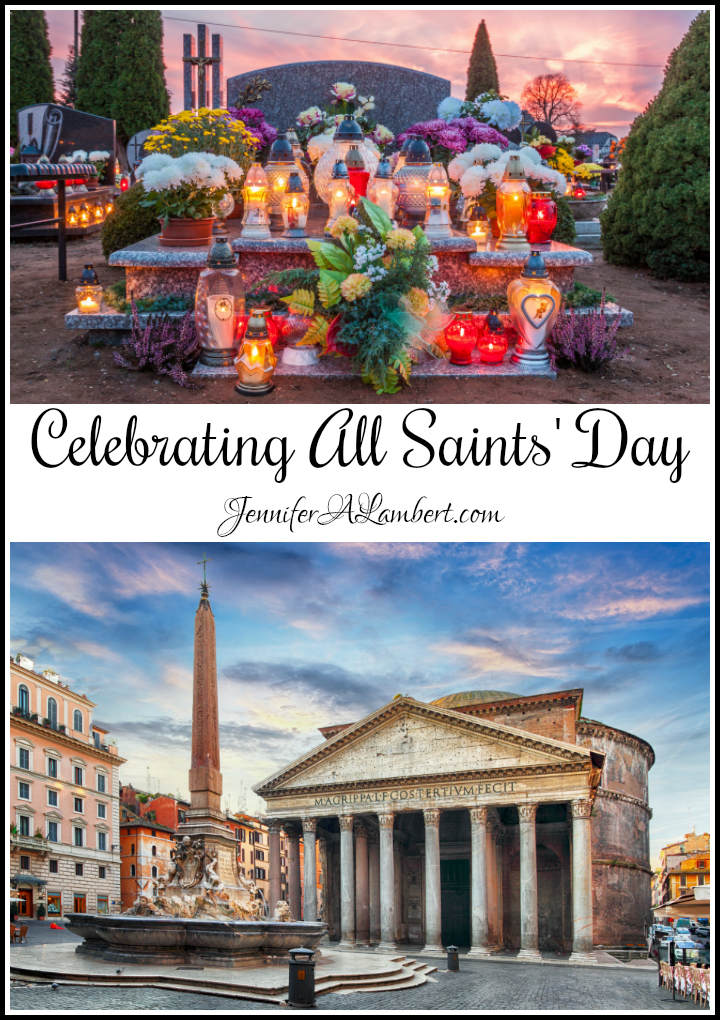
In the early years of the Christian faith, there was a consistent effort to eradicate pagan practices and to replace these with Christian festivals. The Roman Catholic church changed the Celtic Samhain festival and the Roman Feast of the Lamures and renamed them “All Hallows’ Eve,” in an attempt to turn peoples’ thinking away from a focus on the fright of death and ghosts and towards the many saints advocating for Christians in the Kingdom of Heaven. All Saints’ Day was established as the first of November with All Hallows’ Eve replacing the festival of Samhain. All Saints’ Day was probably first started by Pope Boniface IV, who consecrated the Pantheon at Rome to the Virgin Mary and all the Martyrs on May 13, 609 AD.

In the Catholic Church, All Saints’ Day is a “holy day of obligation.” Attendance at mass is a requirement on these days. All Saints’ Day is also commemorated by members of the Eastern Orthodox Church as well as some protestant churches, such as Lutheran and Anglican churches.

All Souls’ Day was established in the early fifth century with a similar intention. This day is not a holy day of obligation. The more sanctified remembering of those who have died help new Christians relate to the departed in a less frightening, or less pagan way.

Lá Féile na Marbh

On the eve of All Souls’ Day in Ireland, families lit a candle in the window to guide the souls of the Dead back to their old homes. As the veil between the worlds thinned, a sluagh, or host, of spirits walked the land, and encountered the same hospitality the Celts have always shown the living, Doors and windows were left unfastened, and any passage through the house that they once used was kept open. The table was laid with the best white cloth, and special food was left out for them to enjoy.

Until quite recently in the Irish Gaeltacht, families kept a seomra thiar, or “room to the West” – sometimes just an alcove or nook–where they placed objects that reminded them of departed ones. At sunset, the family solemnly turned towards the setting sun and spent time in loving remembrance of them. A candle was lit for each soul, then the whole family sat down to a communal feast in their honor.

It was once widely believed that the souls of the faithful departed would return to their family home on All Soul’s Night. Great care was taken to make them feel welcome.

Rituals included sweeping the floor clean, lighting a good fire, and placing the poker and tongs in the shape of a cross on the hearth. A bowl of spring water was put on the table, along with a place setting for each deceased relative. In some areas, children would go “soul-caking” – they’d visit neighbors and beg for cakes in exchange for prayers to be said for the dead.

Families would usually retire early, but before they did, many of them went to the cemetery where their loved ones were buried. They would say prayers for each departed family member, make sure the gravesites were neat and tidy, and then they would leave a candle burning on each grave.

During evening prayers, the family would again light a candle for each of their departed relatives . Often, a candle would be placed in the window of a room where a relative had died. Or, it might be placed in a window that faced in the direction of the cemetery. Then, when evening prayers were over, the candles would either be extinguished or left to burn out.

The door was always left unlatched.

Historically, the Celtic nations have always had a great respect for their ancestors and they believed that at certain times of year, the boundaries between mortals and the souls of the dead cease to exist. This is especially true of the “Three Nights of the End of Summer” – Hallowe’en, Samhain, and All Soul’s Day. The ancients also believed that the dead were the repositories of wisdom and lore and that one of the reasons they return is to speak to their descendants.

Its from these visits by a beloved ancestor that the more fortunate among us are given two very special gifts: the ability to remember old days and old ways, and a deeper understanding of how we are forever linked by blood to the past – and to the future. Source

Ideas for Celebration:

  • Learn about El Día de los Muertos/The Day of the Dead. This is a lovely site with timelines, history, traditions, and recipes.
  • Put out photos of loved ones who have passed away. Tell stories about their lives.
  • Share a harvest meal with friends and family.
  • Light candles inside and outside – in jack o’ lanterns or votive holder or pretty decorative autumn globes.
  • Plant flower bulbs in remembrance and in promise of spring!
  • Kids Party Games
  • Activities for Kids
  • Kids Party Ideas
  • Watch or read Coco.
  • Printables from Shower of Roses
  • A Slice of Smith Life
  • Attend church services. Or do these prayer services at home.
  • Visit a memorial in your city.
  • Visit a cemetery. Bonus if there are famous people or family members or passed friends.
  • Go on a history walk in your town. Our town offers ghost walks about town founders and important people.
  • Go to a thin place and feel the Spirit. Pray and thank Her for the past year and the future year.

It is certainly a good idea around Halloween to help little ones think loving thoughts about our beloved ancestors. To remember them and think of them watching over us with interest and affection can help us all feel protected in this time of year as the days of light turn to the days of darkness.

Resources:

  • The Rhythm of the Christian Year: Renewing the Religious Cycle of Festivals by Emil Bock
  • Festivals with Children by Brigitte Barz
  • The Tao of Jesus: A Book of Days for the Natural Year by John Beverley Butcher
  • All Saints: Daily Reflections on Saints, Prophets, and Witnesses for Our Time by Robert Ellsberg
Share
Pin24
Share
24 Shares
You might also like:

Filed Under: Faith Tagged With: faith, fall, folklore, saint

Celebrating St. Francis

This blog may contain affiliate links: disclosure.
Please see my suggested resources.

October 1, 2019 By Jennifer Lambert 6 Comments

Saint Francis of Assisi, born Giovanni di Pietro di Bernardone, informally named as Francesco, was an Italian Catholic friar, deacon, and preacher.

He founded the men’s Order of Friars Minor, the women’s Order of Saint Clare, the Third Order of Saint Francis, and the Custody of the Holy Land.

St. Francis died at Portiuncula, Italy on October 4, 1226.

Pope Gregory IX pronounced St. Francis a saint on July 16, 1228. The pope also laid the foundation stone for the Basilica of St Francis in Assisi, Italy. The church, also known as Basilica of San Francesco d’Assisi, is a UNESCO world heritage site.

Along with Saint Catherine of Siena, Francis was designated Patron saint of Italy.

Francis fell in love with the humanity and the humility of Jesus; while most of Western and even Eastern Christianity focused on proving the divinity of Jesus.

It’s not easy to put into a capsule the spirit and gifts of Franciscan thinking. Its hallmarks are simplicity, reverence, fraternity, ecumenism, ecology, interdependence, and dialogue. Its motto and salutation is “Peace and All Good!”

Francis believed that God was nonviolent, the God of Peace. This belief may be a simple presupposition for us today, but at the time when the Christian church was waging a Holy Crusade against its enemies, the Saracens, Francis’s interpretation of the gospel life and its demands was revolutionary. Francis saw it from the viewpoint of the poor, especially from the place of the poor, naked, suffering Christ. He had deep devotion to the God who is revealed as nonviolent and poor in the stable of Bethlehem, as abandoned on the cross, and as food in the Eucharist. God’s meekness, humility, and poverty led Francis to become “perfected as his Heavenly Father was perfect.” Francis identified with the “minores,” the lower class within his society…And he passionately pointed to the Incarnation as the living proof of God’s love. He frequently cried out in his pain that “Love is not loved!”

Incarnation is absolutely foundational to the Franciscan worldview. It is said that Francis created the first live Nativity scene. Franciscans emphasize Incarnation perhaps even more than redemption. In other words, Christmas is more important than Easter. Francis said that for God to be born a human being, born in a stable among the poor, shows that we already have redemption. Christmas is already Easter because if God became a human being, then it’s good to be a human being! The problem is already solved. That Jesus was born into a poor family shows God’s love for the poor.

Source: Adapted from John Quigley, “Brothers,” Richard Rohr: Illuminations of His Life and Work, eds. Andreas Ebert and Patricia C. Brockman (The Crossroad Publishing Company: 1993), 5-6.

At Greccio near Assisi, around 1220, Francis celebrated Christmas by setting up the first known presepio or crèche. His nativity imagery reflected the scene in traditional paintings. He used real animals to create a living scene so that the worshipers could contemplate the birth of the child Jesus in a direct way, making use of the senses, especially sight. Both Thomas of Celano and Saint Bonaventure, biographers of Saint Francis, tell how he used only a straw-filled manger set between a real ox and donkey. According to Thomas, it was beautiful in its simplicity, with the manger acting as the altar for the Christmas Mass.

On November 29, 1979, Pope John Paul II declared Saint Francis the Patron Saint of Ecology. During the World Environment Day 1982, John Paul II said that Saint Francis’ love and care for creation was a challenge and a reminder “not to behave like dissident predators where nature is concerned, but to assume responsibility for it, taking all care so that everything stays healthy and integrated, so as to offer a welcoming and friendly environment even to those who succeed us.” He wrote on the World Day of Peace, January 1, 1990, that the saint of Assisi “offers Christians an example of genuine and deep respect for the integrity of creation…As a friend of the poor who was loved by God’s creatures, Saint Francis invited all of creation – animals, plants, natural forces, even Brother Sun and Sister Moon – to give honor and praise to the Lord. The poor man of Assisi gives us striking witness that when we are at peace with God we are better able to devote ourselves to building up that peace with all creation which is inseparable from peace among all peoples.”

On 13 March 2013, upon his election as Pope, Archbishop and Cardinal Jorge Mario Bergoglio of Argentina chose Francis as his papal name in honor of Saint Francis of Assisi, becoming Pope Francis.

At his first audience on March 16, 2013, Pope Francis told journalists that he had chosen the name in honor of Saint Francis of Assisi, and had done so because he was especially concerned for the well-being of the poor. He explained that, as it was becoming clear during the conclave voting that he would be elected the new bishop of Rome, the Brazilian Cardinal Cláudio Hummes had embraced him and whispered, “Don’t forget the poor,” which had made Bergoglio think of the saint. Bergoglio had previously expressed his admiration for St. Francis, explaining that “He brought to Christianity an idea of poverty against the luxury, pride, vanity of the civil and ecclesiastical powers of the time. He changed history.” Bergoglio’s selection of his papal name is the first time that a pope has been named Francis.

Quotes

Start by doing what’s necessary; then do what’s possible; and suddenly you are doing the impossible.

For it is in giving that we receive.

It is in pardoning that we are pardoned.

Where there is hatred, let me sow love. Where there is injury, pardon. Where there is doubt, faith.

All the darkness in the world cannot extinguish the light of a single candle.

Preach the Gospel at all times and when necessary use words.

Lord, make me an Instrument of Thy Peace. Where there is hatred, let me sow love. Where there is injury, pardon…

If God can work through me, he can work through anyone.

If you have men who will exclude any of God’s creatures from the shelter of compassion and pity, you will have men who will deal likewise with their fellow men.

While you are proclaiming peace with your lips, be careful to have it even more fully in your heart.

Sermon to the Birds:

My little sisters the birds, ye owe much to God, your Creator, and ye ought to sing his praise at all times and in all places, because he has given you liberty to fly about into all places; and though ye neither spin nor sew, he has given you a twofold and a threefold clothing for yourselves and for your offspring. Two of all your species he sent into the Ark with Noah that you might not be lost to the world; besides which, he feeds you, though ye neither sow nor reap. He has given you fountains and rivers to quench your thirst, mountains and valleys in which to take refuge, and trees in which to build your nests; so that your Creator loves you much, having thus favoured you with such bounties. Beware, my little sisters, of the sin of ingratitude, and study always to give praise to God.

Symbols associated with St. Francis of Assisi:

  • A bag of gold and rich raiment at St. Francis’ feet.
  • A winged crucifix with five rays.
  • Stigmata.
  • A crown of thorns.
  • A lighted lamp.
  • A fiery chariot.
  • Animals such as birds, deer, and a wolf.

Things to Do:

  • Pray the Canticle of the Sun, which was written by St. Francis.
  • Many churches and parishes have a Blessing of animals or pets on or around this day.
  • St. Francis was influential on our present-day Christmas crib or creche. Make or buy a special nativity set to play with or display.
  • Although St. Francis is one of the most popular saints of the Church, and his feast is a huge celebration in Assisi, there are no particular foods attached to his festival. Tradition has passed on that on his deathbed he requested Frangipane cream or Mostaccioli (almond biscotti). Fire is a symbol of St. Francis, first of all because his heart was on fire with love of God, but there are other stories that deal with fire, particularly when he prayed, the surrounding areas would become so bright that people thought the areas were on fire. So a flaming dessert or wine would be an appropriate ending of a wonderful feast. One could also try some Umbrian style recipes, or just have “Italian night” at home, even simple pasta and sauces.
  • What does poverty in our state of life mean? How can I follow the Gospels like Francis?
  • Study art and photos of Francis. Find out more about the Basilica of St. Francis in Assisi. Although an earthquake in 1997 damaged the basilica, it reopened in 1999.
  • Read about St. Clare and her relationship with St. Francis.
  • Read about the Tau Cross.

Resources

  • St. Francis and The Wolf by L. M. Zecca 
  • St. Francis and the Animals: A Mother Bird’s Story by Phil Gallery 
  • The Good Man of Assisi by Mary Joslin 
  • The Prayer of St. Francis
  • Brother Sun, Sister Moon by Katherine Paterson
  • Saint Francis of Assisi by Demi 
  • Francis: The Poor Man of Assisi by Tomie DePaola
  • The Canticle of the Creatures for Saint Francis of Assisi by Luigi Santucci
  • The Catholic Toolbox
  • Sweet Little Ones
  • The Kennedy Adventures
  • Real Life at Home
  • Catholic Icing
  • Catholic Inspired
  • St. Francis Prayer
  • Catholic Playground
  • Ducksters
  • A Slice of Smith Life
  • Teaching Catholic Kids
  • Lovely Waldorf read alouds
  • Virtual Pilgrimage Tour
  • A Love Letter to St. Francis of Assisi from St. Clare

Lord, make me an instrument of your peace
Where there is hatred, let me sow love
Where there is injury, pardon
Where there is doubt, faith
Where there is despair, hope
Where there is darkness, light
And where there is sadness, joyO Divine Master, grant that I may
Not so much seek to be consoled as to console
To be understood, as to understand
To be loved, as to love
For it is in giving that we receive
And it’s in pardoning that we are pardoned
And it’s in dying that we are born to Eternal Life
Amen.

~Prayer of St. Francis by Sarah McLachlan

Share
Pin101
Share
101 Shares
You might also like:

Filed Under: Faith Tagged With: faith, fall, saint

Celebrating Michaelmas

This blog may contain affiliate links: disclosure.
Please see my suggested resources.

September 23, 2019 By Jennifer Lambert 5 Comments

It’s officially autumn or fall in the northern hemisphere.

Even if it is 90° outside.

by the way, it’s pronounced “Micklemess.” you’re welcome.

Autumn Equinox Traditions

Some traditional rituals for the Celtic festival Mabon include building an altar to offer harvest fruits and vegetables, meditating on balance, gathering and feasting on apples, sharing food, and expressing gratitude. The holiday is named after the Welsh God, Mabon, son of Earth Mother goddess Modron.

Many people gather at Stonehenge to watch the equinox sunrise.

Rosh Hashanah is the Jewish fall festival for the New Year.

Japan marks both equinoxes with a period called Ohigan. The Buddhist belief is the afterlife land is in the west, and during the equinoxes, the sun sets more directly on the western horizon. The equinoxes are also symbolic of the transitions of life. The week around each equinox a time to visit the graves of one’s ancestors, to tidy up the grave sites, and leave flowers. It is also a time of meditation and visiting living relatives.

Many Asians celebrate the Moon Festival on the full moon nearest to the equinox. On a lunar calendar, that is the 15th day of the eighth lunar month. It is celebrated with festival activities, gazing at the moon, and eating moon cakes. In the southern U.S., Moon Pies are often used in place of moon cakes.

Celebrating Michaelmas

Michaelmas is the Catholic feast of the Archangel Michael. Some traditions use this feast day to celebrate other archangels: Michael, Gabriel, Uriel, and Raphael as the Feast of the Angels. The feast day is September 29, which is celebrated as the beginning of fall in many locales. The feast day was probably set near the autumn equinox to draw the faithful away from pagan celebrations, as with most other Christian holidays. Traditions include gathering and eating nuts (which begins on Holy Rood Day on September 14), and eating a fattened goose, which was supposed to protect against financial need for the next year.

“Eat a goose on Michaelmas Day,
Want not for money all the year”.

It is a time of transitions, as servants were paid their wages after the harvest and workers scrambled to find new employment contracts. The employment fairs that facilitated this custom became an opportunity for community celebration. It’s one of the quarter days, when accounts had to be settled.

In Ireland, finding a ring hidden in a Michaelmas pie meant that one would soon be married. 

In remembrance of absent friends or those who had died, special Struans, blessed at an early morning Mass, were given to the poor in their names. Nuts were traditionally cracked on Michaelmas Eve.

In Scotland, St. Michael’s Bannock, or Struan Micheil (a large scone-like cake) is created from grain grown on the family’s land during the year, representing the fruits of the fields. It is cooked on a lambskin, representing the fruit of the flocks. The grain is also moistened with sheep’s milk, as sheep are deemed the most sacred of animals. As the Struan is created by the eldest daughter of the family, the following is said:

“Progeny and prosperity of family, Mystery of Michael, Protection of the Trinity”

It is also a good time to eat blackberries, as “Old Michaelmas Day” on October 10, is traditionally the cutoff time for picking blackberries. It is said that on this day, when Lucifer was expelled from Heaven, he fell from the skies, straight onto a blackberry bush. He then cursed the fruit, scorched them with his fiery breath, spat, and stamped on them and made them unfit for consumption! And so the Irish proverb goes:

“On Michaelmas Day the devil puts his foot on blackberries.”

The Michaelmas Daisy, which flowers late in the growing season between late August and early October, provides color and warmth to gardens at a time when the majority of flowers are coming to an end. The daisy is probably symbolic since St. Michael is celebrated as a protector from darkness and evil, just as the daisy fights against the advancing gloom of Autumn and Winter.

“The Michaelmas Daisies, among dede weeds,
Bloom for St Michael’s valorous deeds.
And seems the last of flowers that stood,
Till the feast of St. Simon and St. Jude.”

Resources for Families

Michaelmas is celebrated in the Waldorf schools, which celebrate it as the “festival of strong will” during the autumnal equinox. The primary idea behind the festival of Michaelmas is to get children to face their own challenges – in other words, their internal and external dragons. Michaelmas is typically the first festival of the new school year celebrated.

Courage

St. George is the Earthly counterpart to St. Michael. Read about dragons. Read stories about St. George. Do something that requires bravery. Make a cape. Make courage tea from edible flowers or salve from calendula. This is a time for spiritual growth as a family.

Decorate with daisies.

Make chains or fill a vase with wild ones. Bunches of daisies are super cheap in the markets now.

Study the moon.

The moon is really beautiful and meaningful on clear crisp nights. We like to look at it rise on our evening walks and sometimes it’s still up during the day! We often get the binoculars to study the craters and terminator at night.

Thank a police officer.

Saint Michael is the patron saint of police officers. Stop by your local police station with a yummy treat to thank them for their service. Tell them that it’s their feast day so you brought some food for feasting and let them know that you are praying for them in an extra special way on Michaelmas. Many churches pray a blue mass.

Pick and eat and cook with blackberries.

We often like to find wild berry patches or a pick your own farm. We’ve mad jam before or pies. It’s a fun tradition with kids!

Feasting

Roast a goose, chicken, duck, or turkey. Or even get a rotisserie from Costco or somewhere. Serve traditionally with carrots and apples and stuffing or homemade “dragon” bread. Maybe try to roast a bannock!

The Harvest Loaf Story

The farmers followed what Archangel Michael had told them, they placed the Harvest Loaf on the table and sat with their families and friends and sang in thanks:

Earth who gives to us this food

Sun and stars who made it good

Dearest Earth and

Stars and Sun

We will remember what you have done.

Check out these great recipes!

A Michaelmas Prayer:

A lovely lesson from Kennedy Adventures.

Saint Michael the Archangel,

defend us in battle;

be our protection against the wickedness and snares of the devil.

May God rebuke him, we humbly pray:

and do thou, O Prince of the heavenly host,

by the power of God,

thrust into hell Satan and all the evil spirits

who prowl about the world seeking the ruin of souls.

Amen.

Resources:

  • Journal: The Michaelmas Daisy Fairy by Cicely Mary Barker
  • Celebrating Autumn Equinox by Waverly Fitzgerald
  • Autumn Equinox: The Enchantment of Mabon by Ellen Dugan
  • Mabon: Rituals, Recipes & Lore for the Autumn Equinox by Diana Rajcehl
  • Michael the Archangel: Protector of God’s People by Barbara Joffie
  • Beyond the Rainbow Bridge: Nurturing Our Children from Birth to Seven by Barbara J. Patterson and Pamela Bradley
  • Saint Michael the Archangel by James F. Day
  • Saint Michael and Me by John Culver II
Share
Pin300
Share
300 Shares
You might also like:

Filed Under: Faith Tagged With: faith, fall, saint

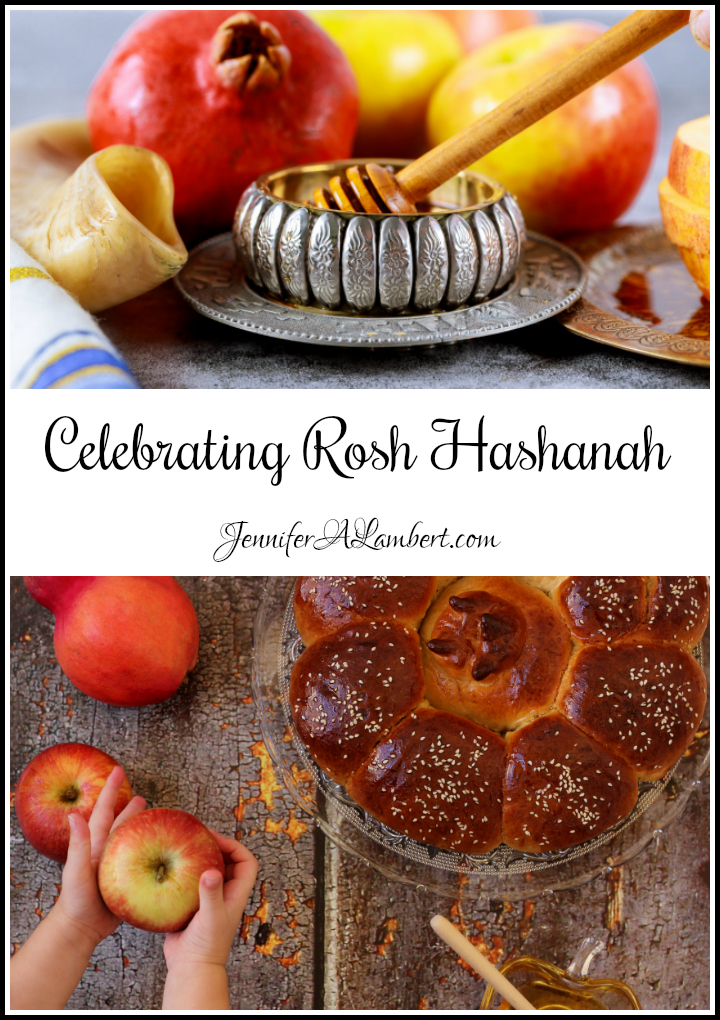
Celebrating Rosh Hashanah

This blog may contain affiliate links: disclosure.
Please see my suggested resources.

September 23, 2019 By Jennifer Lambert 10 Comments

Many cultures celebrate a new year around the autumn equinox. I’ve always felt this is a time of new beginnings.

I love the crisp fall leaves and poignant scents of cinnamon and apples, reminding us of sweetness and decay.

We also enjoy the traditions of Lammas Day.

Rosh Hashanah is a two-day celebration that begins on the first day of Tishri, which is the seventh month of the ecclesiastical year

Rosh Hashanah, the Jewish New Year, is a time when Jews celebrate the good things they have experienced in the previous year, and also when they reflect on hopes and dreams for the coming year.

But Rosh Hashanah is not only festive; it is also a solemn time, a prelude to Yom Kippur, the Day of Judgment.

Rosh Hashanah inaugurates the Days of Awe, ten days during which Jews reflect on their conduct, make amends for past wrongs, and set themselves to do better in the coming year.

We’re not Jewish. We’re not Messianic. We don’t keep Kosher.

I love to celebrate the feasts since we began years ago during our Year 1 history lessons. It’s important to know church history. I teach my kids religion and learn with them.

Reading the Torah

The portion of the Torah read on the first day of Rosh Hashanah is Genesis 22:1-19, the story of the Akedah, or “The Binding of Isaac.” This is certainly a problematic Bible passage. I like this article “I’ve Had it with the Akeda” and I research on it every year.

In congregations that observe a second day of Rosh HaShanah, the Torah portion is Genesis 1:1-2:3, the story of creation.

The Haftarah, the selection from the prophetic books that accompanies Torah readings on Shabbat and holidays, is from I Samuel, and tells the story of Hannah.

I have my very own siddur.

Casting Away

Tashlich (“to cast away”) is a ceremony generally conducted on the first day of Rosh Hashanah when we symbolically cast our sins into a moving body of water – such as a river, stream, or ocean. This often includes the recitation of verses from Micah and Psalms.

Who is a God like you, pardoning iniquity

    and passing over transgression

    for the remnant of his inheritance?

He does not retain his anger forever,

    because he delights in steadfast love.

He will again have compassion on us;

    he will tread our iniquities underfoot.

You will cast all our sins

    into the depths of the sea.

Micah 7:18-19

Bread has been used to represent our sins, but some choose to cast stones, wood chips, or bird seed instead, to be more environmentally healthy.

Symbols of Rosh Hashanah

The foods eaten are symbolic and their names are poetic puns, representing the prayers.

Shofar

A ram’s horn is blown to announce the new year.

Dates

The prayer before eating a date (tamar in Hebrew) includes the phrase “yitamu hataim”— may the wicked cease.

Apples and Honey

Dipping apples in honey on Rosh Hashanah is tradition to wish for a sweet New Year.

Pumpkin or Squash

Before eating pumpkin or squash (k’ra’a in Hebrew), Sephardic Jews say “yikaru l’fanekha z’khuyoteinu“– may our good deeds call out our merit before you.

Peas or Beans

Mentioned in the Talmud as ruviah, a word that sounds like the Hebrew “to increase,” indicates a desire for increased blessings in the new year.

Leeks or Onions

Associated with the Exodus from Egypt.

Beets

From the Aramaic name silka, similar to the Hebrew salak (go away) is used to express the hope that our enemies disappear.

Fish

Fish heads symbolize our wish to be heads, not tails; leaders, not followers. Originally a sheep’s head (a little hard to get these days) served as a reminder of the ram that saved Isaac’s life.

Crown Challah

Round challah represents the circle of the year and of life.

Pomegranates

The abundance of seeds represents prosperity. Also promises you will do many good deeds in the upcoming year.

Sephardic Jews celebrate a Rosh Hashanah Seder with much symbolism.

Our dinner is like a mini Thanksgiving feast.

Menu Ideas

Start the meal with Fingerlickin’ Challah, amazingly soft on the inside with a nice crunch on the outside and a make-ahead Roasted Carrot Soup with Coriander.

Soymilk is the secret to a parve Creamy Carrot Soup that will bring a rich, healthful, and colorful splash to the holiday table.

Anyone from the American south knows black-eyed peas, but did you know Jewish tradition says that eating them on Rosh Hashanah can increase your good luck in the New Year? Sausage, Black-Eyed Pea and Swiss Chard Soup is a hearty way to ensure good fortune and eat your greens at the same time.

Then dazzle your guests with a gorgeous Salmon Over Pomegranate and Golden Kiwi Arugula Salad as the appetizer. 

For the main course, pair the quintessential Hearty Pot Roast with a Cumin Spiced Brisket With Leeks and Dried Apricots, a decidedly non-traditional take on a holiday favorite.

Apples and Honey Mustard Chicken, from the popular Peas, Love & Carrots cookbook, captures the essence of Rosh Hashanah on a platter. The honey-mustard sauce is a beautiful companion for the chicken, which is baked with apples and finished with a crunchy Panko topping.

Pomegranate Braised Beef, another highlight from Peas, Love & Carrots, puts a sweet-tart spin on a holiday classic. Deglazed with hard apple cider, the meat cooks in a flavorful sauce starring pomegranate syrup to ensure a sweet new year.

Make an exotic salmon recipe with Danielle Renov’s show-stopping Tahini and Tamarind Glazed Salmon with Kadaif Topping, from Peas, Love & Carrots finished with fresh pomegranate seeds. A nest of ultra-thin kadaif noodles (think baklava) tops it all off for a crispy, golden crunch.

Citrus Teriyaki Salmon is a great entrée for non-meat eaters and a wonderful alternative to the classic gefilte fish appetizer. Best of all, it couldn’t be easier to make

Side dishes should be exciting, too. Serve time-honored Tzimmes with Honey alongside Jeweled Butternut Squash featuring pistachios, pomegranate seeds, and chopped dates. Pomegranate also plays a starring role in the fresh and fruity Blood Orange Pomegranate Salad.

Pastrami Leek Galette? Yes, you read that right. Leeks are another traditional symbolic food for Rosh Hashanah. Sautéing pastrami with mushrooms and leeks cooks the veggies down to their caramelized essence. The savory, thyme-scented filling bakes right inside the dough for an elegant presentation.

This Ashkenazic Roasted Tzimmes keeps it traditional, simple, and light. In this updated version, a bit of ginger adds a subtle, warm kick while fresh mint offers an herbaceous finish.

A holiday meal can’t be complete without dessert. But don’t settle for dry, crumbly honey cake when you can make a light and fluffy and delicious Honey Bundt Cake. Or go in a more unexpected direction while still nodding to the tradition to eat dates, and serve Sticky Date Pudding with Butterscotch Sauce. Or lighten things up with Baked Pears with Honey and Cinnamon.

Thanks to a few shortcuts, nobody has to know how easy it is to make these unique and oh-so-decadent desserts. Caramel Apple Halva Babka bakes up on frozen challah dough, while Apple Bourekas with Silan-Sesame Drizzle calls for frozen puff pastry squares and apple pie filling.

We like honey cake!

Pair dessert with Wissotzky Teas’ new and exotic chai offerings: Ginger and Turmeric Spiced Chai, Pumpkin Spiced Chai, Salted Caramel, or Spiced Nana Mint Chai. Mint tea drinkers can savor Wissotzky’s new line of Simply Nana Teas, which unleash a subtle layer of earthiness and invigorating minty flavor in natural green, black, and herbal flavors.

Some years, we have turkey or chicken instead of beef.

We always have challah, a lovely fruity salad, fish, and leeks or onions.

Family Resources

  • Go apple picking.
  • Have a honey tasting.
  • Make new year cards for friends and family.
  • Bake challah together.
  • Go on a nature walk.
  • Throw your care, prayers, worries, resolutions into water.
  • Blow the shofar or party horns.

More Resources:

  • PJ Library
  • AISH
  • Chabad
  • Reform Judaism
  • Ducksters
  • The Maccabeats: This is the New Year
  • Shalom Sesame: Tikkun Olam Song
  • Jewish Learning
  • Kids Connect
  • Interfaith Family
  • Jewish Agency
  • Jewish Boston

Books:

  • Rosh Hashanah: A Family Service
  • Rosh Hashanah Yom Kippur Survival Kit
  • High Holidays & More: An Interactive Guide for Kids
  • Rosh Hashanah Is Coming!
  • Apple Days: A Rosh Hashanah Story 
  • I’m Sorry, Grover: A Rosh Hashanah Tale
  • Rosh Hashanah Activity Book for Kids
  • I Spy Rosh Hashanah Book For Kids
  • King of The Fruits – Children Story For Rosh Hashanah
  • The Big Awesome Rosh Hashanah Coloring and Activity Book For Kids and Adults!
  • How The Rosh Hashanah Challah Became Round

L’Shanah Tovah! (For a good year!)

We also have celebrated Hanukkah and Passover.

Share
Pin67
Share
67 Shares
You might also like:

Filed Under: Faith Tagged With: faith, fall, New Year

Celebrating Lammas Day

This blog may contain affiliate links: disclosure.
Please see my suggested resources.

August 1, 2019 By Jennifer Lambert 14 Comments

Lammastide or Lughnasadh/Lughnasa falls at the halfway point between the Summer Solstice and Autumn Equinox.

Lammas means “loaf-mass” in Anglo-Saxon.

The focus was on either the early harvest aspect or the celebration of the Celtic god Lugh.

August 1 is a festival to mark the annual wheat harvest, and is the first harvest festival of the year. On this day it was customary to bring to church a loaf made from the new crop, which just began to be harvested.

After the grain is harvested, it is milled and baked into bread, which is then consumed. It is the cycle of the harvest come full circle.

The grain dies so that the people might live. Eating this bread, the bread of the gods, gives us life. If all this sounds vaguely Christian, it should be. In the sacrament of Communion, bread is blessed, becomes the body of God and is eaten to nourish the faithful. This Christian Mystery echoes the pagan Mystery of the Grain God. 

Lammas coincides with the feast of St. Peter in Chains, commemorating St. Peter’s miraculous deliverance from prison.

In Shakespeare’s Romeo and Juliet (1.3.19), it is observed of Juliet, “Come Lammas Eve at night shall she [Juliet] be fourteen.” Since Juliet was born Lammas eve, she came before the harvest festival, which is significant since her life ended before she could reap what she had sown and enjoy the bounty of the harvest, in this case full consummation and enjoyment of her love with Romeo.

Many churches in Europe, Ireland, and the UK have lovely harvest altars, thanking God for His bounty.

We especially enjoyed visiting the Trier Cathedral Harvest Festival.

Lammas is a festival of regrets and farewells, of harvest and preserves.

  • Reflect on the year in your journal or share with others around a bonfire. Lughnasa is one of the great Celtic fire-festivals.
  • Look up the myths of any of the grain Gods and Goddesses and discuss with your kids, family, and friends. 
  • Go to a county or state fair to celebrate the end of summer, school beginning, harvest.
  • Make corn dollies, herb wreaths or garlands, bake bread.
  • Go on a nature walk and look at the changes in the trees and wildflowers.
  • Sing songs and roast food over the fire.

Robert Burns published the poem John Barleycorn in 1782, and there are various modern versions:

There were three men come out of the west, their fortunes for to try
And these three men made a solemn vow, John Barleycorn would die
They’ve ploughed, they’ve sown, they’ve harrowed, thrown clods upon his head
Till these three men were satisfied John Barleycorn was dead

Refrain: There’s beer all in the barrel and brandy in the glass
But little Sir John, with his nut-brown bowl, proved the strongest man at last

They’ve let him lie for a long long time till the rains from heaven did fall
And little Sir John sprang up his head and so amazed them all
They’ve let him stand till midsummer’s day and he looks both pale and wan
Then little Sir John’s grown a long long beard and so become a man

{Refrain}

They’ve hired men with the sharp-edged scythes to cut him off at the knee
They’ve rolled him and tied him around the waist, treated him most barbarously
They’ve hired men with the sharp-edged forks to prick him to the heart
And the loader has served him worse than that for he’s bound him to the cart
So they’ve wheeled him around and around the field till they’ve come unto a barn
And here they’ve kept their solemn word concerning Barleycorn
They’ve hired men with the crab tree sticks to split him skin from bone
And the miller has served him worse than that for he’s ground him between two stones

And the huntsman he can’t hunt the fox nor loudly blow his horn
And the tinker he can’t mend his pots without John Barleycorn

Regrets

Think of the things you meant to do this summer or this year that did not come to fruition. You can project your regrets onto natural objects like pine cones, corn husks, or paper and throw them into the fire, releasing them.

Farewells

What or who is passing away from your life? What is over or completed? Say goodbye to it. As with regrets, you can find visual symbols and throw them into the fire. You can also bury them in the ground, perhaps in the form of flower bulbs which will manifest in a new form next spring.

Harvest

What have you harvested this year? What seeds did you plant that are sprouting? Find a visual way to represent these, perhaps creating a decoration in your house or garden to represent this harvest to you. Make a corn dolly or learn to weave grain or grass into artistic designs.

Preserves

This is also a good time for making preserves, either literally or symbolically. As you turn the summer’s fruit into jams, jellies, and chutneys for later, think about the fruits that you have gathered this year and how you can hold onto them. How can you keep them sweet in the stores of your memory?

How do you prepare your hearts for the change in season?

Resources:

  • Dancing At Lughnasa
  • The Golden Bough: A Study in Magic and Religion by Sir James George Frazer
  • The Ancient Celtic Festivals: and How We Celebrate Them Today by Clare Walker Leslie
  • The Berenstain Bears’ Harvest Festival
  • Harvest Bounty Loaf Pan
  • Harvest Mini Loaf Pan
  • Autumn Delights Cakelet Pan
  • Wheat & Pumpkin Cast Loaf Pan

You might also like:

  • Celebrating Candlemas
  • Celebrating St. Brigid’s Day
  • Celebrating St. Nicholas’ Day
  • Celebrating St. Patrick’s Day
  • Celebrating St. Valentine’s Day
  • Celebrating St. Lucia’s Day
  • Celebrating Epiphany
  • Celebrating Martinmas
  • Celebrating Joan of Arc
  • Celebrating May Day
  • Celebrating Halloween
Share
Pin139
Share
139 Shares
You might also like:

Filed Under: Family Tagged With: faith, fall, folklore, saint

Celebrating May Day

This blog may contain affiliate links: disclosure.
Please see my suggested resources.

April 29, 2019 By Jennifer Lambert 11 Comments

May Day is the 1st of May.

May Day or Beltane is an ancient spring festival in the Northern Hemisphere. It’s an astronomical holiday. It’s one of the year’s four cross-quarter days – a day that falls midway between an equinox and solstice. May 1st is between the March equinox and June solstice. The other cross-quarter days are Groundhog Day/Candlemas/St. Brigid’s Day or Imbolc on February 2, Lammas on August 1, and Halloween on October 31. The day stems from the Celtic festival of Beltane, which was related to the waxing power of the sun as the Northern Hemisphere moves closer to summer.

Because the Puritans of New England considered the celebrations of May Day to be licentious and pagan, they forbade its observance and the holiday never became an important part of American culture.

May Day probably was originally a fertility festival in ancient Greece and Roman times.

In Germany, the eve of May Day is Walpurgis Night, and the village youth often play pranks and ours charged a toll to enter the village! They decorated a little evergreen May Tree with ribbons and flowers that is then carried by parade to the village barn or town hall. It stayed there until it completely rotted.

Saint Walpurga, an English abbess and missionary, has been hailed by German Christians since 800 AD for battling “pest, rabies and whooping cough, as well as against witchcraft.” In folklore, Hexennacht, literally “Witches’ Night,” was believed to be the night of a witches’ meeting on the highest peak in the Harz Mountains. Christians prayed to God through the intercession of Saint Walpurga in order to protect themselves from witchcraft. Saint Walpurga was successful in converting the local populace to Christianity. People continue to light bonfires on Saint Walpurga’s Eve in order to ward off evil spirits and witches.

In Hawaii, May Day is also known as Lei Day since 1927.

How to Celebrate May Day

Plant flowers or a tree.

I love getting out in the garden in springtime. I love shopping for vibrant flowers, even if we don’t have much of a budget for them. The kids and I scatter wildflower seeds for a bee and hummingbird garden around Earth Day, Arbor Day, and May Day. Hawthorn is traditional and we like to gather it for decorations with wildflowers.

Make a maypole or personal flower wands.

These are just lovely and fun for all children (and big kids)!

Dance around a maypole.

Dance away the cold winter weather with colorful ribbons and weaving in and out with friends and family.

Make a flower crowns or leis.

These are super fun with real or fake flowers. Makes fun presents!

Have a bonfire.

We use our fire pit in the backyard and roast hot dogs and marshmallows and talk and sing. It’s a fun time.

Give flower baskets.

I love this tradition that must be revived! Make small baskets with some fresh flowers and hang on neighbors doors!

Have an outdoor picnic.

Super easy to gather up some snacks and spend some time in the sunshine at a park or back yard.

Go on a nature walk.

We love exploring nature during season changes to see what’s new.

Read books (especially poetry) about springtime.

May first is the day
When children play,
And hang a basket of flowers
On your doorknob—
and mine.                   ~Nellie Edge

How do you welcome May?

Resources:

  • Rainbow Silk Streamer
  • Ribbon Wands
  • Flower Headband
  • A Treasury of British Folklore: Maypoles, Mandrakes & Mistletoe by Dee Dee Chainey 
  • Mummers, Maypoles and Milkmaids: A Journey Through the English Ritual Year by Sara Hannant 
  • The Festival Book: May-Day Pastime and the May-Pole Dances, Revels and Musical Games for the Playground, School and College by E. J. Hardy

You might also like:

  • Celebrating Candlemas
  • Celebrating St. Brigid’s Day
  • Celebrating Lammas Day
  • Celebrating St. Nicholas’ Day
  • Celebrating St. Patrick’s Day
  • Celebrating St. Valentine’s Day
  • Celebrating St. Lucia’s Day
  • Celebrating Epiphany
  • Celebrating Martinmas
  • Celebrating Joan of Arc
  • Celebrating Halloween
Share
Pin166
Share
166 Shares
You might also like:

Filed Under: Family Tagged With: faith, folklore, may, saint, spring

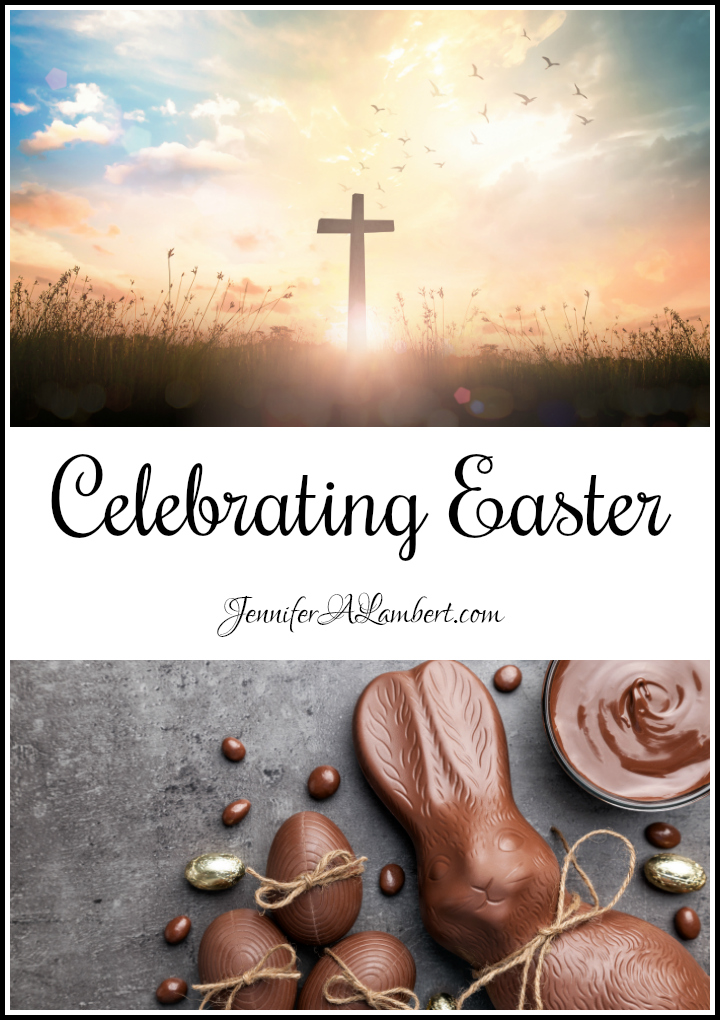
Celebrating Easter

This blog may contain affiliate links: disclosure.
Please see my suggested resources.

April 15, 2019 By Jennifer Lambert 10 Comments

What is Easter?

Easter is the most important and oldest festival of Christians, celebrating the resurrection of Jesus Christ and held (in the Western Church) between March 21 and April 25, on the first Sunday after the first full moon following the northern spring equinox.
The Orthodox date for Easter Sunday often occurs at a later date than the date observed by many western churches. The holiday is also known as Pascha.

Constantine wanted Christianity to be totally separated from Judaism and did not want Easter to be celebrated on the Jewish Passover. The Council of Nicea accordingly required the feast of the resurrection to be celebrated on a Sunday and never on the Jewish Passover.

Many Ancient cultures viewed eggs as a symbol of life.

The Easter egg is hard-boiled and often dyed red to symbolize the blood of Christ. It was an important symbol connected with spring fertility rituals in many early civilizations. Many Greek Orthodox Christians rap their eggs against their friends’ eggs and the owner of the last uncracked egg is considered lucky.

In addition, in some areas, eggs were forbidden during Lent; therefore, they were a delicacy at Easter.
Some speculate that early missionaries or knights of the Crusade may have been responsible for bringing the tradition to the West.

Another important symbol associated with Easter is the lamb.
The lamb comes from the Jewish Passover, where each family killed a lamb as a sacrifice. When Christ became the Passover Lamb for everyone, the lamb became a symbol for His sacrifice. It is often depicted with a banner that bears a cross, and it is known as the Agnus Dei, meaning “Lamb of God” in Latin.

Easter word origins are complex. The word may have come from the Anglo-Saxon Eeostre or Eastre – a Teutonic goddess of spring and fertility.
The Norse eostur, eastur, or ostara, meant “the season of the growing sun” or  “the season of new birth.” 
The early Latin name for the week of Easter was hebdomada alba or “white week,” while the Sunday after Easter day was called dominica in albis from the white robes of those who had been newly baptized. The word alba is Latin both for white and dawn.
The German plural word for dawn is ostarun. From ostarun we get the German Ostern and the English Easter.

The hare is an ancient symbol of fertility and for the moon. The date of Easter depends on the moon. This may have helped the hare to be absorbed into Easter celebrations. Bunnies live in burrows and when they come out of their holes in spring, it reminds us of Jesus’ empty tomb. Easter baskets were originally like bunny nests in Germany. Bunnies, pastries, and candy also came to the New World with German immigrants.

The Easter lily is another new addition to Easter celebrations. Throughout the years, painters and sculptors used the white Madonna lily to symbolize purity and innocence, frequently referring to Mary.
The Easter lily is a rather new addition to Easter celebrations. 
In the 1880s, Mrs. Thomas Sargent brought Bermuda lily bulbs to Philadelphia. A local nurseryman, William Harris, saw the lilies and introduced them to trade. They were easy to force into bloom in time for the Easter season. The Bermuda lily, now the familiar Easter lily, spread throughout the country.

Easter means faith and family.

As the children grow older, Easter egg hunts, colorful baskets full of candy, and all the commercial festivities aren’t as important to us.

We prepare for Easter with Mardi Gras pancake dinners, Ash Wednesday fasting, and Lent daily reading.

Holy Week begins with palms waving, processions and parades, shouts of “Hosanna!” and celebrations, remembering Christ’s entrance into Jerusalem.

Holy Week should be about inclusion into the Kingdom. Jesus wanted it that way and we have taken his idea of Kingdom as legalism – church attendance and excluding those who don’t look like us, talk like us, think like us.

Communion is inclusion.

Eucharist is thanks.

How do we express thanks and inclusion on this holiest of Christian holidays?

Faith

Many churches offer Ash Wednesday service throughout the day or at least several times during the day, to accommodate busy schedules.

There are special Bible studies during Lent.

We read Bible and missionary stories every morning and evening the year-round, and I just choose different ones during Lent.

When the kids were old enough, we sometimes attended sunrise Easter church services.

I like teaching and discussing The Trinity. Visuals make it special for kids and Sunday school classes.

Learning about and planting seeds are great lessons for children and I often tie in stories about our faith and the teaching of Jesus and saints.

Resurrection Eggs are great visual tools for young children to understand The Stations of the Cross and The Passion. But I don’t like to focus on punitive atonement.

I’m still evolving in my faith and searching for good resources to teach my children well.

Family

We’ve lived in many places and celebrated Easter differently with our friends, neighbors, and churches.

Our Utah church held a large pancake dinner on Mardi Gras.

Our neighborhood in Utah held a huge Easter egg hunt that was like trick-or-treating, with each yard throwing out or hiding candy and eggs and toys for all the children in their front yards. We still remember it fondly.

The kids have never enjoyed large Easter egg hunts, so that’s an easy event to forgo.

We love reading books about Easter – Jesus, bunnies, eggs, and springtime!

We made natural Easter egg dye one year. It was fun, but not as vibrant as we would have liked.

My husband and children don’t really like hard boiled eggs that much, so it’s wasteful to dye many eggs.

We made cascarones another year and that was great fun!

We like to learn about Easter traditions and celebrations around the world.

Brunch is popular on Easter Sunday. We often have a lovely special dinner of lamb or ham on Sunday. I love deviled eggs!

Since we lived in Germany, we make lamb cake – a light pound cake in the shape of a lamb, covered with powdered sugar.

Resources:

  • Peter Rabbit Naturally Better Classic Gift Set by Beatrix Potter
  • Peter Rabbit Book and Toy
  • Glow in The Dark Easter Egg Hunt Set
  • The Easter Story Egg – With Storybook about Resurrection
  • Resurrection Eggs
  • Lego BrickHeadz Easter Bunny Kit

Christ is Risen!

How do you celebrate Easter?

You might also like:

  • Celebrating Passover
  • Celebrating Spring
  • Favorite Easter Books
  • 50 Easter Basket Ideas without Candy
Easter Notebooking Pages (FREE)
Share
Pin118
Share
118 Shares
You might also like:

Filed Under: Faith Tagged With: Easter, faith, spring

Celebrating St. Valentine

This blog may contain affiliate links: disclosure.
Please see my suggested resources.

February 5, 2019 By Jennifer Lambert Leave a Comment

Valentine’s Day is a huge holiday, but there’s a rich religious history and interesting legends behind it.

My husband and I don’t really celebrate Valentine’s Day. We’ve never been without kids. I don’t like to eat out. We don’t like crowds. We often just stay home, quiet, and maybe make a special family meal and set out some pretty spring decorations.

I try to make holidays special for the kids and often do theme homeschool activities. We’ve gone to homeschool Valentine parties so they can exchange traditional cards like school kids.

Now that they’re older, we read books about the legend and history and feast day and just have fun, eat yummy food, and await springtime.

Legends of St. Valentine

  • History.com
  • Catholic.org
  • Catholic Education
  • Catholic Herald
  • An Irish Connection

How We Celebrate St. Valentine’s Day:

  • Favorite Valentine Books
  • Valentine Conversation Hearts Math
  • Preschool Activities
  • Montessori Trays
  • Montessori and Sensory Bins
  • Sensory Bin
  • Special Meals
  • Parent Kid or Family Dates
  • Game Night
  • Movie Night

Valentine Resources:

  • Notebooking Pages
  • The Kennedy Adventures
  • February Saints Books
  • Printable Valentines
  • Bible Printables
  • The Homeschool Mom
  • Living Montessori Now
  • Hip Homeschool Moms
  • The Pioneer Woman
  • I Choose Joy
  • The Homeschool Scientist
  • Heart and Soul Homeschooling
  • Bethany Ishee
  • Homeschool Helper Online
  • Homegrown Learners
  • Proverbial Homemaker
  • The Natural Homeschool
  • Homeschool Share
  • DLTK
  • Hands on as We Grow
  • PreK Pages
  • A Slice of Smith Life

How do you celebrate Valentine’s day as a family?

Valentine’s Day Notebooking Pages (FREE)
Share
Pin57
Share
57 Shares
You might also like:

Filed Under: Faith Tagged With: faith, February, Rome, saint, Valentine

Celebrating Candlemas

This blog may contain affiliate links: disclosure.
Please see my suggested resources.

January 28, 2019 By Jennifer Lambert Leave a Comment

I know everybody is going on and on about groundhogs, but I think Candlemas is a beautiful and meaningful holiday.

Candlemas occurs 40 days after Christmas. 

Candlemas is the most ancient of all the festivals honoring Mary.

Celebrating Candlemas

The Presentation of Jesus at the Temple is the ceremony described in the Gospel of Luke, combining the purification rite with the redemption of the firstborn:

22 And when the days of her purification according to the law of Moses were accomplished, they brought him to Jerusalem, to present him to the Lord;

23 (As it is written in the law of the Lord, Every male that openeth the womb shall be called holy to the Lord;)

24 And to offer a sacrifice according to that which is said in the law of the Lord, A pair of turtledoves, or two young pigeons.

25 And, behold, there was a man in Jerusalem, whose name was Simeon; and the same man was just and devout, waiting for the consolation of Israel: and the Holy Ghost was upon him.

26 And it was revealed unto him by the Holy Ghost, that he should not see death, before he had seen the Lord’s Christ.

27 And he came by the Spirit into the temple: and when the parents brought in the child Jesus, to do for him after the custom of the law,

28 Then took he him up in his arms, and blessed God, and said,

29 Lord, now lettest thou thy servant depart in peace, according to thy word:

30 For mine eyes have seen thy salvation,

31 Which thou hast prepared before the face of all people;

32 A light to lighten the Gentiles, and the glory of thy people Israel.

33 And Joseph and his mother marvelled at those things which were spoken of him.

34 And Simeon blessed them, and said unto Mary his mother, Behold, this child is set for the fall and rising again of many in Israel; and for a sign which shall be spoken against;

35 (Yea, a sword shall pierce through thy own soul also,) that the thoughts of many hearts may be revealed.

36 And there was one Anna, a prophetess, the daughter of Phanuel, of the tribe of Aser: she was of a great age, and had lived with an husband seven years from her virginity;

37 And she was a widow of about fourscore and four years, which departed not from the temple, but served God with fastings and prayers night and day.

38 And she coming in that instant gave thanks likewise unto the Lord, and spake of him to all them that looked for redemption in Jerusalem.

Luke 2:22-38

I love the Nunc Dimittis. 

There are lovely works of art and music by Bach commemorating this time.

History:

The earliest reference to specific liturgical rites surrounding the feast are by the nun Egeria, during her pilgrimage to the Holy Land (381–384).

The Emperor Justinian I, after a terrible plague, ordered a period of fasting and prayer throughout the entire Empire in 541 and thanksgiving in 542.

In Rome, the feast appears in the Gelasian Sacramentary, a manuscript collection of the seventh and eighth centuries associated with Pope Gelasius I.

The tenth-century Benedictional of St. Æthelwold, bishop of Winchester, has a formula used for blessing the candles.

It was the traditional day to remove the cattle from the hay meadows, and from the field that was to be ploughed and sown that spring.

References to it are common in later medieval and early Modern literature; Shakespeare’s Twelfth Night is recorded as having its first performance on Candlemas Day 1602.

It was one of the Scottish quarter days, at which debts were paid and law courts were in session, until a change in the law in 1991.

In Irish homes, there are many rituals revolving around welcoming St. Brigid into the home on Imbolc with candles, wheat, and milk. She was seen by Celtic Christians as the midwife of Christ and “Mary of the Gael.” In Ireland and Scotland, Brigid is the “foster mother of Jesus.”

In Poland, the feast is called Święto Matki Bożej Gromnicznej (Feast of Our Lady of Thunder). This name refers to the candles that are blessed on this day, called gromnice, since these candles are lit during thunderstorms and placed in windows to ward off storm damage.

The Western term Candlemas refers to the practice where a priest blesses candles for use throughout the year.

Some Christians observe the practice of leaving Christmas decorations up until Candlemas.

Downton Abbey

“If Candlemas Day is clear and bright,
winter will have another bite.
If Candlemas Day brings cloud and rain,
winter is gone and will not come again.”

“Down with the rosemary, and so
Down with the bays and mistletoe;
Down with the holly, ivy, all,
Wherewith ye dress’d the Christmas Hall”
~Robert Herrick (1591–1674), Ceremony upon Candlemas Eve

Moch maduinn Bhride, Thig an nimhir as an toll; Cha bhoin mise ris an nimhir, Cha bhoin an nimhir rium.
(Early on Bride’s morn, the serpent will come from the hollow I will not molest the serpent, nor will the serpent molest me)
Thig an nathair as an toll, la donn Bride Ged robh tri traighean dh’ an t-sneachd air leachd an lair.
(The serpent will come from the hollow on the brown day of Bridget Though there should be three feet of snow on the flat surface of the ground)
~Carmina Gadelica

I printed a lovely image of Mary and Jesus on tracing paper and we colored them and attached to candle holders. They look lovely!

Celebrating Candlemas:

  • Eat crêpes! Crêpes or pancakes, with their round shape and golden color reminiscent of the solar disc, refer to the return of Spring after the dark and cold of Winter.
  • Candles! Candles! Candles!
  • Make candle holders
  • Read books, especially springtime poetry
  • Take down Christmas decorations
  • Look at weather predictions for the week
  • Have a fun spring teatime and decorate the table with lilies for Mary
  • Get a head start on spring cleaning!

Resources:

  • PB Grace
  • Catholic Icing
  • Catholic Inspired
  • JoyFilled Family
  • Sun Hats and Wellie Boots
  • Badger/Groundhog Candlemas weather folklore history from Yesteryear News
  • Groundhog Day activities
  • Saint Brigid activities
  • Celebrating Spring
  • Candlemas, February 2 by Church of England Liturgy and Ritual
  • Electric Crepe Maker
  • Candlemas Candles
  • Candlemas: February, 1918 by Society Of Saints Peter And Paul 
  • Christmas to Candlemas in a Catholic Home by Helen McLoughlin 
  • Christmas Thru Candlemas: Music for the Feasts of Light II
  • Simeon and Anna meet Jesus Activity & Coloring Story Book

Lord, now you let your servant go in peace,
your word has been fulfilled:
My own eyes have seen the salvation,
which you have prepared in the sight of every people:
a light to reveal you to the nations
and the glory of your people Israel.

Share
Pin236
Share
236 Shares
You might also like:

Filed Under: Faith Tagged With: Christmas, faith, February, folklore, Mary, saint

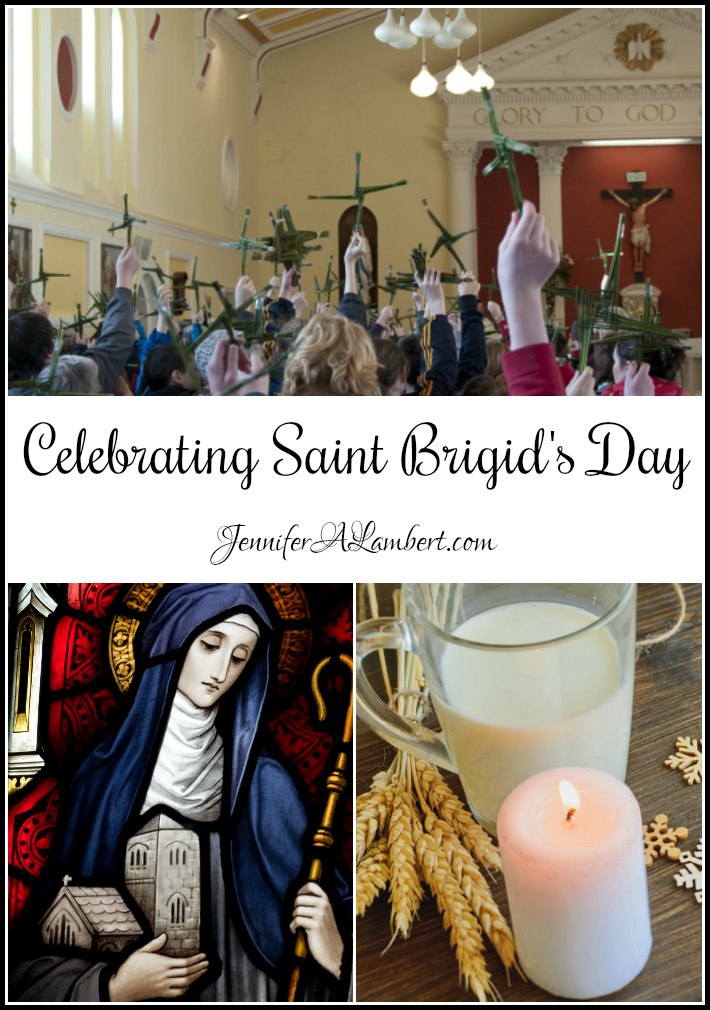
Celebrating Saint Brigid’s Day

This blog may contain affiliate links: disclosure.
Please see my suggested resources.

January 21, 2019 By Jennifer Lambert 11 Comments

Candlemas…Imbolc, the feast day of the Celtic goddess Brigid marks the beginning of spring, celebrates the arrival of longer, warmer days and the early nature signs of spring on February 1.

Born at a liminal time in a liminal place, Brigid is said to have been born on the threshold of a door (neither within or without the house) and at the breaking of dawn (neither day or night). There is ample proof that Brigid is most likely a continuation of the earlier goddess Brigid/ Brigantia who was worshipped in ancient Ireland.

The word Imbolc means “in the belly,” in the old Irish language, referring to the pregnancy of ewes.

Imbolc is one of the four major “fire” festivals (referred to in Irish mythology from medieval Irish texts. The other three festivals on the old Irish calendar are Beltane, Lughnasadh, and Samhain/Halloween).

St. Brigid is the patron saint of babies, blacksmiths, boatmen, cattle farmers, children whose parents are not married, children whose mothers are mistreated by the children’s fathers, Clan Douglas, dairymaids, dairy workers, fugitives, Ireland, Leinster, mariners, midwives, milkmaids, nuns, poets, the poor, poultry farmers, poultry raisers, printing presses, sailors, scholars, travelers, and watermen.

Celebrating Saint Brigid's Day

Celebrating Saint Brigid’s Day

  • Nature walk to look for signs of spring
  • Eat customary Irish foods
  • Read books!
  • Donate to charity or serve others
  • Make Brigid crosses out of straw
  • Visit a farm to learn about the cattle and sheep
  • Leave out scarves for blessings! Known as a “Bratog Bride” in Irish folklore, this special garment can then be used as a cure for headaches or sore throats.

Customs

Brigid would be symbolically invited into the house and a bed would often be made for her and corn dollies made as her representatives. Often a family member, representing Brigid, would circle the home three times carrying rushes. They would then knock the door three times, asking to be let in. On the third attempt they are welcomed in, the meal is had, and the rushes are then made into crosses.

Irish children, especially girls, often dress up in rags and go door to door like trick or treating, chanting:

“Here comes poor Brigid both deaf and blind,

Put your hand in your pocket and give her a coin

If you haven’t a penny, a halfpenny will do

If you haven’t a halfpenny, God bless you.”

One of the earliest references to the St. Brigid’s Cross is from a 1735 poem:

“St. Bridget’s cross hung over door

Which did the house from fire secure

O Gillo thought, O powerfull charm

To keep a house from taking harm;

And tho’ the dogs and servants slept,

By Bridget’s care the house was kept.”

Resources:

  • Recipes for a Feast of Light
  • St. Brigid’s Blessings and Poems from Brigidine Sisters
  • Shower of Roses
  • The Kennedy Adventures
  • PB Grace
  • Coloring Page from Waltzing Matilda
  • Irish Folklore: St. Brigid
  • Fish Eaters: St. Brigid
  • Imbolc Activities and Recipes

Books:

  • The Life of Saint Brigid: Abbess of Kildare by Jane G. Meyer
  • Brother Wolf, Sister Sparrow by Eric A. Kimmel
  • The Story Of Saint Brigid by Caitriona Clarke
  • Brigid and the Butter: A Legend about Saint Brigid of Ireland by Pamela Love
  • Brigid’s Cloak by Bryce Milligan
  • Saint Brigid and the Cows by Eva K. Betz
  • Folk Tales of St. Brigid by Fr. Joseph Irvin
  • Brigid’s Way: Reflections on the Celtic Divine Feminine by Bee Smith
  • Brigid: History, Mystery, and Magick of the Celtic Goddess by Courtney Weber
  • Brigid of Kildare: A Novel by Heather Terrell
  • Brigid: Meeting The Celtic Goddess Of Poetry, Forge, And Healing Well by Morgan Daimler
  • Brigid of Ireland by Cindy Thomson

Spring is just around the corner!

Linking up: Pinch of Joy, House on Silverado, Eclectic Red Barn, Grammy’s Grid, Random Musings, Suburbia, Mostly Blogging, Pam’s Party, Pieced Pastimes Shelbee on the Edge,, My Life Abundant, InstaEncoouragements, LouLou Girls, Ginger Snap Crafts, Fluster Buster, Ridge Haven Homestead, Jenerally Informed, Stroll Thru Life, My Wee Abode, Penny’s Passion, Bijou Life, Artful Mom, Try it Like it, Soaring with Him, Debbie Kitterman, Anchored Abode, Imparting Grace, Slices of Life, OMHG, Modern Monticello, Cottage Market, Answer is Choco, Momfessionals, Lyli Dunbar, CWJ, Hubbard Home, Lauren Sparks, Moment with Franca, Create with Joy,

Share
Pin54
Share
54 Shares
You might also like:

Filed Under: Faith Tagged With: faith, February, folklore, Ireland, saint, spring

  • « Previous Page
  • 1
  • 2
  • 3
  • 4
  • Next Page »
Suggested ResourcesNotebookingPages.com LIFETIME Membership

Archives

Popular Posts

10 DIY Gifts with Essential Oils10 DIY Gifts with Essential Oils
Natural Remedies for HeadacheNatural Remedies for Headache
10 Natural Remedies to Keep on Hand10 Natural Remedies to Keep on Hand
Henna Hands CraftHenna Hands Craft
Homemade Turkey Divan CasseroleHomemade Turkey Divan Casserole
This website uses cookies to improve your experience. We'll assume you're ok with this, but you can opt-out if you wish.Accept Reject Read More
Privacy & Cookies Policy

Privacy Overview

This website uses cookies to improve your experience while you navigate through the website. Out of these, the cookies that are categorized as necessary are stored on your browser as they are essential for the working of basic functionalities of the website. We also use third-party cookies that help us analyze and understand how you use this website. These cookies will be stored in your browser only with your consent. You also have the option to opt-out of these cookies. But opting out of some of these cookies may affect your browsing experience.
Necessary
Always Enabled
Necessary cookies are absolutely essential for the website to function properly. This category only includes cookies that ensures basic functionalities and security features of the website. These cookies do not store any personal information.
Non-necessary
Any cookies that may not be particularly necessary for the website to function and is used specifically to collect user personal data via analytics, ads, other embedded contents are termed as non-necessary cookies. It is mandatory to procure user consent prior to running these cookies on your website.
SAVE & ACCEPT