Jennifer Lambert

A Sacred Balance

Visit Us On FacebookVisit Us On PinterestVisit Us On InstagramVisit Us On Linkedin
  • Homeschool
    • Book Lists
    • How Do We Do That?
    • Notebooking
    • Subjects and Styles
    • Unit Studies
  • Travel
    • Europe
      • Benelux
      • France
      • Germany
      • Greece
      • Ireland
      • Italy
      • London
      • Porto
      • Prague
    • USA
      • Chicago
      • Georgia
      • Hawaii
      • Ohio
      • Utah
      • Yellowstone and Teton
  • Family
    • Celebrations
    • Frugal
  • Military Life
    • Deployment
    • PCS
  • Health
    • Recipes
    • Essential Oils
    • Fitness
    • Mental Health
    • Natural Living
    • Natural Beauty
  • Faith
  • About Me
    • Favorite Resources
    • Advertising and Sponsorship
    • Policies
  • Reviews

© 2025Jennifer Lambert · Copyright · Disclosure · Privacy · Ad

Tips for Teachers With Low Budgets

This blog may contain affiliate links: disclosure.
Please see my suggested resources.

April 15, 2019 By Jennifer Lambert Leave a Comment

With school budgets growing tighter, the modern teacher needs to be resourceful in securing supplies for the classroom. Teaching is a demanding job and creating a lasting impact on students is difficult without the proper resources. Luckily, there are a few tricks for getting around high-cost items, and still give your kids the best experience possible. 

Printables

If your school won’t give you the budget to buy non-standard paper items, there are ways to produce them yourself. There are templates for printing graph paper, various lined paper or coloring sheets online. You will only be printing the amount you actually need, so this is also a good way to reduce waste. There are also plenty of worksheets and workbooks available online for free, or a fraction of the cost, of physically published ones. You can even find fun craft time ideas to engage your students. Just make sure you’ve got the ink and the budget for high-volume printing!

DIY Smartboard

Smartboards are one of the technological staples of the 21st-century classroom. They make introducing concepts to your students more visually appealing, interactive and internet-friendly. Unfortunately, they cost a fortune. If you want to provide your young minds with this dynamic teaching device but your school can’t afford it, there’s a surprisingly easy way to make it yourself! This is probably a good idea even if your school can afford a real one. All you need is Bluetooth, a Wii controller, an infrared pen and the correct software. Depending on what grade level you teach, you could include your students in the process as a lesson in itself.

Donations

The future is crowdfunding! Many people are sympathetic to the plight of the teacher and the lack of funding, parents especially. Everyone wants what is best for the children, right? There are many platforms like GoFundMe and Kickstarter that allow you to reach out to the public and accept donations online. You can create a wishlist on sites like Amazon that allow people from anywhere in the world to send you what you need. You may be amazed at the support you receive. This generosity and community spirit can be motivational for you and your students, as well. Coming together is one of the strengths of humanity.

Electronic Alternatives

It may seem counter-intuitive, but investing in electronic alternatives to traditional teaching supplies could save you money long-term. Rather than buying more paper, writing utensils and books every single year, a one-time investment in tablets or laptops for your little learners could replace all of these outdated expenses at once. They could also save your students from future back problems- no more huge backpacks filled with heavy books and supplies! Books become PDF files, essays are typed and submitted online and even those bulky, expensive calculators are replaced. There are many applications for in-classroom educational games that students participate in together, as well. This flexible technology makes the possibilities for learning endless.

As the times get tough, the tough get creative. Children are the future, so their education is imperative. Please consider these options when planning for your next school year!


Share
Pin
Share
0 Shares
You might also like:

Filed Under: Uncategorized Tagged With: budget, finance, frugal, money

Decorating on a Budget

This blog may contain affiliate links: disclosure.
Please see my suggested resources.

December 11, 2017 By Jennifer Lambert Leave a Comment


This is a sponsored post written by me on behalf of CORT for IZEA. All opinions are 100% mine.

There are quite a few decorating challenges for military families.

Since we move every few years, we have the fun chance to redecorate often, but we need to do that on a budget.

I don’t like nor can we afford to buy an entire house full of new goods every few years when we move.

Home Décor Hacks for Military Families:

Blank Empty Spaces

Moving to a rental means a lot of white or blank walls. It’s an empty canvas!

What can we do with all that plain wall space?

Bright furniture perhaps with easy to wash throw pillow covers are easily changed with the seasons.

Fun drapery and curtains brighten up windows in every room.

Eye-catching wall art help combat those boring spaces. We love our travel photos!

Rugs are great for tile, hardwood, linoleum – really any floor surface. It really pulls a room together.

We have several mixy-matchy rugs that tie in our favorite colors and add warmth and cushion to tired feet.

Storage

Tables with cabinets, shelves, drawers, and baskets do double duty as storage containers so I don’t have to feel cluttered.

I love how our entertainment cabinet holds our TV and has drawers and cabinets to keep our gaming systems safe and tidy.

I like to display all my books in big bookcases for easy reference.

We showcase our keepsakes on the mantle and sofa table.

Games and toys are easily accessible in bookcases or cabinets either inside baskets or bins or stacked neatly.

Lighting

Lighting sets the mood.

We love natural lighting, but it gets dark early in some seasons!

We prefer simple table and floor lamps (preferably on dimmer switches!) instead of harsh ceiling lights in the afternoons and evenings.

We love to gather in the living room and play board games or snuggle up to read together by the warm glow of our table lamps and candlelight.

Furniture rental

Furniture rental is a great option for active duty military personnel since with each new PCS comes a new living situation. Temporary unaccompanied duties are also a great time to use this option.

That sectional sofa we have today, may not fit in our future home.

By working with CORT, we can find the right pieces to fit our existing spaces. Then when we are ready to move to the next base in a new city (or country!), we just give CORT a call and they’ll come pick it all up!

CORT works with military personnel to provide what we need when we need it. The best part of the furnishing process – CORT picks it up when we are ready to move on to the next assignment!

Learn more about CORT on their blog.

Visit Sponsors Site
Share
Pin10
Share
10 Shares
You might also like:

Filed Under: Military Tagged With: budget, frugal, homemaking, military

How to Budget

This blog may contain affiliate links: disclosure.
Please see my suggested resources.

June 30, 2016 By Jennifer Lambert 21 Comments

Being examples and teaching our children how to budget is super important.

Making your money work for you is important.

We’ve spent most of our marriage struggling to climb out of debt while keeping up with too much stuff, wanting this and that – and more, more, more.

As a large military family living on one income, it’s often difficult to keep our heads above water.

We strive to teach our children the value of things and experiences. I want them prepared for real life with all its financial ups and downs.

We teach our children that a trip to Florence is more important than that new Lego set. We want them to realize that rent and food and utilities and insurance have to be paid, but sometimes we have to buy the hamburger instead of the steak to offset the expense of fixing the van. Internet and smart phones and TV are luxuries, even though we’ve come to see them as necessities, like utilities.

We have to be prepared for surprise financial setbacks with a savings account and budget in place.

Growing up as an only child, I was privy to how my parents ran our household and planned for the future. I am fortunate that I accompanied them on home and car purchases to learn how that works. They’re very organized with their investment portfolio. Since they are both retired government employees, they lived on fixed incomes, but with careful planning for many years, they live very comfortably.

Financial education is important.

Isn’t that the goal? We want to prepare for the future. We want to help jumpstart our kids into a financially successful adulthood. We want to live comfortably in retirement. We want to leave our children a legacy. We want to be able to bless others.

How do you set a budget?

Creating a budget or spending plan for the first time can be overwhelming.

A budget dictates to you what you can spend, where, and when; a spending plan allows you the control of your money every single month. It realizes that your purchases change and expenses vary from month to month and that a one-size-fits-all monthly budget doesn’t truly fit anything.

~Becoming Minimalist

What’s Your Income?

Know your income.

This should be a no-brainer, right?

Also, I know some couples who really don’t share this info with each other. That’s a warning sign and y’all should work that out.

So, know how frequently you get paid and how much.

Take into account any other income you receive and what you will use it for. Alimony, child support, investment dividends, tax returns, affiliate income, inheritance, etc. Don’t just blow that money. Have a plan for it.

I know not everyone has a set amount every pay period, with commissions or bonuses or hourly rates or whatnot…so you need to average that out to know what to expect. Then consider the lowest possibility and set your budget for that.

What are Your Bills?

Know what bills you have.

You should be organized with this, right?

We took the “no-paper option” so we get email notifications and most of our bills are automatically deducted from our accounts.

Bills are typically the ones that don’t change (or change very little) from month to month – like rent, insurance, car payments. Our utilities are in this category because they’re a set amount each month and we reconcile annually.

I also put any debt in this category. While ideally, credit cards shouldn’t be used at all or paid off monthly…we’re getting there. And I have set that payment high in order to pay it off sooner rather than later.

What are Your Expenses?

These are the extra and perhaps flexible bills each month.

Utilities often fall into this category.

Luxury items are in this category. Cable or satellite TV, Netflix, Internet, cell phones are things most people have and they sometimes fluctuate based on services used. Remember, these are not necessities. They should be the first to go during financial emergency.

Groceries and gas for vehicles. This is the most flexible area for us. I can cut costs on groceries with careful meal planning.

Our car and renter’s insurance fluctuates just a tiny bit each month, but I usually keep those items in my bills category.

We pay for music lessons for our kids.

My husband and son get their hair cut every 8 weeks or so. I cut my own hair so that’s not an expense for us.

Be honest with yourself about expenses.

Do you get your nails done weekly? Do you regularly go to the hair salon? Do you go shopping for clothes frequently? Do you need a latte fix every day?

Evaluate those expenses and put them in your budget. Consider what you might need to limit or cut out of your life to make it work.

What are Your Priorities?

Everyone has different priorities.

Some people are perfectly content to live on rice and beans and buy the latest and greatest newest technology every time a new model is released.

Others don’t have Internet or cell phones at all but have an extensive garden of fresh fruits and vegetables.

Collectors and hobbyists spend time and money on their interests.

Many want to be able to give generously.

Our priorities:

We like to travel and eat well. We’re investing for our children’s educations and our retirement. And books. Always, more books.

Because of our financial priorities, we live a little differently than a lot of people we know.

We don’t have a car payment right now. Our furniture is thrift store-yard sale chic.

We don’t go shopping for entertainment and we seldom eat out.

We opt out of ads online to limit temptation! Since we don’t have a TV, we don’t see many commercials or advertisements except on Internet sidebars and some online games or apps.

How we save money:

I try to use the library first – before purchasing books for personal use or our homeschool. Often the Kindle versions of books are cheaper than the paper copies.

The kids wear hand-me-downs from cousins, each other, thrift stores, and yard sales. I seldom buy anything new that isn’t on sale.

We don’t have huge birthdays, Christmas, Easter, or other celebrations. We prefer experiences.

Do the Math.

This is easy to create on paper or on the computer.

I list all our bills and income in a column on the left and amounts in the right column. I have a column for X when they’ve cleared our bank. I use an Excel spreadsheet that does the calculations for me. I have a sheet labeled for each month and a sheet for our debt so I can see our progress.

Below is an example of my current Excel budget book. It’s more like a spending plan.
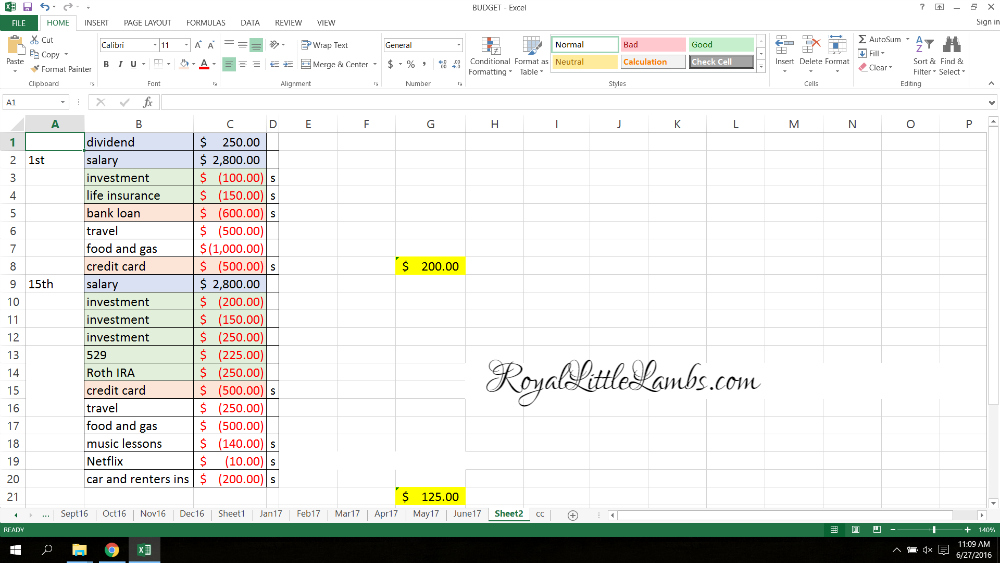
I’ve rounded the numbers and used generic names for our accounts.

I realize not everyone is in a position to invest.

I want to show you the reality.

I am not trying to brag about our income.

It’s public information anyone can look up about military service members. It’s a fixed income.

Yes, we receive some amazing benefits for being a military family: housing and utilities allowances, commissary and AAFES shopping privileges, dental and medical services at the base clinic, tax-reduced (but rationed) gasoline purchases on base. My husband’s state of residence is Illinois, so we don’t pay state taxes as a military family.

The offset is being far from home and family, missing those important holidays and events. Also, deployments, TDYs, training events, and late night or weekend exercises can be difficult on families. PCS (moving) often eats up our savings and is always stressful in many ways.

We currently have about $2500 in our savings account.

I’m fortunate to be able to stay home to educate our four children. We’re grateful for the opportunities military life offers us.

You can see we’re aggressively paying down our debt while not starving or eliminating our priority to travel. We’re still working this out with baby steps. We also have a pin and chip travel credit card that we over-used. It’s not shown in my Excel spreadsheet. We plan to attack that after these debts are paid within the year. We’re using every bit of extra income on paying that travel card (tax return, monetary gifts, and an IRA dividend we receive every autumn). We don’t plan to continue using that credit card since our new bank cards have the pin and chip now!

My Excel budget spreadsheet is color-coded.

The blue is income.

The green are investments, with amounts that seldom change.

The red is debt.

The fields left white are the flexible expenses. These amounts fluctuate from month to month.

My Color Coded Excel Budget

I’m sure you noticed some gaping holes in my budget plan?

We have a separate bank account for our local expenses. Our rent, cell phones, and Internet are auto-deducted from our local account. We have a certain amount auto-deposited each pay period into the local account to cover those expenses. We use anything left over in that account each month to pay that travel credit card. We are at the mercy of the exchange rate from USD to Euro. (I love the idea of a separate account for housing expenses and I will carry that idea over when we move back to the States!)

We also have an auto deduction going directly to our church.

I have a separate account for my blogging “business.” Honestly, I don’t even sorta break even. I pour way more into this enterprise than I make every month. Some days, that’s very frustrating.

What’s Your WHY?

This goes a bit beyond just priorities.

When you get discouraged, when the van breaks down and you use your travel fund to fix it, when your child asks if you can have a “real Christmas” and you feel guilty, what will you do?

Leave room for emergencies and pray about big purchases. Obviously, a working vehicle is necessary for getting to and from work to make the money. While we cringed to fork over that $300+ for the new alternator and valves, we did so knowing that it had to be done and our trip could either be postponed or we could be more frugal somewhere else.

We remind ourselves what the big picture is: planning for our futures, teaching our children values, and leaving a legacy for our kids.

Sure, we splurge sometimes on gelato, a cute new shirt or shoes in sale when needed, flowers for the garden or dining table for a special occasion, or that Kylo Ren lightsaber.

We try to make sure there’s room in the budget for fun or it becomes drudgery.

UPDATE 8/25/16: We have PAID OFF TWO accounts! Only 3 to go. We plan to have those paid by May!

View this post on Instagram

A post shared by Jennifer Lambert, M.Ed. (@jenalambert)


Update August 2017: Only 1 account left to go!

Resources:

  • Debt-Proof Living: How to Get Out of Debt & Stay That Way by Mary Hunt
  • 31 Days to Radically Reduce Your Expenses: Less Stress. More Savings by Kalyn Brooke
  • Slaying the Debt Dragon: How One Family Conquered Their Money Monster and Found an Inspired Happily Ever After by Cherie Lowe
  • 31 Days of Living Well and Spending Zero: Freeze Your Spending. Change Your Life. by Ruth Soukup
  • Unstuffed: Decluttering Your Home, Mind, and Soul by Ruth Soukup
  • Clutter Free: Quick and Easy Steps to Simplifying Your Space by Kathi Lipp
  • The Spender’s Guide to Debt-Free Living: How a Spending Fast Helped Me Get from Broke to Badass in Record Time by Anna Newell Jones
  • The Year without a Purchase: One Family’s Quest to Stop Shopping and Start Connecting by Scott Dannemiller
  • The Year of Less: How I Stopped Shopping, Gave Away My Belongings, and Discovered Life is Worth More Than Anything You Can Buy in a Store by Cait Flanders
  • Make Room for What You Love: Your Essential Guide to Organizing and Simplifying by Melissa Michaels

Do you have any budget tips to share?

You might also like:

  • How to Save Money while Shopping
  • Teaching Kids About Money
  • How We Save Money
  • Minimizing
  • Online Yard Sale Tips
  • Decorating on a Budget
  • 5 Money Tips
Share
Pin16
Share
16 Shares
You might also like:

Filed Under: Frugal Tagged With: budget, finance, frugal, money

Losing Control

This blog may contain affiliate links: disclosure.
Please see my suggested resources.

March 12, 2014 By Jennifer Lambert 14 Comments

So, we saved almost $1500 in a little over a month.

Wanna know how?

By losing control.

We went down to just one vehicle.

How we're surviving with one vehicle

My husband started driving our van to work. We put his truck up for sale on the lot on base since we’re moving out of the country and can only ship one vehicle. And the van is paid for, title in hand.

I have kept a budget in an Excel spreadsheet ever since before we were married. I don’t itemize it as closely as a I should. I have a cell for each bill, many on auto-pay (like our investments and insurance), and others (like utilities, Internet, and cell phones) are generally the same amount each month. Then there’s our food/gas/living expenses cell that fluctuates wildly each pay period. I should have monitored that more carefully. The pay-all-cash, envelope system just doesn’t appeal to my husband or me. We just don’t use ATMs and my husband’s paychecks are direct-deposited. Our bank is really just an online entity.

I’ve been rather proud of being frugal this past year. We’d cut down on our spending pretty drastically. We don’t eat out. That helps a lot.

When I noticed we had all this extra money leftover after a couple paydays, I was rather devastated that I must blow that much cash on errands a few times a week – that it would add up to that much in a month of being stuck at home. I asked my husband to verify the budget and he did some math-y formula stuff and looked at the accounts and numbers.

Then I asked if this could have anything to do with my being stuck at home for almost a month while he took the van to work. He’s been picking up the groceries we need. And we’ve been paying cash for gas.

Light bulb (in the voice of Gru from Despicable Me).

So, how did we save so much money? I didn’t monitor well all the little seeps of using that debit card.

Like, when I poorly plan and we need a single item from the grocery store and then I come home with three bags.

Or grocery shopping too close to meal time and not planning to have a slow cooker dinner ready or lunch leftovers and then picking up a couple of those ready-made pizzas from the deli area.

Or not thawing out meat well enough in advance and having to rush out to pick up some rotisserie chicken or even some fresh meat – and five other items to make the recipe I decided last minute.

Not to mention all the extra gas wasted with the unnecessary running around that could be eliminated with better planning.

With better planning, I could shop for meals monthly or even twice a month, and let that be the end of it.

And all that extra money we’re saving with having one vehicle? So many options! Into our savings account to earn interest. To pay off unsecured debt. To take a vacation en route to our next duty station. To take the kids on fun staycation places before we move.

I wish we had done this sooner. I wish we hadn’t bought into the “need” for two vehicles. This was my selfish demand when we arrived here with our van from our last duty station. I wanted freedom to drive where I wanted, when I wanted. I didn’t even wait to see if we could “survive” with one vehicle.

I didn’t wait on the Lord to provide the perfect vehicle or say NO to me. I pressured my husband to drive the 1.5 hours down to Carmax to purchase a used Jeep Liberty that we owned for a year, then encouraged him to trade that in for a pickup truck that we are now having to sell. And we owe more than it’s worth. (Please pray it sells soon!) And I can imagine even more blessings when we don’t have that extra monthly payment to make!

My husband just mentioned yesterday how simple it is, having only one vehicle, even with having to juggle a couple appointments this week. It makes us appreciate our provision more than ever.

I read blog posts and articles all the time with lists about how to save money, cut costs, be frugal…and they really just all say the same things. They’re good lists, but I haven’t gleaned anything life changing from them.

Eat at home. Combine errands. Don’t use credit cards. Don’t shop online. Reduce. Reuse. Simplify.

I’ve done almost all of that I can do…except sacrifice by having only one vehicle…so there it is.

But I needed to lose control. Of my selfishness. Of my finances. Of my demand. Of that blasted Excel spreadsheet with its numbers and formulas and figures in black and white that don’t necessarily add up to God.

I am amazed and blessed…and shocked.

Check out some other frugal posts by the Review Crew.

Share
Pin1
Share
1 Shares
You might also like:

Filed Under: Frugal Tagged With: budget, finance, frugal, Marriage, money

A Week’s Worth of Groceries

This blog may contain affiliate links: disclosure.
Please see my suggested resources.

May 29, 2013 By Jennifer Lambert 6 Comments

So, I really hate to shop. If I can get out of it, I will. I certainly don’t want to drag my four younguns to a store with me.

I dropped 3 kids off at gymnastics and rushed to Sam’s Club, right across the street.

I’ve always loved Costco, but they’d gotten so expensive to have a membership. When I got wind of a discounted Sam’s membership, I asked my husband to look into it and compare. He just signed up, so here we are. I still prefer the quality and selection of Costco.

What Does A Week’s Worth of Groceries Cost?

We buy our meat from a local butcher. It is ah-may-zing! So, that’s not in this post. We buy meat as needed to fill our freezer or for special occasions. Usually about every other month or so.

I do buy dairy. We just didn’t need any this trip. We use milk, cream, and half and half, usually in cooking. The kids drink milk. I don’t know of any local legal sources for dairy right now. And my kids love those Danimals yogurt drinks. They’re really not that bad. We’re running low on those, but I have to get those at Wal-Mart.

Our new next-door neighbor raises chickens and when our garden begins producing, we’re trading veggies for eggs!

So, here is my cart for a two weeks’ period. My husband gets paid twice a month and that’s about when we do our shopping, except for milk and eggs and incidentals. I keep a well-stocked pantry. It takes a lot of food to feed 6 people 3 meals a day plus snacks. We try to eat out rarely.

As you can see, most of my cart is fruits and vegetables.

If I don’t buy junk, they don’t eat junk.

No cookies, no candy, no prepared food.

I do like Annie’s products and will buy those on sale.

I do have chocolate chips and peanuts. I buy lemon juice to make our own lemonade. Almonds are a staple. And that bread beside my purse? It tastes like homemade and it’s only got 5 ingredients! Cuz I’ve been lazy making it lately.

Yes, my girls LOVE Brussels sprouts and asparagus…and we all love spinach and green beans and snap peas…and various children love the different fruits.

A Week’s Worth of Groceries

I am right pleased with this trip.

Cost, you’re wondering?

sams-receipt.png

And, I’m terrible at budgeting and menu planning. I’m moody.
We really like eMeals for helping us with meal planning.

My meat for the world’s greatest meatloaf didn’t thaw out so we had breakfast for dinner.

How do we compare to the rest of the world?

Using Rakuten, Honey, iBotta, and Checkout 51 helps save money while shopping in store and online!

You might also like:

  • How to Save Money while Shopping
  • Teaching Kids About Money
  • How We Save Money
  • How to Budget
  • Minimizing
  • Online Yard Sale Tips
  • Decorating on a Budget
  • 5 Money Tips
Share
Pin
Share
0 Shares
You might also like:

Filed Under: Frugal Tagged With: budget, finance, frugal, health

Suggested ResourcesReceipt Hog

Archives

Popular Posts

10 DIY Gifts with Essential Oils10 DIY Gifts with Essential Oils
Natural Remedies for HeadacheNatural Remedies for Headache
10 Natural Remedies to Keep on Hand10 Natural Remedies to Keep on Hand
Henna Hands CraftHenna Hands Craft
Homemade Turkey Divan CasseroleHomemade Turkey Divan Casserole
This website uses cookies to improve your experience. We'll assume you're ok with this, but you can opt-out if you wish.Accept Reject Read More
Privacy & Cookies Policy

Privacy Overview

This website uses cookies to improve your experience while you navigate through the website. Out of these, the cookies that are categorized as necessary are stored on your browser as they are essential for the working of basic functionalities of the website. We also use third-party cookies that help us analyze and understand how you use this website. These cookies will be stored in your browser only with your consent. You also have the option to opt-out of these cookies. But opting out of some of these cookies may affect your browsing experience.
Necessary
Always Enabled
Necessary cookies are absolutely essential for the website to function properly. This category only includes cookies that ensures basic functionalities and security features of the website. These cookies do not store any personal information.
Non-necessary
Any cookies that may not be particularly necessary for the website to function and is used specifically to collect user personal data via analytics, ads, other embedded contents are termed as non-necessary cookies. It is mandatory to procure user consent prior to running these cookies on your website.
SAVE & ACCEPT