Jennifer Lambert

A Sacred Balance

Visit Us On FacebookVisit Us On PinterestVisit Us On InstagramVisit Us On Linkedin
  • Homeschool
    • Book Lists
    • How Do We Do That?
    • Notebooking
    • Subjects and Styles
    • Unit Studies
  • Travel
    • Europe
      • Benelux
      • France
      • Germany
      • Greece
      • Ireland
      • Italy
      • London
      • Porto
      • Prague
    • USA
      • Chicago
      • Georgia
      • Hawaii
      • Ohio
      • Utah
      • Yellowstone and Teton
  • Family
    • Celebrations
    • Frugal
  • Military Life
    • Deployment
    • PCS
  • Health
    • Recipes
    • Essential Oils
    • Fitness
    • Mental Health
    • Natural Living
    • Natural Beauty
  • Faith
  • About Me
    • Favorite Resources
    • Advertising and Sponsorship
    • Policies
  • Reviews

© 2025Jennifer Lambert · Copyright · Disclosure · Privacy · Ad

Thirteen

This blog may contain affiliate links: disclosure.
Please see my suggested resources.

September 28, 2020 By Jennifer Lambert 7 Comments

All three of my girls are now over twelve years old.

I feel poignant about this. I should feel happy to get over that hump, I guess.

My girls are getting much more independent, doing their own things. I encourage them to own themselves, speaking up, and managing their own appointments, activities, time.

Watching them walk away with my heart is the hardest thing I’ve ever faced. Keeping a smile on my face so they don’t see my anxiety is about to kill me.

My daughters are 19, 14, and 13.

My son is just now ten, but it seems different.

Having teen girls isn’t all the bad that society and the media portray it to be.

Parenting teens doesn’t have to break us.

I really love seeing my girls grow and mature. It’s fascinating to see their minds change as their bodies also develop. Two of my daughters are bigger than I am and they almost cradle me now as I once cradled their small childish forms. But they can also hip check me in a moment so I love how gracious and sweet they are.

I remember how awkward I was at age thirteen, lanky and uncomfortable in my skin, unsure of my thoughts, struggling to fit in with kids at school, wondering who I should be and what values I should have.

I love how much more capable and confident my daughters are than I was at their age.

When my kids were very little, they were highly active and energetic. My girls went through the typical awkward stage when the were like young colts learning how to canter gracefully. Gymnastics and sports help with getting through these awkward times. They’re pretty aware of their bodies and the space they take up and I encourage my girls to expand themselves instead of shrinking as our society and the church culture seem to require. I want them to regain their confidence they seemed to have misplaced the last few years.

I read a lot of child development, cognitive psychology, and education material. I’m not an expert, but I am fascinated in learning about these topics and how I can best teach and parent my four kids.

I often use the analogy with my family that adolescent brains change from a child caterpillar brain to confused mush like a chrysalis, then to the more mature butterfly young adult brain by the time they’re 25.

Changes I’m Noticing in my Teens

Attention spans

It’s great that I can hold my girls’ attention for longer than ten minutes. I can give multi-step instructions and usually expect them to be followed and completed. Their memories are getting better. I see them focus on activities for longer periods of time, often completing projects before getting distracted or moving on to something else. I love they have the ability to train their minds by staying at home. We work, work, work, on brain health and executive function so they can do their best.

Making connections

We’re in our last 4-year cycle of history in our homeschool, beginning the rhetoric phase. Witnessing the connections and abstract thinking in my girls just brings me the greatest joy as a mother and teacher. They can think critically younger and better than I could when I was in college! I love their hard questions that we research and work through together.

Awareness of current events

I enjoy having the hard conversations with my kids and hearing what they think of what’s happening in our city, state, country, and the world. I have to be careful not to overwhelm my younger kids with the horrors of our world and continue to focus on hope and love and reconciliation. They’re starting to ask what they can do to help make our world a better place. We recycle, compost, reduce, reuse. We try with our baby steps to ease our consciences any way we can. Every little bit counts.

Expansion of strengths

After years of exposing and strewing and providing so many opportunities and experiences for my kids, they’re starting to narrow down what they’re interested in, focusing more on what they love, looking at ways to turn their passions into careers. I love seeing them grow and teach themselves. We start out generalizing their education and seeing them begin to specialize is so fun.

Ability to take criticism

My kids are so much healthier than I ever was (and still am) about constructive criticism. I try to scaffold and prime my kids when I think a situation or experience might be difficult or stressful or just very new. I want them to be aware of what to expect. I can’t always predict what might happen or what people might say or do. I can’t always be there to protect my kids. They’re growing more and more independent. Other adults and kids often aren’t as kind with their words or actions. We discuss the situation afterwards.

Maturity

I love seeing the potential in my kids. I’m getting glimpses of the adults they will soon be. They use nonviolent language (mostly) and solve problems (usually well and without my input) together. We seldom have negative or immature conflicts in our household. They have more emotional intelligence than I ever did. I’m learning so much from my kids about how to be healthy in all relationships.

Around age 12, kids undergo a big change, a crisis, in their development. They are reaching puberty and hormones make physical and mental changes in their bodies. It’s a difficult age and many kids struggle to make this change and reach the other side unscathed. Two of my girls suffer depression and anxiety. I know I sure had trouble for several years from 12-15. There seems little I can do to help my girls overcome or avoid the inner struggle. Perhaps it’s genetic or just their personalities.

Of course, tweens and teens are weebly wobbly and sometimes it seems like one step forward and three steps back.

I love being with my kids all day, every day and learning academics with them and assisting them to explore their interests. I am privileged and blessed to travel this life with my children.

During the first seven years, children work mainly out of imitation, while from ages 7-14, children work out of authority. This is why attachment is so important to develop a trusting relationship with kids.

This is also why many families experience difficulties with teens not listening. They didn’t feel attached or safe or listened to as young children, so they won’t just magically begin when they’re older. They develop their own thoughts, values, opinions, preferences. Many parents feel threatened and triggered by kids who express themselves, question authority, and other natural developmental growth.

I’m seeing my girls begin to try on new personalities and personas like actresses. They’re trying to discover who they are and who they’d like to be, what they’d like to look like. They change their hair and clothes very frequently. I try to keep up. I try to be patient and welcoming. Sometimes, it’s frustrating and since I’m pretty constant and decrepit in my boring 40s, there are bound to be clashes when I don’t realize they’ve already moved on to something new.

The Waldorf curriculum is so incredible because it is so responsive to student development. I believe all children should have access to an education that respects their development and inspires their soul. I wish I had discovered it many years ago when we began homeschooling. I try to incorporate aspects of it in our learning rhythms.

Looking back at my children when they were babies, toddlers, preschoolers, learning to read and ride bikes, it’s easy to see the milestones they reached and achieved.

My girls look like women now and I have to look twice sometimes and my heart hitches as I remember their goofiness when they were small.

Now, my teens are looking more to the future and completing high school, making friends, planning for jobs and college and careers.

I love watching them learn how to fly.

Thirteen year olds are often withdrawn physically and emotionally, can be standoffish, tends to be critical – they are protecting their budding separate thoughts and personality!

The Parenting Passageway

You might also like:

  • Sixteen
  • Eighteen
  • Ten
Share
Pin28
Share
28 Shares
You might also like:

Filed Under: Family Tagged With: development, high school, parenting, teen

Parenting Young Adults

This blog may contain affiliate links: disclosure.
Please see my suggested resources.

July 20, 2020 By Jennifer Lambert 9 Comments

Parenting is a series of mistakes, failures, successes, heartache, pride.

My firstborn is certainly the research subject in all our parenting decisions.
She is also the catalyst for many rules and lots of changes we make in our family.

She was always a dynamo. She never met a stranger. She’s a social butterfly through and through and I am always content to be “Her Mom.”

I’ve watched her grow and fail, learn, and dance to and fro.

We began homeschooling because of her fall birthday. We tried a month of third grade because of her and promptly brought her back home.

I pushed until she pushed back.

I learned boundaries as a parent. I learned how to be me, a mother, a person, and make personal demands based on my own needs from her example.

She’s quite the lawyer in her well-thought-out arguments and I struggle sometimes to be democratic, respectful, gentle.

I was never treated with respect in my own home when I was growing up. I had no privacy. I wasn’t allowed to express emotions or thoughts. I attempted suicide at age 20 and ran away at age 21.

I want to be a better parent than mine were. Navigating this modern world with no role models and no guidance is really hard.

I feel I am in uncharted waters with an almost twenty-year-old.

The Christian parenting and the secular parenting books, blogs, experts all say almost the same things – tough love, harsh consequences, isolation, withdrawing love and affection, removing privileges. We don’t do that with our young kids, so why would we start now?

I never liked the purity or stay at home daughter movements. They remove autonomy from women and open doors for abusive relationships.

Parenting never ends.

As children get older, the parent-child relationship evolves into friendship, hopefully. It becomes a solid relationship with gives and takes. It amazing to watch these little people grow into adults.

Our society does not respect children. Teenagers are viewed with suspicion and young adults are often humiliated and taken advantage of by many adults.

Young people have so much to offer if we allowed them respect and freedom they deserve.

Parenting a Young Adult

Respect

I have always tried to respect my children. It’s sometimes difficult when I feel disrespected and triggered. I often have to walk away and give myself a timeout and think about it.

I have very few rules: no drugs. no porn. no illegal activity.

I require my children to respect each other.

Communication is important. It’s up to me as the adult and parent to model healthy and nonviolent communication. Sometimes, it’s really, really hard. I have had to walk away to think and regroup and calm down many times.

I find myself more and more stating as calmly as possible, “What you said/did is disrespectful and that’s not ok.”

Expectations

We tried to do a contract, but it was worthless with no real consequences. It just has to be an ongoing conversation and it’s exhausting.

I keep going back to respect. If we’ve never done arbitrary consequences, how can I begin now? I don’t want to require her to pay rent because she needs to save for college and her future, even though she hasn’t saved a penny in over two years from her part time job.

Attending college classes and working a part time job is paramount. I feel it teaches responsibility and offers a gradual climb into the adult world of vast responsibility.

While I would love to expect chores to be completed, that isn’t always the priority at this stage when there are assignment deadlines and potentially late shift work schedules.

I have found that if I issue very specific time-sensitive commands, they get done more immediately.

Disappointment

Of course I’ve been disappointed by some of my child’s poor choices.

I had to get over my own issues with piercings, tattoos, and dyed hair. It’s her body.

While tattoos and ear plugs are pretty irreversible, I don’t worry so much about hair anymore.

It’s more worrisome when she’s made poor financial and relationship choices. She has to live and learn from her mistakes.

She hates college and I don’t really blame her. It really is so very different than twenty years ago and I don’t understand why. It should be easier with so much information at our fingertips. She’s taking some time off and looking for full time work.

I’m trying not to project onto her my education values. Sometimes it does feel like a kick in the teeth. All those homeschool years – wasted? It’s her life and her future. But I fear she may have unnecessary struggles without a college degree, certificate, apprenticeship, or training.

One-third of college students drop out at the end of their freshman year. The United States now has the highest college dropout rate in the industrial world.

Thrivers by Michelle Borba

Boundaries

I have to set clear boundaries – with consequences.

It’s really hard when there are few arbitrary consequences that matter with older teens and young adults.

Natural consequences can be scary and dangerous. Risk taking isn’t such a big deal with small kids. They might get a bruise or at worst a broken bone. Older teens and young adults might get in trouble with legal authorities or cause real irreparable harm to themselves and others.

I don’t want to the younger kids exposed to inappropriate media. I don’t want my younger kids exposed to porn, racist or sexist jokes, or violence.

Social media continues to expose the masses to a plethora of information, not all of it good. We use it as education as to boundaries, what’s worthwhile and what is abusive or vile.

I say often why something is inappropriate. Often I feel it shouldn’t be consumed by anyone.

I teach about tone and sarcasm. We need to practice kindness and I must model it for them to be to recognize it.

Why should we exploit others for entertainment?

Preparation

Preparing for the future is most important for young adults.

The goal is that they be successful and independent citizens.

I try to begin young with all my kids, teaching them valuable life skills.

I discuss finances, values, goals frequently about things they understand.

They know when we have struggled financially because of an emergency. They understand when we’re saving or paying off debt. I want them to realize their privilege in financial security also.

They’ve never known adversity. Other than stress and moving frequently as a military family.

I require my kids to purchase their own smartphones. We pay for the monthly family plan.

As soon as their age is in double digits, they call to make their own appointments, with me standing by to assist if needed.

I encourage my kids to talk to clerks and store employees if they need something or to place an order. They need to learn to communicate clearly and respectfully with others.

Of course, kids must learn to do their laundry and make meals for themselves. I provide a cookbook with all our favorite family recipes.

They must help with car maintenance. It’s important to learn and understand the expense of necessary auto upkeep.

We have 529 college plans, but they probably won’t pay for an entire four-year degree. They have to work part time, save, and apply for scholarships. We discourage loans and the lifelong debt that brings.

It’s so hard sometimes to watch the fledglings flounder, fall, fail. I want to rescue them, but that wouldn’t help them learn to be successful.

You might also like:

  • Graduating from Homeschool
  • Parenting Teens
  • 5 Best Life Skills Books for Teens
  • How to Prepare for After High School
  • Homeschool High School
  • Teen Driving Tips
  • Emotional Health
  • Teaching Kids About Healthy Relationships

Resources:

  • You Are Not Special: … And Other Encouragements by David McCullough Jr.
  • Grown and Flown: How to Support Your Teen, Stay Close as a Family, and Raise Independent Adults by Lisa Heffernan and Mary Dell Harrington
  • Doing Life with Your Adult Children: Keep Your Mouth Shut and the Welcome Mat Out by Jim Burns
  • Setting Boundaries® with Your Adult Children: Six Steps to Hope and Healing for Struggling Parents by Allison Bottke
  • How to Raise an Adult by Julie Lythcott-Haims
  • Brainstorm: The Power and Purpose of the Teenage Brain by Daniel J. Siegel M.D.
  • Smart but Scattered–and Stalled: 10 Steps to Help Young Adults Use Their Executive Skills to Set Goals, Make a Plan, and Successfully Leave the Nest by Richard Guare, Colin Guare, Peg Dawson

What’s your relationship like with your adult children?

Share
Pin41
Share
41 Shares
You might also like:

Filed Under: Family Tagged With: college, parenting, relationships, teen

Celebrating Holidays

This blog may contain affiliate links: disclosure.
Please see my suggested resources.

June 29, 2020 By Jennifer Lambert 5 Comments

Maybe some of us didn’t grow in healthy homes or with families who celebrated holidays in ways we want to continue with our own children.

I grew up an only child and I felt so much pressure to make birthdays, Mother’s Day, and Father’s Day special since I had no one to share it with.

I feel pretty whiny about writing this, but it seems like it needs to be said.

I spent my own money that my grandma sent to buy thoughtful presents for my parents. They were seldom appreciative. I remember my father demanding I buy my mother flowers for their anniversary one year when I was a teenager and I bristled at that chore since I felt it was not my responsibility. I remember many birthdays and Mother’s Day when she unwrapped perfumes and whatnot that my father purchased and said were from me. We usually went out to dinner for steak on birthdays.

My mother always wants more and loves shopping as entertainment. I don’t share that hobby. It stresses me out.

I remember most of my birthdays were when my father was out of town on business trips. My mother invited her family and my school mates and neighborhood friends. I realized when I got older that my father didn’t like gatherings.

Christmases were always pretty stressful when I was young. My mom is the youngest child of six and everyone getting together on Christmas Eve was bound to end in negativity on someone’s part. I was mostly too young to notice, but I knew my parents fought about it before and afterwards. Most years, my dad stayed at home while I accompanied my mother to the Christmas Eve party. My grandmother passed when I was 16, and it all deteriorated after that.

My parents usually send me a check, not divisible by 6, so I wonder every year who they don’t like. They’ve started wrapping and packaging weird handmedowns for my kids and it’s always a confusion when the kids ask me about their presents. Sometimes, I don’t know what to say. And apparently my mother thinks I need and use an inordinate amount of kitchen towels.

My parents possess three SUVs, pay a $850 mortgage for a 3500+ sq ft house, receive 3 retirement checks each month, and yet do not buy me or the kids anything for holidays. They constantly complain that they don’t have enough money.

It’s hard for me when my parents ask what I want for my birthday or Christmas and I tell them an item I really want, but they say, “oh, no, not that; what else do you want?” So I usually just say: “I don’t really need anything, thanks.”

As a mom of four, I am dealing with my own issues and trauma. I don’t want my kids to feel pressure. If they don’t want to celebrate my birthday or Mother’s Day per society convention, that should be ok.

I just want to feel cared for too.

I want my kids to realize that some people might have gift giving/receiving as their love language. It’s important to show people we love them in ways they can understand. I know my grandparents had this love language, but it might be only because I saw my grandma a few times a year and she felt a need to make up for a shallow relationship with things.

I am trying to work out my own hurt feelings when my birthday passes by with nothing. It seems that something or other always tries to ruin the day. I try to look at where I failed and how I can live better and model a better reaction to anger or fear and we can still celebrate more appropriately, perhaps without pressure or presents but still a rather cheerful greeting or hug.

I’ve tried to model celebrating with my kids’ birthdays, serving special meals, homemade cake, and presents. I ask their preferences which vary year to year as they get older. I hope I’ve done well. We’ve done away with flashy parties since we have no one to invite and we’re never invited anywhere. Perhaps they’re resentful but the younger three kids surely have little memory of the time before when I stressed over keeping up with others in that way.

I wanted a Pinterest-perfect holiday season before there was even social media. I wanted it to look like something out of style magazines on my husband’s lieutenant budget. Every year without fail, I cried over a failed expectation or the wine spilled or the pork roast was still raw in the middle.

I used to make myself physically ill planning events and holidays. Surely it wasn’t worth it. I don’t think anyone really noticed except that I was very upset if things weren’t living to my impossible level of perfection.

I needed to calm down and reflect on what was most important: relationships.

What memories do I want my family to have of holidays?

There were some recent Christmases when we traveled and minimally decorated and didn’t do presents, but the kids are too young to trade that and asked if we could do it more traditional from now on.

My husband has never shown interest in birthdays or holidays and all the work falls to me and I feel resentful. Years go by and things get forgotten until they roll around on the calendar again. Yet he bragged when we were dating what a thoughtful unique gift giver he was.

The stress of all the past years are like a tidal wave of trauma.

I don’t like knick knacks or presents that will just sit around and collect dust. I’ve purged and minimized so much over the years with all our military moves. I’ve streamlined and curated our possessions. While I have some regrets of items we had to sell or donate, I’m pretty content and I don’t just need more “stuff.”

When we first married, he bought himself a DVD player and surround sound system but wrote my name on the wrapped presents under the tree. I was maybe more upset by memories of my first husband only buying items for himself. I don’t care anything about electronics. If it weren’t for him and the kids, I wouldn’t own a TV.

He tried to buy me jewelry a couple times. The jade pearl necklace and bracelet set was obviously on sale because it’s missing some beads, but surely he didn’t know or look closely enough. He once bought me a children’s pearl necklace set that I returned to the store and he got very upset.

I told my husband just not to buy me presents anymore and he didn’t. He hasn’t.

Fifteen years have gone by.

He bought me caramel chocolates for our anniversary when he was last deployed. Everyone who has ever known me knows I loathe caramel.

My husband never showed appreciation for the presents the kids made him or that I purchased “from” them. I guess he didn’t have a good model for that. He doesn’t much remember what his family did on Father’s Day, Mother’s Day, birthdays. Christmas was a huge affair, focused on the kids. I stopped buying anything for my husband on holidays. We were strapped for money for many years anyway and I convinced myself this was best.

I mentioned last year that maybe it’s not healthy for the kids to see us not give each other presents on holidays. The kids asked me about it and I didn’t have a good answer for them.

I need us to model for the kids a healthy relationship, healthy holidays, healthy celebrations. We need to do better.

He bought me a hoodie for Christmas and kept asking all.day.long did I like it; did he do good? It became exhausting.

We have no relationship with my husband’s family so I felt so inauthentic and impersonal sending them gift cards for every birthday and Christmas. They probably misinterpreted my desire and reason to end that practice but I found it almost impossible to find gift cards for them when we lived in Germany and we never found a replacement tradition. I want more than a gift card relationship. I’m not sure what kind of holidays he had with his two sisters and parents while growing up. I know Christmases were huge affairs with piles of presents. I can’t and won’t recreate that.

My parents are not generous with their time, affection, money, or things and it makes holidays difficult when I am torn between being their daughter and also a wife and mom to my own family.

My daughter works part time and I would never ask her or expect her to spend her own money on presents for me or her siblings, but she doesn’t have to brazenly announce that we are not worth her time, effort, or money. She needs to learn to express her frustration in healthier ways.

It is exhausting and painful for me to try to please everyone all the time.

Perhaps I should practice more what I preach: say what I mean and mean what I say. Precision of language.

Most people can’t really handle bluntness or boldness. They need things sugar coated because they’re used to word and mind games.

Children know what they want and aren’t shy about asking for it.

I collect presents for my children all year round for Christmas and birthdays. I pay attention to what they say they like and want.

I focus on food during holidays because those are good memories for me. My aunt always had a gorgeous spread on Christmas Eve, Easter, Independence Day. I learned a lot about decorating and cooking from her.

And my daughter criticized me for cooking too well that holidays aren’t even that special. What a backwards compliment.

Should I speak up and ask specifically for what I want on my birthday and Mother’s Day? It seems selfish and greedy. I’m not one to spend money on myself often.

It feels like a “Mommie Dearest” kind of a moment to sit them down and demand that that my kids do something for me.

But they all miss the point: The true gift any mother wants is not to do anything.

Lyz Lenz

I’m often overlooked and I don’t want my kids to grow up thinking that’s how to treat people, especially their own future in-laws. I want them to have healthier families than mine was and is, what I’m trying to teach them even with my mistakes.

It’s up to me to end abusive or traumatic cycles and this includes making holidays and celebrations a cheerful, not stressful time. I want my kids to have good memories. I don’t my kids remembering their mom sulking every Christmas because the cinnamon rolls overbaked a tiny bit and complaining about not getting anything for her birthday again this year.

Maybe my family doesn’t really know or remember my preferences, likes, dislikes so they just don’t do anything. Maybe they really are thoughtless and don’t even want to put forth the effort. But maybe my family just wants a bulleted list or PowerPoint presentation about what to get Mom on Mother’s Day, Christmas, my birthday.

Yes, I realize we are privileged. We don’t struggle financially or medically. We have nothing but time and effort to improve our relationships with each other.

How I like to celebrate holidays:

Breakfast: spinach onion Parmesan omelet or veggie frittata

Dinner: seafood. I especially love salmon and scallops.

Presents: Always welcome are books from my wish list, bird feeders, experiences, gardening items.

I like to keep things simple.

How do you celebrate holidays?

Share
Pin29
Share
29 Shares
You might also like:

Filed Under: Family Tagged With: Christmas, holiday, motherhood, relationships

Teaching Sex Ed

This blog may contain affiliate links: disclosure.
Please see my suggested resources.

June 22, 2020 By Jennifer Lambert 12 Comments

We are born trusting our bodies and our instincts for what our bodies need.

For most of us, something interrupted that trust long before puberty.

We can’t just allow our kids to grow almost all the way up and then one day realize they are sexual beings and break out some library books to teach them what goes where, the end, amen.

Like my mom did.

She just called me into the dining room and there sat a stack of library books and she said, “have at it” and left me there to look through them.

I don’t remember being able to ask any questions.

I found The Joy of Sex on my bachelor uncle’s bookshelf when I was a preteen. He never censored my reading.

I remember reading one of my mom’s magazines on the living room floor, probably Glamour, when I was about 12 and asking my dad what is an orgasm? He yelled at me, “What the hell are you reading?” and he never answered my question. I felt like I was in trouble. The dictionary definition didn’t help me. There was no internet in 1988. I couldn’t ask my equally ignorant friends or acquaintances at school.

While I understood the biology of puberty and even the mechanics of sex and procreation, it was still a shock when I got my first period.

I was 12, one month shy of my thirteenth birthday. My father was tickling me and we were wrestling around on the floor. Suddenly, he sat up, and told me through clenched teeth to go to my mother. I didn’t know what I had done wrong, why I was in trouble for nothing.

Through some unknown communication, my mother somehow knew and took me to the bathroom and bathed me like I was a toddler. I was stunned, speechless, and helpless. I looked like a skinny ten-year-old. I had no breasts, but had developed public hair the last year. Nothing seemed textbook. The memory is a huge embarrassment to me.

I still wonder where my breasts went. I only grew during pregnancy and nursing and then they went back to flat nippled pancakes. I couldn’t find any clothing that fit or looked right.

I was another disappointment to my mother that I never looked like her in all her mesomorph glamorous hourglass glory.

I had to use my mother’s sanitary products. I didn’t get to go to the store to choose a variety to try or discover for myself what worked best or was more comfortable for me. I wasn’t allowed to wear tampons. Those weren’t for virgins. I eventually began wearing tampons when I was about 16. I was also no longer a virgin then.

My father discovered condoms in my purse when I was 18. Why was he going through my purse in the first place? He stormed into my bathroom when I was getting out of the bath. I never had any privacy. I stood there dripping, trying to cover myself with a towel while he berated me, lectured me, yelled at me.

I couldn’t think quick enough. I could’ve lied that they were leftovers from when we had handed them to the principal during high school graduation, which was true.

The scenario dissolved into my parents forbidding me to see my boyfriend anymore. They told me I could leave with the clothes on my back if I didn’t like. I prepared to leave. I was already a sophomore in college with a part-time job. But I had nowhere else to go, nowhere to live. No family or friends would take me in. My boyfriend’s parents wouldn’t intervene to let me live there. The best they could offer was maybe I could move in with his sister, a single mom. It wasn’t appealing to me.

I was lost and alone and on the cusp of adulthood, with my parents treating me like a juvenile delinquent.

The relationship never improved.

I snuck around for months with my boyfriend only to break up with him in an ugly immature way because of the stress.

It ruined many future relationships for me. I didn’t know how to have healthy relationships. I was in my early twenties, living at home and going to college, having to pretend I was an adult while having to sneak around with friends, dates, boyfriends.

I want to help my children grow up more healthy than I did.

Children need mentors instead of gatekeepers.

We have to start the conversation about sexual health when children are very young, with those first innocent and precious, maybe uncomfortable for us, questions.

Where do babies come from?

How are boys and girls different?

What are those bugs or animals doing together?

Talking about sexual health with the children in your world encompasses many topics, not just sex, puberty and reproduction. The exciting part is that we generally have about 18 years to roll it all out. Starting early, approaching subjects gradually using age-appropriate language throughout their development, makes it a lot less overwhelming or awkward than trying to cram it into one talk.

Sex Positive Families

We need to answer honestly, but not overwhelmingly, according to the child’s age and ability.

I think it’s best to avoid cartoons, fruit, cutesy birds and bees analogies.

I often panicked and overtalked when my son wanted a very simple answer.

It’s best to keep it simple and teach the proper names for all body parts for both male and female to our sons and daughters.

Maybe we should stop projecting our own sexual hangups onto others. My parents and The Church didn’t give useful or healthy advice.

And stop sexualizing children and teens. Stop assuming, joking, encouraging, or asking kids about romantic relationships. They’re children.

Comprehensive sex education gives kids & teens the resources to make the healthiest decisions for themselves. This isn’t radical; it’s ethical.

Eric Sprankle, Psy.D.

Sexual health is more than sex.

Comprehensive Sex Education:

  • Human Development (including reproduction, puberty, sexual orientation, and gender identity)
  • Relationships (including families, friendships, romantic relationships and dating)
  • Personal Skills (including communication, negotiation, and decision-making)
  • Sexual Behavior (including abstinence and sexuality throughout life)
  • Sexual Health (including sexually transmitted diseases, contraception, and pregnancy)
  • Society and Culture (including gender roles, diversity, and sexuality in the media)

Teaching human development seems like the easy part! It’s science. It is unemotional. This goes here and this happens and sometimes there is procreation. This is neutral ground.

Relationships are a bit more difficult as we are almost all still dealing with our own issues and navigating through them. It’s important that kids and teens know what a healthy relationship looks like, especially since I am still learning how to do this myself.

We all are still learning personal skills and how to get along well.

As far as behavior, health, and culture, that’s where things tend to get more difficult!

We cannot just focus on abstinence and STIs and call it a day. When generations of people fear sex and think it’s all bad and struggle with healthy relationships, we have to change something.

I have witnessed some disturbing acts this past year.

On two separate occasions, with two different families, parents teased their children and laughed at their cries of “No!” and “Stop!” The two incidents took place while I was a spectator at my son’s baseball games.

One father squirted a water bottle onto his tween daughter and the mother, father, extended family all admonished her for saying, “Stop!” and she cried while they continued to make fun of her and got her shirt all wet.

The other incident, a mother squirted her baseball player son with a water bottle – a little too much in the face, trying to clean out his sandy eyes. He started crying and getting angry and she ridiculed him and told him he was fine, but then proceeded to empty the water bottle onto his head and he got rather hysterical at that invasion. She continued to laugh at him and other parents chuckled at the scene.

I was horrified. These kids are learning that consent doesn’t matter. They are learning they are not safe. They are learning their parents won’t believe them nor do their feelings matter. They are learning that “no” or “stop” don’t mean anything. And they might do things to others and wonder why it’s not ok.

Teaching Consent

Consent through Fear, Guilt, Pestering, Begging, Pleading is not Consent.

Teaching about autonomy and consent should begin when children are babies. It has nothing to do with sex.

Children should have bodily autonomy.

Kids can and should choose what and when to eat, clothing, when to sleep, and how to control their bodies, including touch.

Kids should learn at a young age that they can make their own decisions based on their bodies needs and desires. I assist, coach, and guide them to make healthier decisions. Sometimes, it’s inconvenient for me. (We compromise on meals and sleep schedules. Our family has privilege and freedom with this.)

Model asking permission before touching kids or their belongings and teach them to do the same with others.

Ask permission before picking up, tickling, or engaging in any activity that involves touching a person or their possessions.

Teach kids their bodies are their own. They don’t have to touch, kiss, hug, or high five relatives or friends or anyone.

Teach kids to ask before hugging their siblings or friends and other adults.

Practice asking teens and other adults if it’s a good time for conversation. Show respect for space.

Teach kids and teens not to give out personal information in person or online.

We have to talk about harassment, assault, and rape.

We have to end these ridiculous attitudes about sexual violence.

I don’t want to know his swim scores. I don’t care what she was wearing. I don’t care if she did drugs or how much she had to drink. I don’t care if they had sex before. I don’t care if they were watching porn.

No means no.

Kids have the right to say no and we as parents must accept their no. If and when a situation arises when we must compromise, we have to do so respectfully and lovingly. Connected parents who are not controlling are more likely to have children willing to cooperate and desiring to find solutions that makes everyone happy.

I’ve had the hard conversations with my three daughters about not wearing this or that, about not running, skating, biking, hiking alone. They must constantly be vigilant and aware of their surroundings and who might pose a threat. I warn them about not accepting a drink from anyone or setting food or drink down and coming back to it. I constantly remind my daughters to take up space. I want to believe all women because I think all of us has experienced sexual assault at some point, even if we don’t want to admit it or be really honest about it.

We have to also talk to our sons about respecting all people all the time. We have to discuss his privilege to go anywhere he likes and how he might seem threatening just by his size and strength compared to women. I teach my son to make room for others. I try to calmly point out to my husband and son when they use inappropriate or questionable language, gestures, or block a space with their physical presence.

According to male rape myths, boys and men cannot be sexually abused. The truth is, the figure is staggering. 

If we don’t have these constant conversations, then sexual assault will continue and be more and more accepted in our society.

Anyone can be a victim and it is never his or her fault, no matter the clothing choices, or being alone, or being under the influence of a substance.

Sex is rarely about just sex.

When teens and young adults begin dating, sex is bound to become an issue or a topic of conversation. This is normal and natural. How we react as parents is of paramount importance.

The images of dads with guns and interviews and applications to date their daughters is disturbing. Girls are not property to be sold or bought or even protected like she is fragile.

Boys are not all predators only “out for one thing” as media and society would tell us. “Boys will be boys” and they can’t control themselves, we are taught by almost everyone, and especially by The Church.

Sexual harassment and inappropriate jokes aren’t funny.

Intimacy is not about sex. Intimacy is about TRUTH. When you trust someone, when you can tell someone your truth, when you show your real self to someone, when you can stand in front of someone and their response is: “You are safe with me.” THAT is intimacy.

Happy teens with healthy family relationships seldom rush into early sexual relationships with other dysfunctional partners.

It’s almost considered a normal rite of passage for teens to engage in sexual acts. I remember being curious what all the fuss was about when I was a teenager. Then at 16, I was pretty disappointed and society sure labels the girls and boys differently.

I certainly don’t have a healthy sexual history. I want more for my kids.

I’ve asked myself many times to quell my anxiety and do some soul searching:

“What’s the worst that can happen?”

  • What if my daughter gets pregnant?
  • What if my son gets a girl pregnant?
  • What if my child gets an STI?
  • What if my daughter gets assaulted or raped?
  • What if my son harasses, assaults, or rapes?
  • What if my child is nonbinary or LGBTQ+?

I want my kids to know what contraceptives are and what are the risks and how they can be obtained and used. I don’t want them ignorant or afraid. I hope and pray that they come to me if or when something happens that could be life-changing or life-threatening.

Unfortunately, we still live in a society with a government that wants to dictate what happens to a woman’s body.

Most of these questions concern most parents. Of course we have big emotions if these things happen. No one wishes for a teen pregnancy, violence, or the ostracization that comes from an alternative lifestyle.

I hope that I have the right reactions and love to help my child through anything.

Sometimes [sex] is about a hunger to be desired. It may be an escape from boredom or loneliness. It may also be a way of staking territory or claiming a possession, or may serve as an attempt to lock into an exclusive relationship with another. Sex can be a powerful symbol of status and recognition. It can be about scoring or about belonging or fitting in or clinging and holding on. It may be about dominance or submission or may function to please someone. Sex, in some cases, reflects a lack of boundaries and an inability to say no. It can, of course, express love, heartfelt passion, and true intimacy. Nearly always, in one form or another, sex is about attachment. In the lives of our adolescents it is, most often, an expression of unfulfilled attachment needs.

Hold On to Your Kids: Why Parents Need to Matter More Than Peers by Gordon Neufeld and Gabor Maté, MD

It’s important for people to realize that sex should feel good. We are so enamored of sin and purity in American culture and history that it’s easy to push an agenda that sex is bad, wrong, dirty, or sinful.

There is no “switch” to turn on when a person walks down the aisle into a marriage and sex is suddenly considered ok by society, especially religious people. We are doing young people a huge disservice when we teach that sex is bad.

To those struggling with “sexual sin” (e.g., masturbation, same sex attraction), just know that it’s the person who taught you about sin that is causing the struggle, not your sexuality.

Eric Sprankle, PsyD

As a Christian, I started off with the biblical curriculum that seems to be pretty approved across the evangelical board. Most of it is ok. It also misses many marks that affect our society.

Do I want gaps in my kids’ education? Of course not. Do I want my kids learning from their friends, the media, Netflix shows, Hollywood? Not without an open conversation, a safe space where they can ask me questions, and discuss difficult topics with me.

I want my kids and teens and young adults to be able to ask me the hard questions, even if it makes me uncomfortable, even if I don’t know the best answer. We can discuss it and discover the best course of action or philosophy together.

The body is much sinned against, even in a religion based on the Incarnation. Religion has often presented the body as the source of evil, ambiguity, lust, and seduction. This is utterly false and irreverent. The body is sacred.

John O’Donohue, Anam Ċara

Pornography is not real life.

Sexual media is fantasy. Kids and teens are exposed to a lot of fake bodies and abusive sexual and relationship circumstances in the media.

It’s important to talk about these issues with kids and teens before we realize they’re viewing porn online, on smartphones, or with their friends.

Internet and social media makes everything instantly accessible. It doesn’t seem to matter if there are parental controls on devices. If kids are curious, they will find a way.

We have to discuss the dangers of pornography and its exploitation of males and females. We have to talk about sexting before we discover photos of underage teens on devices.

I am blessed that my nineteen year old daughter feels safe to be open with me about her life. I don’t have to agree, but it is her life and her body. I can only guide her and tell her about my past and help her make good choices for herself.

Many people regardless of faith or background feel fear or even disgust regarding many sexual topics. It’s important to move past issues that are uncomfortable for me. That means that I have to learn about things that I never knew before.

Sex is about pleasure. It should never be degrading or demeaning or humiliating.

We have to talk about gender.

If our teen speaks up about sex, sexuality, or gender…listen, love, and be humble.

The concepts of gender and sexual orientation are awkward for many of us whether we grew up in religious homes or not. Gender fluidity wasn’t acceptable until recently. We are still working out LGBTQ+ equality in our society.

For people who cannot accept gender or sexual differences other than binary cishet, please ask yourself why and don’t just wrongly quote religious texts to justify your hatred and intolerance.

I want to be respectful of everyone. I am learning how to do this.

I had students who were abused because their Christian parents couldn’t accept who they are.

The discovery of one’s sexual preference doesn’t have to be a trauma. It’s a trauma because it’s such a traumatized society.

James Baldwin 

When I was in college, I didn’t know sexual slang or anything about pornography. I was sheltered and naïve.

As a student and even after I graduated, I was the butt of many jokes from classmates, partners, and then from my high school students during my first few years of teaching.

I don’t want my kids to feel shame because they don’t know something that everyone else seems to know.

A couple books that really helped me as a parent heal from all the lies our society teaches about sex:

The Great Sex Rescue: The Lies You’ve Been Taught and How to Recover What God Intended by Sheila Wray Gregoire

Come As You Are: Revised and Updated: The Surprising New Science That Will Transform Your Sex Life by Emily Nagoski

Sex is a difficult topic for many parents. We just have to do better.

I’ve written about sex ed before and my philosophy is evolving as my kids grow up and I learn how to parent better.

  • Is it Time for The TALK?
  • Having The TALK
  • Healthy Sexuality and Relationships
  • Why I Don’t Teach Purity
  • 10 Things I Want to Tell My Children
  • In the Middle
  • Parenting Teens
  • Teaching Kids About Relationships
  • Making Sense of It Book Review
  • Shameless Book Review

Book List

Maybe preview so you’re prepared before you read these to your kids or hand them to your kids to read.

  • My Body! What I Say Goes!: A book to empower and teach children about personal body safety, feelings, safe and unsafe touch, private parts, secrets and surprises, consent, and respectful relationships by Jayneen Sanders
  • Amazing You: Getting Smart About Your Private Parts by Gail Saltz
  • It’s Not the Stork!: A Book About Girls, Boys, Babies, Bodies, Families and Friends by Robie H. Harris
  • It’s Perfectly Normal: Changing Bodies, Growing Up, Sex, and Sexual Health by Robie H. Harris (My husband read this with our son.)
  • It’s So Amazing!: A Book about Eggs, Sperm, Birth, Babies, and Families by Robie H. Harris
  • The Period Book: A Girl’s Guide to Growing Up by Karen Gravelle and Jennifer Gravelle
  • Body Drama: Real Girls, Real Bodies, Real Issues, Real Answers by Nancy Amanda Redd
  • Cycle Savvy: The Smart Teen’s Guide to the Mysteries of Her Body by Toni Weschler
  • Malia’s Magnificent Moontime: A Holistic Guide to Menstrual Self-Care by Angela Shabazz and Kendi Shabazz Muhammad
  • Moon Mother, Moon Daughter by Janet Lucy and Terri Allison 
  • Celebrate Your Body by Sonya Renee Taylor and Book 2 by Dr. Carrie Leff
  • The Girls’ Guide to Sex Education: Over 100 Honest Answers to Urgent Questions about Puberty, Relationships, and Growing Up by Michelle Hope, M.A.
  • Asking About Sex & Growing Up: A Question-and-Answer Book for Kids by Joanna Cole
  • Sex is a Funny Word: A Book about Bodies, Feelings, and YOU by Cory Silverberg
  • Consent: The New Rules of Sex Education: Every Teen’s Guide to Healthy Sexual Relationships by Jennifer Lang, MD
  • S.E.X., second edition: The All-You-Need-To-Know Sexuality Guide to Get You Through Your Teens and Twenties by Heather Corinna
  • Changing Bodies, Changing Lives: Expanded Third Edition: A Book for Teens on Sex and Relationships by Ruth Bell
  • Unprotected Texts: The Bible’s Surprising Contradictions About Sex and Desire by Jennifer Wright Knust
  • The Gender Wheel: a story about bodies and gender for every body by Maya Christina Gonzalez
  • It Feels Good to Be Yourself: A Book About Gender Identity by Theresa Thorn
  • Pink Is for Boys by Robb Pearlman
  • Sparkle Boy by Leslea Newman
  • Julián Is a Mermaid by Jessica Love
  • Gracefully Grayson by Ami Polonsky
  • Small Gods by Terry Pratchett
  • Sense and Goodness Without God: A Defense of Metaphysical Naturalism by Richard Carrier
  • Tell Me: What Children Really Want to Know About Bodies, Sex, and Emotions by Katharina von der Gathen. Read a review.
  • Who Are You? The Kid’s Guide to Gender Identity by Brook Pessin-Whedbee
  • Maybe He Just Likes You by Barbara Dee
  • That’s What Friends Do by Cathleen Barnhart 
  • Express Yourself by Emily Roberts
  • Stand Up for Yourself and Your Friends by Patti Kelley Criswell
  • What Does Consent Really Mean? by Pete and Thalia Wallis
  • C is for Consent by Eleanor Morrison
  • Consent (for Kids!): Boundaries, Respect, and Being in Charge of YOU by Rachel Brian
  • Consent: The New Rules of Sex Education: Every Teen’s Guide to Healthy Sexual Relationships by Jennifer Lang
  • Making Sense of “It”: A Guide to Sex for Teens (and Their Parents, Too!)  by Alison Macklin
  • A Better Way to Teach Kids about Sex by Laura Padilla-Walker, Dean M. Busby, Chelom E. Leavitt, and Jason S. Carroll

Resources

  • Kelly Grove The “Sex Lady” Who Teaches Us to Do Better and The Things Sex Education Failed To Teach You
  • Lily Isobella, especially these posts: Not My Son and What Did You Need to Know?
  • Born in an Age of Porn
  • Don’t tell the kids to just look away
  • How Sex Ed Perpetuates Rape Culture
  • How to Talk to Kids About Consent
  • Scarleteen
  • Get the Sex Education You Never Had With These 9 Books
  • Our Whole Life Curriculum
  • These are Our Bodies Curriculum
  • Fast Times at Ridgemont High

These books and resources can be a great education for those of us with gaps and questions. We should want to do better and have a more open, trusting relationship with our children than we perhaps did with our parents. I’ve read and watched a lot of it with my own teens so we can discuss the concepts, issues, and scenes.

When young people are not informed early that their bodies can be a safe place for them to get to know, to explore, and that it can be pleasurable to do so… or when they’re taught about sex only from a reproductive standpoint without discussion of pleasure, we do not adequately prepare them with the necessary awareness, language and interpersonal skills that best ensure their safety and satisfaction within sexual experiences.
An attempt to deny or dismiss pleasure contributes to higher incidences of “consenting” to sex when it isn’t truly desired; being less aware of the non-verbal cues and unique needs of partners; faking orgasms; and, not being aware of and confident within one’s own body.
When young people are ill-informed and under-prepared, they cannot make informed choices.
Sex education discussions must be shame-free, must include the nuances of pleasure and must be early and ongoing to truly make a meaningful impact.
Ideally, children live long enough to grow into adults. Let’s do our part to prepare them for safer, mutually satisfying sexual experiences when they get there.

When we erase pleasure from sexual health talks with young people, we fail to fully prepare them for safer, mutually satisfying experiences into adulthood.

Sex Positive Families

Our conversations about sex must evolve if we want society to be healthy.

Share
Pin28
Share
28 Shares
You might also like:

Filed Under: Family Tagged With: relationships, sex

Making a House a Home

This blog may contain affiliate links: disclosure.
Please see my suggested resources.

June 15, 2020 By Jennifer Lambert 16 Comments

We bought a house!

The dream of a house can be the eternally postponed preliminary step to taking up the lives we wish we were living…If you lived in your heart, you’d be home right now.

Rebecca Solnit

We’ve rented this house for almost three years. I’m tired of paying high rent when we could be earning equity.

Aaron has about a year and a half until retirement from the Air Force.

We’re settling down in Dayton, Ohio.

Having always rented a house made us feel like we never had a home. We often wanted to do updates or improvements, but we didn’t want to sink a lot of money into a rental and landlords are often weird.

Home is another word for the Spirit that we are, our True Self in God.

Richard Rohr, Falling Upward

My husband and I have lived together in five houses:

  1. My little 3 BR that I bought and sold within a year in the town where I grew up. It doesn’t even count because we had just met, married, and he was going away for a year, but then we moved.
  2. The tiny hot ranch we rented in Texas where I had my two middle girls
  3. The handicapped accessible Hawaii house on Hickam AFB that the kids still call home
  4. The huge ramshackle rental behind the Mormon curtain in Salt Lake City, with our big vegetable garden
  5. The German house over the Getränke shop in a little village

Now, our Ohio suburban with a creek in the backyard. 

When we moved in, our son asked us if this was our forever home. He was tired of moving. We all were and are. We didn’t know then that we would be able to purchase this house and stay here.

The ache for home lives in all of us. The safe place where we can go as we are and not be questioned.

Maya Angelou, All God’s Children Need Traveling Shoes

I lived in the same house for my first sixteen years. We moved to another house until I moved out. My parents now live in a house that will never be my home. I have no memories there.

My husband grew up in the same town – in two houses – where he lived all his youth and young adult life. His sisters still live there. His middle sister still lives in the house where they all grew up.

It’s hard looking back at all the houses I’ve lived in, all the houses our family has lived in during our military moves. I often get confused when I am sleepy or sick, my memories getting befuddled in all the hallways and rooms in my mind.

Home is that youthful region where a child is the only real living inhabitant. Parents, siblings, and neighbors, are mysterious apparitions, who come, go, and do strange unfathomable things in and around the child, the region’s only enfranchised citizen.

Maya Angelou, Letter to My Daughter

I can finally throw out all the boxes I’ve saved over the years since we had to pack some items in their original boxes for the movers to ship them, like our flat screen TV.

I love getting rid of the clutter! I don’t have to save anything “just in case” we might need it at our next destination.

I only have to keep things I find beautiful, special, nostalgic.

I can paint walls, update the garden, remove and replace fixtures. I can do anything I want!

At a crossroad, a kind soul asked aloud,

“Which way shall I turn? Which way is best?”

Quietly the Universe responded,

“Go until it feels like home.”

Adrian Michael

How I’m Decorating Our First Home

Entry Way

We usually enter our home through the garage.

We have some hooks for bags, hats, and jackets.

We can go straight through another door to the backyard. I have a shoe rack there blocking the seldom used door and I don’t like it, but it’s what it is for now.

We have a large pantry where we store seldom used and bulky kitchen appliances.

The coolest thing is there is a laundry chute from my closet to that pantry and I can scoot the clothes into the laundry room!

Laundry Room

I love having a large laundry room with lots of storage.

I have room for my chest freezer at the end of the counter. We store our baking molds, raclette, fondue, ice cream maker, and slicer on the shelf above the counter.

We often use it as a mud room since it’s right by the doors to the backyard and garage.

I have a huge pantry on the right and a big sink.

There are wire shelves over the washer and dryer and I would like to replace those with cabinets and solid shelves.

We may replace the tile floor. It seems like it needs regrouting or something.

Kitchen

All the flooring on our main level was updated with Pergo wood grain and it’s nice.

The cabinets were painted a weird textured grey and we plan to update those by painting the lower cabinets black and upper cabinets white. It should brighten the room immensely.

I love the granite countertops.

The stainless GE appliances are the best I’ve ever had.

On the right side is our fridge and coffee nook with the pantry we redid when we first moved in.

Breakfast Nook

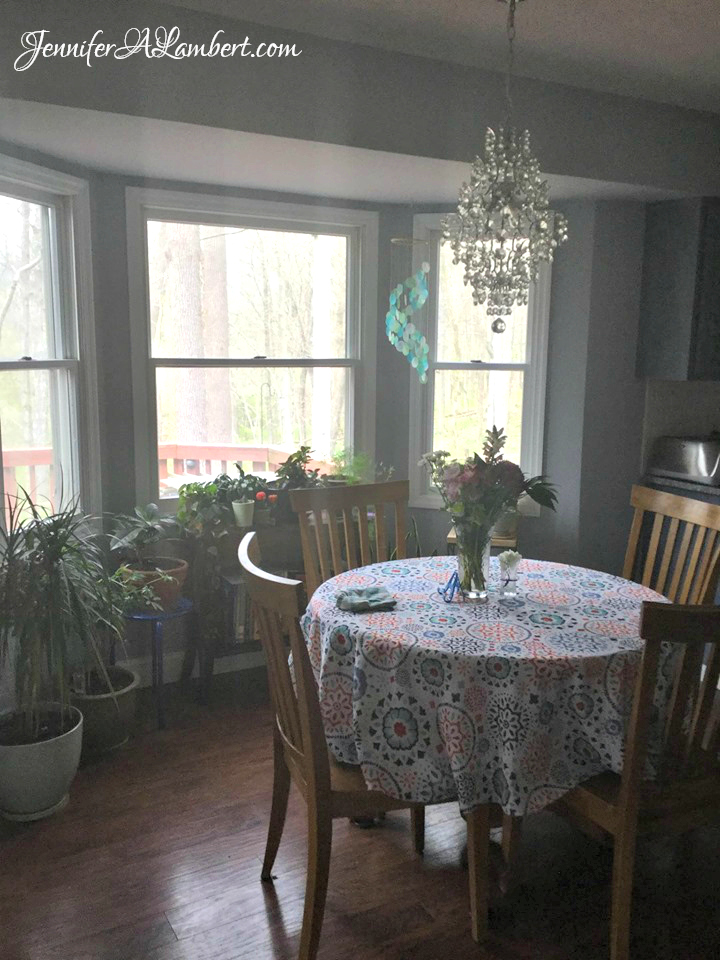
I love my bay windows and mini jungle in our breakfast nook.

I scored this table and chairs in Utah over ten years ago- at two different yard sales – for a total of $30!

I loathe the little chandelier and will replace it soon with something less ostentatious.

Dining Room

The china cabinet and dishes belonged to Aaron’s grandma.

We all eat dinner together here almost every evening.

Fridays, we have homemade pizza in the basement with a movie on our TV.

Powder Bathroom

Could you believe we lived here almost three years and suffered with these light fixtures being upside down? And I would hit my head when I washed my hands!

We plan to get a better mirror, repaint, and maybe wallpaper an accent wall, buy a small cabinet vanity in place of the tiny pedestal sink and perhaps a shelf or cabinet over the commode. New rugs too.

Living Room

We have six people in our family, so all the cutesy seating arrangements for four I see on design sites aren’t right for us.

I bought a new sofa and loveseat last year. I love the sleek design. I chose the La-Z-Boy Dixie Sofa and Loveseat in Mocha.

The pink gooseneck rocker belonged to my grandma. My parents bought me the Harbor Town recliner last year.

I’m getting a new rug soon. I already have the smaller one by our sliding door to the deck and a runner and little rug at the front door.

It looks a little crowded, but it’s working for now.

  • C-Shaped Accent Table 
  • Teal Glass Lamps
  • Square Coffee Table
  • Velvet Pillows
  • Collage Picture Frames
  • Round End Table
  • Mohawk Patchwork Area Rug

Hearth

I love having a brick hearth and wood mantel.

We have shells from our travels and some fun collected items. I love candles and lanterns.

  • Teapot 
  • Decorative Lantern
  • Metal Lantern
  • Wood Tray with Votive Candle Holders
  • Metal Compass Rose
  • Mercury Glass Pillar Candle Holder Set 
  • Hearth Cricket

Reading Nook

We have this weird landing at the top of the stairs that seems like wasted space to me.

Other homes with our similar floor plan have four bedrooms upstairs, but we have only three. Our middle girls have always shared a bedroom.

Thanks to everyone who helped me create this space!

Aaron’s grandma’s chair with the kids’ bookshelf.

Photos of our parents and grandparents watch over the kids.

I plan to get some tall houseplants since it’s pretty bright from our foyer windows.

I just added a floor lamp too.

Bedroom

We have a tall vaulted ceiling that I have no real ideas what to do with. Maybe a center beam?

We plan to paint the walls a pale grey and perhaps get some crown molding.

I ordered some navy and beige paneled drapes to match our new bedding (from Target).

We finally got a new mattress set – after twenty years!

I’m still in love with my bedroom furniture and I couldn’t find any better. No need to update it when it works great.

Not in love with my crooked wedding pics over the bed. We have so much wall space and I have few ideas to update this room.

  • Charging Station
  • Color-Block Blackout Window Curtains
  • Square Finials Curtain Rods
  • Beggarstaff Hamlet canvas print

Kids’ Rooms

My middle girls share a room with bunk beds with one window overlooking the backyard. They hate it, but it’s the way it is. They share the hall bathroom that has two sinks.

My son has the other upstairs bedroom with two front windows and ceiling fan. We gave him that room because they bunks wouldn’t fit any which way and the fan would have been dangerous for the top bunk. He uses my bathroom but we may have to reevaluate this soon.

Basement

We love having a finished basement.

I like having the TV and video games tucked out of sight.

I have the kids’ white erase boards on one wall. I have the three kids’ desks where we do any formal homeschool lessons, mostly math. My home office is upstairs with all my bookcases is in a room opposite our dining room.

We bought a used elliptical very cheaply from an older couple moving away and it’s awesome.

Our sectional sofa is still holding up ok after 10+ years.

There is a wet bar that I want to update with a new updated counter, faucet, and hopefully a narrow refrigerator in place of the pantry or a short beverage cooler in place of a cabinet.

My eldest daughter, almost twenty, has a bedroom and bathroom to herself in the basement but no windows.

Garden

We have a large front yard. We’re tackling the clover and weeds and trying to grow grass in the bald spots.

We have a little garden beside the garage where we get the most sunshine. We have peas, spinach, lettuce, green beans, cucumber, yellow squash, radishes, and carrots.

Our back yard slopes down to a lovely creek. It’s very shady.

We’re updating slowly as we can afford it.

We added pretty stepping stones and pine wood chips to a muddy area.

I plan to turn the sand pit into a Japanese shade garden.

We plan to sand, repair, and repaint the deck in brown or gray floor with white railings.

There is a firepit surrounded by too large gravel. I want to place some flat stones around it for a seating area.

Hostas are poking through the wood chips on either side. We need a new fence and I think I will prefer a picket instead of rail and wire.

Four walnut trees are coming down next month. You can see two on the right. The walnuts fall on our deck and it’s dangerous!

It’s really quite scary knowing we are responsible for all the maintenance on this home.

We know we need new siding and deck repairs. Most of the inside is in fantastic shape and we just want to make some updates.

We got a 30-year VA loan and I wonder if it will ever get paid off.

Elemental Blessing For A New Home

Before a human voice was ever heard here,
This place has known the respect of stone,
The friendship of the wind, always returning
With news of elsewhere, whispered in seed and pollen,
The thin symphonies of birdsong softening the silence,
The litanies of rain rearranging the air,
Cascades of sunlight opening and closing days,
And the glow of the moon gazing through darkness.
May all that elemental enrichment
Bless the foundation and standing of your home.
Before you came here, this place has known
The wonder of children’s eyes,
The hope of mornings in troubled hearts,
The tranquillity of twilight easing the night,
The drama of dreams under sleeping eyelids,
The generous disturbance of birth,
The anxieties of old age unclenching into grace
And the final elegance of calmly embraced death.
May the life of your new home enter
Into this inheritance of spirit.
May the rain fall kindly,
May daylight illuminate your hearts,
May the darkness never burden,
May those who dwell here in the unseen
Watch over your coming and going,
May your lives of love and promise
Refine and deepen the mind of this land.

John O’Donohue, To Bless the Space Between Us

For a New Home

May this house shelter your life.
When you come in home here,
May all the weight of the world
Fall from your shoulders.
May your heart be tranquil here,
Blessed by peace the world cannot give.
May this home be a lucky place,
Where the graces your life desires
Always find the pathway to your door.
May nothing destructive
Ever cross your threshold.
May this be a safe place
Full of understanding and acceptance,
Where you can be as you are,
Without the need of any mask
Of pretense or image.
May this home be a place of discovery,
Where the possibilities that sleep
In the clay of your soul can emerge
To deepen and refine your vision
For all that is yet to come to birth.
May it be a house of courage,
Where healing and growth are loved,
Where dignity and forgiveness prevail;
A home where patience of spirit is prized,
And the sight of the destination is never lost
Though the journey be difficult and slow.
May there be great delight around this hearth.
May it be a house of welcome
For the broken and diminished.
May you have the eyes to see
That no visitor arrives without a gift
And no guest leaves without a blessing.

John O’Donohue, To Bless the Space Between Us
We removed the bottom hooks! We are HOME.

You might also like:

  • Considerations Before Renting a Home
  • CORT Furniture Rental
  • Decorating on a Budget
  • Putting Dreams on Hold
  • How to Make Moves Less Stressful
  • My Kitchen Essentials
  • Military Kids are Third Culture Kids
Click here
HOME
Abraham Verghese, Cutting for Stone

What makes your house a home?

Share
Pin31
Share
31 Shares
You might also like:

Filed Under: Family Tagged With: homemaking, military, milspouse

How to Be a Good Homeowner

This blog may contain affiliate links: disclosure.
Please see my suggested resources.

June 15, 2020 By Jennifer Lambert Leave a Comment

Whether you think you’re currently living in a transition house or your forever home, there are things you should do to take care of your property on a regular basis, to ensure that you’re being a good homeowner.

After all, if you did ever decide you wanted to sell, it’s easier to do when your house has been well cared for, rather than being allowed to get a little run down and tired. But beyond the salability of your house, your family’s safety and comfort are even more important. 

Monthly and seasonal upkeep and maintenance routines

There are a few things that you should do on a regular basis, as part of your home care routine. Some are essential to the safety of your home and family and others are just a good idea to ensure that you get maximum enjoyment out of your home.

  • Check filters and vents throughout your home. This includes:
    • Cleaning / replacing your furnace filter / checking the AC filter for debris; 
    • Making sure the dryer exhaust is clear and reminding everyone who does laundry to clean the in-machine filter every time they use it; 
    • Checking your kitchen and bathroom exhaust vent / filters to make sure they are clean and in good working order; 
    • Vacuum dust from air vents throughout your house to avoid breathing in dust when air is circulated;
    • Check other external air vents, beyond the dryer, to make sure they are clear of debris, snow or other blockages.
  • Clean the garbage disposal by running it with something as simple as ice, and then flushing it with hot water and baking soda, to give it a thorough going over.
  • Check drains and faucets. 
    • Showerheads and faucets can get clogged up with mineral deposits, depending on how hard your water is, so keeping them clean will keep them running smoothly;
    • Check drains in showers, sinks and tubs for blockages: a hunk of hair can do a lot of damage if it’s not dealt with! If you’ve got a jet tub in the bathroom, make sure all the jets are clean and working properly.
  • Keep up the pool. When in use—and depending where you live, that can be year round or just a few months in the summer—make sure that all the systems for your pool and/or spa are working correctly, including filters, heaters and so on. Regular maintenance of these will save you a lot in the long run.

On a seasonal basis, you should also:

  • Check your alarms. Smoke alarms and carbon monoxide detectors should be checked and batteries replaced; and double check the location of your fire extinguishers. You should also check all electrical cords at this time to ensure they aren’t fraying, which can be a major fire hazard.
  • Do a closet change over. Move fall and winter clothes out into storage closets or boxes and bring spring / summer clothes into your everyday use closets and vice versa. There’s no need for mittens to be handy in July!
  • Deal with your lawn care seasonally as well: 
    • In fall, you need to prepare your garden to settle down for the winter; you should also make sure that your gardening equipment is cleaned and stored, hoses are drained and water is shut off to the exterior.
    • In spring, you need to help it back to life by raking up leaves and debris, aerating your lawn and getting the planting beds ready for another season.
  • Check the pool. If you have a swimming pool, spa or both, make sure that you are doing what’s necessary to open and close them diligently. Repairs are a lot more costly than just making sure everything is in good repair along the way.
  • Service all appliances. Have your furnace and AC checked and serviced seasonally, as well as fireplaces; make sure to have your wood fire chimney swept before you put it to good use and avoid a chimney fire. If you use window units for AC, make sure they’re clean, to avoid spraying dust and debris when you turn them on.
  • Check gutters and downspouts. Keeping water flowing away from the foundation of your house, whether in a spring storm or days of autumn showers is essential for a safe, dry basement. Make sure your gutters are clean and free of debris and check downspout positioning.

Annual upkeep and maintenance routines

  • Keep out drafts. Checking and fixing/replacing caulking and weather stripping around windows and doors can go a long way to keeping out drafts and avoiding losing all your heat or air conditioned air—with costs that go with it—to the outdoors!
  • Keep water out. If you live in an area that sees flooding, make sure your sump pump is in good working order and if you don’t already have one, get a battery back up for it! Just fill it with water to test that the sump runs and then go outside to make sure it’s draining. A power outage is all it takes to go from a bad storm to a flooded basement! Check foundation seams as well, to make sure you aren’t on your way to a leak.
  • Look over appliances. While the furnace and AC probably get regular maintenance, how often do you inspect / clean the refrigerator coils or check the drainage hose from your dishwasher or clothes washer? A regular inspection and cleaning of all your appliances can keep them in good working order for longer.
  • Check the roof. What you’re looking for is tiles that are peeling or lifting up, which can let water, snow and ice leak into your home, causing a lot of damage to the interior. This is also a good time to check the siding or brick work on your home, to make sure that it is all in good repair.
  • Mend the drive. If you have a driveway, fix cracks or have it resealed to ensure that it remains in good repair over the long term.
  • Check the deck. Wooden decks, stairs and railings can rot over time so a regular inspection to make sure that they aren’t loose or coming loose is a good idea, for everyone’s safety.
  • Deal with interior organizational projects. If you’ve always been meaning to clean out and reorganize the garage, your basement or all the closets in the house, it’s a good idea to take a look at these projects on at least an annual basis. Otherwise, it can get a little overwhelming to dig into and you might never do it! Having a home for all of your stuff is essential to keeping it tidy and clean, making it a comfortable living space for everyone.

Every few years upkeep and maintenance routines

  • Water heater. It’s worth making sure your water heater is in good order, particularly if you own it versus renting. The last thing you need is a rusted out heater base to give way! You should also check the pressure valve to make sure it’s operating as it is supposed to.
  • Attic insulation. Take a peek up in the attic to make sure that your insulation is in good shape, hasn’t been disturbed or otherwise lost its loft. You may need to add some every 5 years or so, depending on the quality and type of insulation.

Over the longer term

Life expectancies for various appliances and fixtures of your home vary, depending on the whether patterns you experience but as a rule, you should be thinking about budgeting to  replace the following items over time:

  • Roofs – every 25-30 years for asphalt shingles
  • Windows – every 10-12 years for vinyl encased windows
  • External doors – every 15-17 years
  • Siding – 30-40 years
  • Eaves / Soffit – 30-40 years
  • Garage doors – 10-15 years
  • Water heater – 8-10 years
  • Sump pump – 4-6 years
  • Furnace – 18-20 years
  • AC – 15-20 years

It might seem like an overwhelming list, but a lot of it is just a matter of habit. A little upkeep and maintenance will help your home look good and take care of you longer, avoiding costly repair bills and allowing you to budget for big replacements when they might be needed.

Source: Marty Basher is the improvement and organization expert with Modular Closets, https://www.modularclosets.com. Marty regularly contributes on topics of DIY renovations, home design, organization, improvement and more, helping homeowners get the most out of the spaces in their home. Modular Closets are high-quality and easy-to-design closet systems made in the USA you can order, assemble and install yourself, in no time at all. Using closet modules (closet pieces you can mix & match to design your own modular closet), homeowners everywhere are empowered to achieve a true custom closet look- for nearly 40% less than standard custom closets. 

Share
Pin
Share
0 Shares
You might also like:

Filed Under: Family Tagged With: homemaking

Red Flags

This blog may contain affiliate links: disclosure.
Please see my suggested resources.

June 1, 2020 By Jennifer Lambert Leave a Comment

It’s important for me to teach my kids about red flags in relationships.

I didn’t have anyone guide me in healthy relationships when I was a teen or young adult and I found myself in toxic patterns.

We seldom see the red flags while we’re walking past them or living with them.

We want to ignore the red flags. We’ve been taught to only see the best in people. We’ve been taught to be polite and compliant.

I realize there were so many red flags in my previous relationships that I should’ve seen, that maybe my parents and friends should’ve said, “Hey! This isn’t ok!” but they didn’t. Even when I knew I wasn’t healthy enough to protect myself and relied on them for help. They didn’t vet my relationships well. They didn’t see it either or didn’t care.

I was deceived about so many things. I had no power to discern the truth.

I was so naive. I was so gullible.

Big Red Flags

Communication

He made fun of me, belittling me, humiliating, shaming. I took it because he was “older and wiser” and I just thought I surely must really be dumb.

He was often distant. He monopolized conversation. It was always about him. He didn’t want to hear my stories. He didn’t want to know what I did at work that day. He only wanted to talk about himself.

As an introvert, I’m a great listener. This wasn’t a red flag at all for me. I loved learning about his past and hearing the stories that were important to him.

But I failed to realize that I wasn’t important to him.

Trust

I want to be trusting. I want to believe the best. I’m still devastated that people will lie and deceive.

Years later, I’m still realizing how he lied to me and about the stupidest things. Things that shouldn’t have really mattered.

He lied about dealing drugs. He lied about stopping the dealing. The gallon bag in the hall closet was not full of catnip.

He left me at a party with his friends. I wasn’t that comfortable with his friends. I didn’t know what to say or do around them. I had to wait hours to get a ride home.

After the separation and divorce, he lied about my daughter. I was a puddle of emotions every weekend she visited him. I wondered who she stayed with, what she ate, where she slept. I asked why she returned with infected bug bites all over her legs and the worst diaper rash anyone had ever seen in history of diaper rashes. He had no good answers. She stayed with his father, his niece, his girlfriend. He had to work and he wasn’t that involved or interested.

And I just recently found out (eighteen years later!) he plotted to start a custody battle. But he never paid the child support or the credit card that the court mandated.

His narrative to his family and friends about the divorce are vastly different than the truth.

Abuse

He was addicted to porn. He made fun of me. He didn’t like my lack of experience. He said no one had every criticized him in bed. He didn’t like the way I looked. He didn’t like where I had hair. He wanted me to look fake and plastic like the porn models.

So many red flags before he ever hit me.

Then I really believed I deserved that first time. I calmly patched the hole in the wall of our rental house and fixed the windowpane.

The second time he hit me, I left. I didn’t want my daughter witnessing that.

He was furious with me for being so hands off while our daughter toddled around, learning to walk. She stumbled and bumped her head on the coffee table and he lost it.

Earlier that day, he had been talking about wanting another baby. I was barely hanging on financially. We had just bought a house near his parents. I was commuting to work about an hour each way. He made about $10/hour, developing photo film.

His family is Pentecostal evangelical. This was the first taste of any real religion or church I had. It all but broke me. They didn’t like questions. They didn’t like women being intelligent or leaders. It was hard and I tried to conform to what they wanted. I thought it must be right and good. I never could live up to their standards. We got married because his church said it was sin to live together.

I don’t even remember what my wedding ring looked like. I do remember picking out one together at a shop, but he lapsed on the layaway, so I didn’t get that one. He wore a borrowed, too big suit to our small wedding in their warehouse church. The “reception” was at his parents’ house. I remember cubing cheese in the kitchen and there wasn’t enough food to go around. My father didn’t go at all. My mother attended the wedding and went home. There was only one night in a local hotel I was comped as a kickback from work. Nothing was idyllic. Nothing was looked back on as charming. It was sad and devastating and embarrassing.

I can’t remember him ever giving me gifts. I remember maxing out the Best Buy credit card for electronics for him. I remember explaining and then arguing that the bank card was attached to our joint account and if he blew money on cigarettes and soda, I didn’t have enough for gas to work or monthly bills.

I was criticized by his family for negotiating the purchase of vehicles from his cousin, who worked as a local Chevy salesman. I was encouraged to use that dealer because that’s where his whole family went. I also went to another dealer just to check pricing and loan info. I was able to get a better deal than from his cousin. They accused me of disloyalty to their family. I still find it ironic that they thought it was better to pay more for loyalty.

I should have seen and reacted to the red flags sooner. Hindsight is always 20/20.

It takes a long time, years…to heal from abuse. Trauma reactions continue with my current relationships. I try to recognize where my triggers occur and deal with that so I don’t confuse my husband and children. It’s never about them.

Share
Pin
Share
0 Shares
You might also like:

Filed Under: Family Tagged With: abuse, growth, Marriage, mental health, relationships

My Family Goals

This blog may contain affiliate links: disclosure.
Please see my suggested resources.

May 25, 2020 By Jennifer Lambert 21 Comments

What should our family look like?

I feel like my whole life is a test I didn’t study for.

I was always anxious. I tiptoe on eggshells around my parents. I shouldn’t have to.

I have a rocky relationship with my parents and my husband’s sisters. We have nothing in common. I have different priorities and values.

I’m tired of being apologetic about my choices.

My parents are really well-off financially and have a 3500 sq. ft. house and 3 cars but complain constantly about their money troubles. They sent a few items to two of my four children last Christmas and claim they “do not recall” playing favorites. He sends me daily emails dripping with racism about everything he thinks is wrong with our society.

It’s hard for me to make excuses to my children or protect my parents.

My parents fit every mark on this checklist.

I’ve spent the last twenty years healing and trying to create a healthy respectful family atmosphere for my kids. I had to re-parent myself and work through my trauma and history and grow up.

I want to be gentle, loving, kind, and proactive. I want my kids to grow up to whole and complete. I want them to realize their privilege. I pray they are loved as people and I did enough.

Gentle parenting is “guiding instead of controlling, connecting instead of punishing, encouraging instead of demanding. It’s about listening, understanding, responding, and communicating.”

~LR Knost

I have goals for my family based on what I don’t want. I honestly don’t really know anyone IRL who has a family I want as a role model. I think we’re all trying to do the best we can, but it’s getting harder and harder to be ignorant about being abusive, mean, punitive.

I wish I had been mature and healthy enough many years ago to have firm goals for my own family, but I’ve had to learn by trial and error, making many mistakes and living with many regrets.

My Family Goals

Forgiving.

Parents, children, siblings, and others…should be ready and willing to forgive each other for most minor squabbles.

For everyday things – the bickering that comes with living closely with someone else.

I have always made it a big priority for our family to be active peacemakers.

I have some issues with forgiving, but I’m working on it.

Accepting.

Some things just don’t matter.

Being accepting doesn’t mean being a doormat. It means boundaries and respect.

Differences are good things. Iron sharpens iron.

Introverts and Extroverts can get along.

We respect and accept how we complement each other’s strengths. I have two very compliant kids and two very absent-minded and somewhat defiant kids. We have to talk things through when expectations clash.

There are all kinds of people in this world and we talk about it all day long and at dinnertime.

I am actively teaching anti-racism to my white children. There are no excuses for exclusion.

Motivating.

We should cheer each other on in our endeavors.

Soccer, baseball, gymnastics, academics, job interviews, promotions, awards.

We should be happy for each other. We should encourage each other to try even if it’s scary or hard.

We cry together and laugh together. We help each other through the big emotions.

We help each other through the bad times and lift each other up and over the hills.

Integrity.

Doing the right thing when no one is watching.

It’s easy to do what we’re “supposed to do” when an authority is watching us.

We live in a society of watchers, rule makers, legalistic check markers.

My father always prided himself on having integrity.

He picked and chose where it lied. He would steal office supplies, short change store clerks, poorly tip service staff, and cheat on his taxes. He’s very racist and anti-poor.

It was confusing for me as a kid, but it’s even harder as an adult as I teach my own kids to do the right thing all the time, in all circumstances, with all people.

Apparently, this idea is bizarre to most people, even Christians.

Loving.

Family members should love each other.

Love looks different to everyone.

It’s important to know the love languages of my kids and spouse and actively try to show it in ways they perceive.

Shoulder time with my son and husband. Ice cream dates. Little gifts. Doing the dishes when they need it. Folding and putting away laundry. Going together for errands. Remembering important dates.

Love is forgiveness and healing. Love is duty and unity.

Love is action.

Yielding.

Living as a family often means yielding my will to someone else’s.

It doesn’t mean I am walked all over or invisible or lose my identity. I can never be called submissive.

It means that I feel the other person is more important or as important as myself.

I want my kids to have empathy and sympathy. I have to model that.

It means apologizing for wrongs. It means compromise.

It means knowing my limits and asking for help. It means self-care.

Ideally, everyone in the family should feel that way and it should be give and take and equally offered.

Sometimes the hardest gift we can give our children is the gift of acknowledging and accepting our own imperfections. Angelita Lim wrote, “I saw that you were perfect and I loved you. Then I saw that you were not perfect and I loved you even more.” There is deep truth to that. Our children need to see us being human, being real, being our messy beautiful selves so they know that’s it’s okay for them to be human and real and messy and that it’s all beautiful. Besides, aren’t we all a little more lovable when we’re soft and open and oh-so-velveteen-real instead of acting like we’re flawless, mistake-proof, and sharp-edged perfect? 

L.R. Knost

It’s up to me what my family looks like, what our values are. I have to model it and guide my husband and kids towards the goal.

Share
Pin26
Share
26 Shares
You might also like:

Filed Under: Family Tagged With: Marriage, parenting, relationships

Disciplining without Control

This blog may contain affiliate links: disclosure.
Please see my suggested resources.

May 18, 2020 By Jennifer Lambert 7 Comments

I see so many posts on social media and I hear so many conversations among parents about controlling their children.

While some parents really do want to control their kids, others realize the language and systems we learned about behavior and child development and parenting – and have used or are using – just aren’t the best methods, don’t really work, and destroy relationships with our families.

Most of us envision having our adult children over for tea or family meals, maybe vacations to the beach, or camping. We want to be there and have fun with our future grandkids.

That begins now while our children are young. We’re building an empire of love and respect now, or tearing down the future generations.

If, in a relationship we feel we have to do what another demands in order to keep them happy, the casualty is our own true self. It is not easy to love the “self” if we have lost our Authentic Self to a dysfunctional power dynamic. This is as true for toddlers and children as it is for teens and for us.

~Viktorija Bert

Discipline is literally teaching disciples.

It’s more like coaching, guiding, walking alongside and learning together. It’s gentle, respectful, kind, loving.

Control is easy when kids are very young. It’s not so easy as kids grow up and learn to think for themselves.

Control is about power.

Power Over vs. Power With:

Using power over others is a form of violence.

We exercise power over others without their consent. When we use power over others, we come from a place that what we believe or want to do is right. As a result of our “rightness” we don’t believe consent is necessary. We think we know better, we have more experience, and we are right.

Using power over others isolates us. Power over stops communication in its tracks. It disconnects us from the other person. It comes from a place of scarcity and it is fear-based.

For example, we often use power over children when we feel there isn’t enough time, money, space, patience, or whatever we believe is scarce in our lives.

This is a place of scarcity and fear that drives us to disconnect. We believe we don’t have enough of whatever we need to listen to or discover what is happening for the child.

Instead let’s consider power with other:

  • Power with creates mutuality and respect. When we operate from a place of power with, we create a space where each person matters. Power with opens up the possibility of both sides (people) being influenced and changed by the other person.
  • Power with is grounded in a place of knowing that the relationship with the other person is paramount. Power with equalizes the power dynamics built into our culture and society. It allows for those who have not been heard to be seen and heard.
  • Power with recognizes that each individual makes a difference and can change the course of events.

Source: Parenting for Social Change

Parenting Works

Kids desire to please parents. They want to work with us and are confused when nothing they do seems right.

Kids learn to avoid harsh words and punishments. They learn to lie.

When kids get older, they learn how to deceive, lie, and avoid angry parents. Teens often rebel because they don’t have any choices.

This trauma-induced lifestyle stays with kids through adulthood. It often exhibits itself in chronic physical illness.

I wish I had known sooner and started practicing gentler parenting sooner.

My eldest child and I had a hard time growing up together. My middle girls only experience me as an angry mom for a few years, but that was too long and I see it in their anxiety and shyness. It took a long time to heal us and I’m still working hard on that. My son has never know me as a harsh parent and he flourishes.

We can do better as parents.

Don’t stifle your child.

  1. Don’t overschedule.
  2. Give them real responsibility with chores.
  3. Allow them to resolve conflict.
  4. Let them to make choices.
  5. Don’t be overly critical.
  6. Don’t be overprotective.

I don’t keep tabs on my kids with smart devices with GPS to monitor them. They purchase their own smartphone when they get jobs to afford it and need it when they become more independent and involved with activities away from the house.

I don’t touch my kids without their consent and never in anger or frustration.

We practice nonviolent communication. If I raise my voice, I apologize.

I don’t critique what or when they eat except to tell them when it’s close to mealtime or to offer additional nutrition to supplement.

I help them make wise decisions by offering information so they learn to make good choices without being constantly told what to do.

Self-Control

As a parent, I have to model self-control and help my child to learn it. This is co-regulation. I have to re-parent myself in order to be a better parent to my kids.

  • Modeling self-control
  • Anger Management
  • Obedience is not Wisdom
  • My Family Goals
  • Respectful Parenting
  • Respectful Parenting During the Holidays

Natural Helpers

We have to get our outside time very day and stay healthy by building our immunity. Physical health affect mental health and vice versa.

  • Nature Exposure
  • Exercise
  • Sunshine and Fresh Air
  • Getting enough rest and sleep
  • Supplements like Vitamin D
  • Essential oils

Leadership

We practice servant leadership in our home and I encourage my kids to be peacemakers.

  • The SERVE Model
  • Servant Leaders
  • How to Apologize

Attachment

My children are supposed to be attached to their parents. I set clear boundaries as my kids get older and more independent, but I am pleased they seek me out to help when they need it.

  • Lesson from Noah
  • Authentic Parenting
  • Love Languages for Kids
  • Healthy Relationships
  • Emotional Health

I want to have healthy relationships with my kids as they grow up.

Book Resources:

  • Screenwise by Devorah Heitner
  • Raising Humans in a Digital World: Helping Kids Build a Healthy Relationship with Technology by Diana Graber
  • Raising a Screen-Smart Kid: Embrace the Good and Avoid the Bad in the Digital Age by Julianna Miner
  • Viral Parenting: A Guide to Setting Boundaries, Building Trust, and Raising Responsible Kids in an Online World by Mindy McKnight
  • Glow Kids: How Screen Addiction Is Hijacking Our Kids – and How to Break the Trance by Nichola Kardaras
  • Last Child in the Woods: Saving Our Children From Nature-Deficit Disorder by Richard Louv
  • Unconditional Parenting: Moving from Rewards and Punishments to Love and Reason by Alfie Kohn
  • The Danish Way of Parenting: What the Happiest People in the World Know About Raising Confident, Capable Kids by Jessica Joelle Alexander and Iben Sandahl 
  • Bringing Up Bébé: One American Mother Discovers the Wisdom of French Parenting by Pamela Druckerman
  • How Children Learn by John Holt
  • Free to Learn: Why Unleashing the Instinct to Play Will Make Our Children Happier, More Self-Reliant, and Better Students for Life by Peter Gray
  • Balanced and Barefoot: How Unrestricted Outdoor Play Makes for Strong, Confident, and Capable Children by Angela J. Hanscom
  • Simplicity Parenting: Using the Extraordinary Power of Less to Raise Calmer, Happier, and More Secure Kids by Kim John Payne
  • Free-Range Kids: How Parents and Teachers Can Let Go and Let Grow by Lenore Skenazy
  • Nonviolent Communication: A Language of Life: Life-Changing Tools for Healthy Relationships by Marshall B. Rosenberg, PhD 
  • Hold On to Your Kids: Why Parents Need to Matter More Than Peers by Gordon Neufeld and Gabor Maté  
  • The Myth of Normal: Trauma, Illness, and Healing in a Toxic Culture by Gabor Maté 
Share
Pin39
Share
39 Shares
You might also like:

Filed Under: Family Tagged With: parenting, relationships

What Respectful Parenting Looks Like

This blog may contain affiliate links: disclosure.
Please see my suggested resources.

May 11, 2020 By Jennifer Lambert 15 Comments

Why can’t children have preferences?

Why won’t adults respect a child’s preferences?

Why can adults have preferences and no one bats an eye?

I’m sure you have strong preferences for some things and you won’t budge on them. Do you sneer at a child’s preferences?

The child who is 100% obedient is not socialised. As great as we think it might be to have our children do as we say without question, it isn’t. We don’t want to raise our children so that they don’t question things. That’s “sheep farming,” not parenting.

Pennie Brownlee

Children aren’t treated like people.

Coercion is about control.

I overhear parents with their kids at sports practices and games, restaurants, medical waiting rooms, and parks. I’m often horrified at how parents speak to their children. They don’t talk to their spouses or other adults that way!

I know which of my children prefers broccoli over carrots. I know who doesn’t like pork and black pepper. I know which colors they like. I know their favorite cups and plates.

I respect them.

A child treated with respect won’t have to spend their adulthood learning they are worthy of it.

A. Simeone

No one expects me to eat something I don’t like. No one ridicules or cajoles me to “try just a bite.” No one expects me to wear a yellow shirt, even if it was a gift. I don’t think I look good in yellow. I’m an adult and I won’t tolerate being treated like that. How would I talk down to a child like that?

I listen.

There’s really no such thing as the “voiceless.” There are only the deliberately silenced, or the preferably unheard.

Arundhati Roy

We work together.

Family dynamics can sometimes be difficult with six individual people.

While respect works best from the beginning, when children are very young, it’s not too late to make amends with older kids and teens.

Parenting Styles

Early work by Baldwin and colleagues (Baldwin, Kalhoun, & Breese,
1945) proposed three styles of parenting: democratic, authoritarian, and laissez-faire.

Williams (1958) created the dual axes and Straus (1964) introduced the four quadrants. Shaefer (1965) expanded on the details.

There are Five Parenting Styles based on the Olson Circumplex Model (2011): Balanced, Uninvolved, Permissive, Strict, Overbearing.

Diana Baumrind created a commonly-referenced categorization of three parenting styles in the 1960s and expanded in the 1980s and again recently.

In the early 1980s, Baumrind’s parenting style model based on Hegel was expanded using a two-dimensional framework parental responsiveness and parental demandingness by researchers Eleanor Maccoby and John Martin. They further fleshed out Baumrind’s permissive parenting to create a separate offshoot — uninvolved parenting, also known as neglectful parenting.

  1. Authoritarian Parenting is defined as the adult gets their needs met at the expense of the child. (Parent gets their way. Strict and harsh.)
  2. Authoritative Parenting is defined as responsive to the child’s needs while maintaining limits and consistency in enforcing boundaries. Consistency.
  3. Permissive Parenting is defined as the child gets their needs met at the expense of the parent. (Child gets their way. Parent doesn’t say no.)
  4. Uninvolved Parenting is defined indifferent to children’s needs and uninvolved in their lives. Neglect.

Baumrind’s (2013) typology has come to include seven parenting styles:

  1. authoritarian (low responsiveness, high demandingness),
  2. authoritative (high responsiveness, high demandingness),
  3. disengaged (low responsiveness, low demandingness),
  4. permissive (high responsiveness, low demandingness),
  5. directive (average responsiveness, high demandingness),
  6. good enough (average responsiveness, average demandingness), and
  7. democratic (high responsiveness, average demandingness).

Dr. John Gottman performed a detailed laboratory examination of children whose parents interacted with their emotions in various styles. The research identified four “types” of parents that reflected parenting stereotypes we often learn ourselves, or from our peers, as children.

1. The Dismissing Parent disengages, ridicules or curbs all negative emotions, feels uncertainty and fears feeling out of control, uses distraction techniques, feels that emotions are toxic or unhealthy, uses the passage of time as a cure-all replacement for problem solving.

  • Effects: Children learn that there is something wrong with them, cannot regulate their emotions, feel that what they are feeling is not appropriate, not right, and abnormal.

2. The Disapproving Parent is similar to the dismissing parent but more negative, judgmental and critical, controlling, manipulative, authoritative, overly concerned with discipline and strangely unconcerned with the meaning of a child’s emotional expression.

  • Effects: Similar to the dismissing parenting techniques.

3. The Laissez- Faire Parent is endlessly permissive, offers little to no guidance about problem solving or understanding emotions, does not set any limits on behavior, encourages “riding out” of emotions until they are out of the way and out of sight.

  • Effects: Kids can’t concentrate, can’t get along with other others or form friendships, can’t regulate their emotions in a healthy way.

4. The Emotion Coaching Parent is identified by Dr. Gottman but not a common stereotype, perhaps because it isn’t negative, or because when we were kids, playing with kids, they didn’t really understand what made their parents so “good.” This “good” parent is what Dr. Gottman calls The Emotion Coach. When you look back on memories of your own childhood, you may recognize that some of the strategies below were used by your parents when you felt the closest to them – when you felt that they could really relate to you, when you were truly understood.

  • Effects: Your child’s mastery of understanding and regulating their emotions will help them to succeed in life in a myriad of different ways – they will be more self-confident, perform better in social and academic situations, and even become physically healthier.

The five essential steps of Emotion Coaching:

  1. Be aware of your child’s emotion
  2. Recognize your child’s expression of emotion as a perfect moment for intimacy and teaching
  3. Listen with empathy and validate your child’s feelings
  4. Help your child learn to label their emotions with words
  5. Set limits when you are helping your child to solve problems or deal with upsetting situations appropriately

I like aspects of Balanced, Democratic, or Authoritative, but I want to take it further. Gottman really gets it with his idea “emotion coaching” parents.

Respectful or Positive Parenting can be defined as both child and parent being able to meet their needs in a way that is acceptable to both. While many seem to think this is too permissive or perhaps even neglectful, it’s based on mutual respect with a parent setting healthy boundaries. It is beyond authoritative style by respecting a child’s need emotions as an equally important person.

Parenting styles typically refer to the types of discipline parents hand out to children.

Parenting styles are perhaps easily compared to leadership styles. We’ve all worked for horrible bosses or appreciated good leadership.

Leadership Styles

  • Autocratic Leadership relies on coercion, and its style is paternalism, arbitrariness, command, and compliance. The autocratic leader gives orders which must be obeyed by the subordinates. He determines policies for the group without consulting them and does not give detailed information about plans, but simply tells the group what immediate steps they must take.
  • Democratic or Participative Leadership is a managerial style that invites input from employees on all or most company decisions. The staff is given pertinent information regarding company issues, and a majority vote determines the course of action the company will take.
  • Free-Rein or Laissez-Faire Leadership allows maximum freedom to followers and gives employees a high degree of independence in their operations. A free rein leader completely abdicates his leadership position, to give all responsibility of most of the work entrusted to him to the group which he is supposed to lead, limiting his authority to maintain the contact of the group with persons outside the group.
  • Paternalistic Leadership is when the leader assumes that his function is paternal or fatherly. His attitude is that of treating the relationship between the leader and the group as that of a family with the leader as the head of the family. He works to help, guide, protect, and keep his followers happily working together as members of a family. He provides them with good working conditions and employee services.
  • Benevolent Leadership is committed to making society better both inside and outside their organizations. Benevolent leaders are servant leaders, approachable and accessible. 

Many of us grew up with authoritarian parents and autocratic leadership.

We need to shift the paradigm to respect and benevolence.

What Respectful Parenting is NOT:

  • Permissive
  • Neglect
  • Conditional
  • Blind Obedience
  • Punishment
  • Coercive
  • Humiliating

What is Respectful Parenting?

  • Empathy
  • Validation
  • Connection
  • Acceptance
  • Relationship
  • Preferences
  • Modeling

It took a lot of work for me to shift my parenting style. Since I had no models to show me the way, I had to work it through by trial and error.

I see how my parenting mistakes affected my eldest child. I see how my harshness hurt my middle girls.

My son never experienced any of that and he flourishes.

What would my girls be like if I had respected them from day 1?

I love this: 15 Habits of Respectful Parents

How I have changed my parenting:

I seldom say no without an explanation. I redirect. I offer alternatives. I explain why something might be a bad idea at this time. I ask questions to help my child with critical thinking.

We don’t make our kids share. They work out how to take turns by themselves.

We don’t force them to say please or thank you. But kids are so empathetic and they remind me to say it!

I don’t force my kids to express affection. This teaches consent.

Every person has preferences and we try to defer to everyone with different tastes, but we also have to all work together for harmony. There’s always something at mealtime that everyone likes.

We discuss courtesy and expectations. We discuss feelings. We teach empathy.

How you tend to your child’s feelings now is how they will do it for themselves later.

Chanelle Sowden

A positive approach seeks both to understand and coach the child while maintaining healthy boundaries.

I don’t desire to break my children’s wills.

Many Christian parenting materials encourage parents to break kids with physical violence and humiliation into blind obedience and this causes many problems later, and the trauma of abuse.

School models encourage teachers to maintain classroom management with shame, humiliation, and threats.

I want authentic relationship with my children. I want my kids to have the freedom to say no, talk back, and question so we can discuss cause and effect.

I am proactive and clearly state my expectations and why. My kids are welcome to politely argue. Sometimes I change my mind or we work for a compromise together.

It’s about give and take. It’s about respect.

I want my kids to learn how to make wise decisions, so they must be able to make poor choices and learn from them.

This doesn’t mean I don’t protect my kids. If they choose not to bring a coat when it’s cold or to wear dressy sandals for a hike, I ask if they think that’s wise and then I toss a coat or extra shoes in the car just in case.

We don’t use punishment as a parenting tool. I would never make writing a punishment. Natural consequences are enough. I use positive reinforcement and guide my kids to develop their own internal motivation and self control.

I use my life experience to guide my kids while allowing them to maintain autonomy.

Screen Positive Parents:  

We have no limits on screentime or arbitrary rules about technology and I don’t police my kids. Devices go to the charging station at bedtime. We do turn off the Wi-Fi by midnight so we all sleep better.

Screen positive parenting is a way to celebrate with our kids their love of technology while honoring our concerns.

  1. Recognize that technologies such as computers, devices, games, and shows are a valuable part of modern life.
  2. Value the joy and learning and opportunity that screens can bring.
  3. Honor the rights of children to access this technology so prevalent in society. 
  4. Be critical of the way consumerist society has harnessed media to advertise to children and wishing to protect our children’s rights to be free from marketing.
  5. Challenge the societal norms and prejudices present in much children’s media (such as kids’ shows being overly male, overly white, overly hetero, and physically normative).
  6. Understand the vast resources poured into manipulating children to spend more time on screen technology.

Screen Positive Parenting: the Parent Allies Guide to Screentime

Source: Parent Allies

Think about that for a moment. I am not the police. I am a parent.

This is not my job.

I encourage my kids to budget their own time and set their own limits and develop their own self control. Sometimes, they learn the hard way when the teen stays up too late and has to work the next morning.

No one polices me on the computer or tablet and I know I have tasks to complete for a smooth running household and home business.

We discuss inappropriate memes, sites, apps and our kids ages 13-18 have private social media accounts and certain guidelines for their protection.

My kids know what they should do and they do it with few reminders. But as a parent, coach, guide…I do remind them and I try not to nag. I am teaching them executive function.

I am my kids’ partner in learning how to human.

Society would rather see “well behaved” children than bold, vulnerable, honest, open, vibrant, curious, FREE children, because those children grow up knowing their power and free people are dangerous to a society that values compliance over happiness.

Oppressed To Oppressor

Common Parenting Issues

What about hitting?

It’s never ok. I am a pacifist, nonviolent advocate. Hitting is usually about not having the language to express frustration. I help by having a time-in until the child is ready to vent in a healthier way.

What about tantrums?

This is communication. It’s the parent’s job to remain calm. Keep the child safe until the tantrum is over. Be proactive to understand causes and be proactive to prevent the tantrum next time.

What about yelling?

It happens. Apologize and try to remain calmer. Model better behaviors.

What about timeout?

I don’t isolate my kids. We do time-ins where we sit near each other until we’re ready to communicate our big feelings and work through the problem together.

What about rewards? What about chore charts? What about praise?

I don’t offer rewards but model intrinsic motivation. A child knows when she has accomplished something and I share in her joy.

L.R. Knost

My goal is to have a peaceful, respectful relationship with my kids as they grow into young adults.

It took an awful lot of reading to find alternatives to the way society treats children and expects children to be parented and taught.

I always felt there were better ways than what I experienced as a child and what I learned in teacher training at university and saw in the classroom.

I had to re-parent myself and heal my wounds while attempting to parent my own kids. I’m growing up while my kids are growing up too.

Recommendations:

  • Nonviolent Communication: A Language of Life: Life-Changing Tools for Healthy Relationships by Marshall B. Rosenberg
  • Escape from Childhood by John Holt 
  • Parenting for Social Change: Transform Childhood, Transform the World by Teresa Graham Brett

Linking up: Random Musings, April Harris, Create with Joy, Marilyn’s Treats, Anita Ojeda, Grammy’s Grid, Mostly Blogging, LouLou Girls, Welcome Heart, Mary Geisen, InstaEncouragments, Purposeful Faith, Suburbia, Our Three Peas, Life Abundant, Worth Beyond Rubies, Soaring with Him, Ducks in a Row, Girlish Whims, Fluster Buster, Ginger Snap Crafts, Debbie Kitterman, Anchored Abode, Slices of Life, CKK, Life Beyond the Kitchen, Answer is Choco, Simply Sweet Home, Momfessionals, Katherine’s Corner, Grandma’s Ideas, Imparting Grace, Embracing Unexpected, Lyli Dunbar, OMHGW, Fireman’s Wife, CWJ, Being a Wordsmith, Kippi at Home,

Share
Pin34
Share
34 Shares
You might also like:

Filed Under: Family Tagged With: parenting, relationships

  • « Previous Page
  • 1
  • …
  • 4
  • 5
  • 6
  • 7
  • 8
  • …
  • 18
  • Next Page »
Suggested ResourcesNotebookingPages.com LIFETIME MembershipRakuten Coupons and Cash Back

Archives

Popular Posts

10 DIY Gifts with Essential Oils10 DIY Gifts with Essential Oils
Natural Remedies for HeadacheNatural Remedies for Headache
10 Natural Remedies to Keep on Hand10 Natural Remedies to Keep on Hand
Henna Hands CraftHenna Hands Craft
Homemade Turkey Divan CasseroleHomemade Turkey Divan Casserole
This website uses cookies to improve your experience. We'll assume you're ok with this, but you can opt-out if you wish.Accept Reject Read More
Privacy & Cookies Policy

Privacy Overview

This website uses cookies to improve your experience while you navigate through the website. Out of these, the cookies that are categorized as necessary are stored on your browser as they are essential for the working of basic functionalities of the website. We also use third-party cookies that help us analyze and understand how you use this website. These cookies will be stored in your browser only with your consent. You also have the option to opt-out of these cookies. But opting out of some of these cookies may affect your browsing experience.
Necessary
Always Enabled
Necessary cookies are absolutely essential for the website to function properly. This category only includes cookies that ensures basic functionalities and security features of the website. These cookies do not store any personal information.
Non-necessary
Any cookies that may not be particularly necessary for the website to function and is used specifically to collect user personal data via analytics, ads, other embedded contents are termed as non-necessary cookies. It is mandatory to procure user consent prior to running these cookies on your website.
SAVE & ACCEPT