Jennifer Lambert

A Sacred Balance

Visit Us On FacebookVisit Us On PinterestVisit Us On InstagramVisit Us On Linkedin
  • Homeschool
    • Book Lists
    • How Do We Do That?
    • Notebooking
    • Subjects and Styles
    • Unit Studies
  • Travel
    • Europe
      • Benelux
      • France
      • Germany
      • Greece
      • Ireland
      • Italy
      • London
      • Porto
      • Prague
    • USA
      • Chicago
      • Georgia
      • Hawaii
      • Ohio
      • Utah
      • Yellowstone and Teton
  • Family
    • Celebrations
    • Frugal
  • Military Life
    • Deployment
    • PCS
  • Health
    • Recipes
    • Essential Oils
    • Fitness
    • Mental Health
    • Natural Living
    • Natural Beauty
  • Faith
  • About Me
    • Favorite Resources
    • Advertising and Sponsorship
    • Policies
  • Reviews

© 2025Jennifer Lambert · Copyright · Disclosure · Privacy · Ad

Celebrating Easter

This blog may contain affiliate links: disclosure.
Please see my suggested resources.

April 15, 2019 By Jennifer Lambert 10 Comments

What is Easter?

Easter is the most important and oldest festival of Christians, celebrating the resurrection of Jesus Christ and held (in the Western Church) between March 21 and April 25, on the first Sunday after the first full moon following the northern spring equinox.
The Orthodox date for Easter Sunday often occurs at a later date than the date observed by many western churches. The holiday is also known as Pascha.

Constantine wanted Christianity to be totally separated from Judaism and did not want Easter to be celebrated on the Jewish Passover. The Council of Nicea accordingly required the feast of the resurrection to be celebrated on a Sunday and never on the Jewish Passover.

Many Ancient cultures viewed eggs as a symbol of life.

The Easter egg is hard-boiled and often dyed red to symbolize the blood of Christ. It was an important symbol connected with spring fertility rituals in many early civilizations. Many Greek Orthodox Christians rap their eggs against their friends’ eggs and the owner of the last uncracked egg is considered lucky.

In addition, in some areas, eggs were forbidden during Lent; therefore, they were a delicacy at Easter.
Some speculate that early missionaries or knights of the Crusade may have been responsible for bringing the tradition to the West.

Another important symbol associated with Easter is the lamb.
The lamb comes from the Jewish Passover, where each family killed a lamb as a sacrifice. When Christ became the Passover Lamb for everyone, the lamb became a symbol for His sacrifice. It is often depicted with a banner that bears a cross, and it is known as the Agnus Dei, meaning “Lamb of God” in Latin.

Easter word origins are complex. The word may have come from the Anglo-Saxon Eeostre or Eastre – a Teutonic goddess of spring and fertility.
The Norse eostur, eastur, or ostara, meant “the season of the growing sun” or  “the season of new birth.” 
The early Latin name for the week of Easter was hebdomada alba or “white week,” while the Sunday after Easter day was called dominica in albis from the white robes of those who had been newly baptized. The word alba is Latin both for white and dawn.
The German plural word for dawn is ostarun. From ostarun we get the German Ostern and the English Easter.

The hare is an ancient symbol of fertility and for the moon. The date of Easter depends on the moon. This may have helped the hare to be absorbed into Easter celebrations. Bunnies live in burrows and when they come out of their holes in spring, it reminds us of Jesus’ empty tomb. Easter baskets were originally like bunny nests in Germany. Bunnies, pastries, and candy also came to the New World with German immigrants.

The Easter lily is another new addition to Easter celebrations. Throughout the years, painters and sculptors used the white Madonna lily to symbolize purity and innocence, frequently referring to Mary.
The Easter lily is a rather new addition to Easter celebrations. 
In the 1880s, Mrs. Thomas Sargent brought Bermuda lily bulbs to Philadelphia. A local nurseryman, William Harris, saw the lilies and introduced them to trade. They were easy to force into bloom in time for the Easter season. The Bermuda lily, now the familiar Easter lily, spread throughout the country.

Easter means faith and family.

As the children grow older, Easter egg hunts, colorful baskets full of candy, and all the commercial festivities aren’t as important to us.

We prepare for Easter with Mardi Gras pancake dinners, Ash Wednesday fasting, and Lent daily reading.
Holy Week begins with palms waving, processions and parades, shouts of “Hosanna!” and celebrations, remembering Christ’s entrance into Jerusalem.

Holy Week should be about inclusion into the Kingdom. Jesus wanted it that way and we have taken his idea of Kingdom as legalism – church attendance and excluding those who don’t look like us, talk like us, think like us.

Communion is inclusion.

Eucharist is thanks.

How do we express thanks and inclusion on this holiest of Christian holidays?

Faith

Many churches offer Ash Wednesday service throughout the day or at least several times during the day, to accommodate busy schedules.

There are special Bible studies during Lent.

We read Bible and missionary stories every morning and evening the year-round, and I just choose different ones during Lent.

When the kids were old enough, we sometimes attended sunrise Easter church services.

I like teaching and discussing The Trinity. Visuals make it special for kids and Sunday school classes.

Learning about and planting seeds are great lessons for children and I often tie in stories about our faith and the teaching of Jesus and saints.

Resurrection Eggs are great visual tools for young children to understand The Stations of the Cross and The Passion. But I don’t like to focus on punitive atonement.

I’m still evolving in my faith and searching for good resources to teach my children well.

Family

We’ve lived in many places and celebrated Easter differently with our friends, neighbors, and churches.

Our Utah church held a large pancake dinner on Mardi Gras.

Our neighborhood in Utah held a huge Easter egg hunt that was like trick-or-treating, with each yard throwing out or hiding candy and eggs and toys for all the children in their front yards. We still remember it fondly.

The kids have never enjoyed large Easter egg hunts, so that’s an easy event to forgo.

We love reading books about Easter – Jesus, bunnies, eggs, and springtime!

We made natural Easter egg dye one year. It was fun, but not as vibrant as we would have liked.

My husband and children don’t really like hard boiled eggs that much, so it’s wasteful to dye many eggs.

We made cascarones another year and that was great fun!

We like to learn about Easter traditions and celebrations around the world.

Brunch is popular on Easter Sunday. We often have a lovely special dinner of lamb or ham on Sunday. I love deviled eggs!

Since we lived in Germany, we make lamb cake – a light pound cake in the shape of a lamb, covered with powdered sugar.

Resources:

  • Peter Rabbit Naturally Better Classic Gift Set by Beatrix Potter
  • Peter Rabbit Book and Toy
  • Glow in The Dark Easter Egg Hunt Set
  • The Easter Story Egg – With Storybook about Resurrection
  • Resurrection Eggs
  • Lego BrickHeadz Easter Bunny Kit

Christ is Risen!

How do you celebrate Easter?

You might also like:

  • Celebrating Passover
  • Celebrating Spring
  • Favorite Easter Books
  • 50 Easter Basket Ideas without Candy
Easter Notebooking Pages (FREE)
Share
Pin118
Share
118 Shares
You might also like:

Filed Under: Faith Tagged With: Easter, faith, spring

Celebrating St. Patrick

This blog may contain affiliate links: disclosure.
Please see my suggested resources.

March 11, 2019 By Jennifer Lambert 6 Comments

We really like the story of St. Patrick.

It’s a fun holiday. It’s been popular in the USA for many years.

I love the prayer Breastplate. In part:

Christ be within me, Christ behind me, Christ before me, Christ beside me, Christ to win me, Christ to comfort and restore me, Christ beneath me, Christ above me, Christ inquired, Christ in danger, Christ in hearts of all that love me, Christ in mouth of friend and stranger.

Legend of St. Patrick:

Patrick’s birth name was Maewyn Succat. He was born a Roman citizen in Roman Britain, in the town of Banna Venta Berniae, sometime in the late 300s AD. He was kidnapped into slavery and brought to Ireland. He escaped and became a priest, went back to Ireland, where he had a lot of luck converting the Druids into Christians.

He changed his name to Patricius (or Patrick), which derives from the Latin term for “father figure,” after he became a priest. 

It became a popular feast day or holiday in the 17th century.

Since the holiday falls during Lent, it provides Christians a day off from the prescriptions of abstinence leading up to Easter.

The first ever St. Patrick’s Day parade was held in Boston in 1737. In 1762, the first New York City parade took place.

It wasn’t until 1798, the year of the Irish Rebellion, that the color green became officially associated with the day. (It used to be blue.)

Thanks to a marketing push from Budweiser in the 1980s, downing (green) beer has become a common way to celebrate.

  • St. Patrick’s Day Parade.com
  • Irish Genealogy
  • Ireland Calling
  • Catholic.org

How We Celebrate St. Patrick’s Day:

  • We visited Ireland in 2016.
  • I designed an Ireland unit study.
  • Check out these fun preschool St. Patrick’s Day works.
  • Teach the Trinity with shamrocks.
  • Go on a nature rainbow scavenger hunt.
  • Special Irish-themed meal. We don’t like corned beef, so I sometimes make pastrami sandwiches or lamb stew.
  • Make soda bread.
  • Game Night.
  • Wear green of course!

St. Patrick Resources:

  • St. Patrick Unit by The Homeschool Mom
  • The Kennedy Adventures St. Patrick printables and Snacks and
    Preschool and
  • March Saints Books
  • Rainbow Watercolor Salt by the Rhythms of Play
  • Fruit Rainbow by Passion for Savings
  • Skittles science by Homeschool Preschool
  • Lucky Charms catapulting from Joy in the Works
  • Science activities from Feel Good Teaching
  • Printables from You Brew My Tea
  • Sugar Spice and Glitter Unit
  • EdHelper Resources
  • Montessori From the Heart unit
  • DLTK St. Patrick
  • Crayola St. Patrick
  • Printables from Spaceships and Laserbeams
  • Preschool Printables and Booklet from Teach Mama
  • A Slice of Smith Life
  • Christian Preschool Printables
  • Three-Sided Wheel Trinity Printables
  • 50 crafts and recipes from I Heart Naptime
  • Red Ted Art crafts
  • Living Montessori Now
  • Paper Dali coloring page
  • coloring page from Classical Family
  • Homeschool Share lapbooks
  • Embark on the Journey pack
  • Gift of Curiosity pack
  • Resourceful Mama dot printables
  • pack from 3 Dinosaurs
  • preK pack from Over the Big Moon
  • The Notebooking Fairy pages
  • The Notebooking Nook pages
  • Cynce’s Place pages
  • Notebooking Pages St. Patrick
  • Story of St. Patrick by Homegrown Learners
  • My St. Patrick’s Day Pinterest board
  • Patrick: Son of Ireland by Stephen R. Lawhead
  • Paddy and the Wolves: A Story about Saint Patrick When He Was a Boy by Steve Nagel 
  • The Story of St. Patrick by J. Janda
  • The Story of Saint Patrick’s Day by Patricia A. Pingry
  • The Story of St. Patrick: More Than Shamrocks and Leprechauns
  • St. Patrick’s Day in the Morning by Eve Bunting
  • St. Patrick’s Day by Gail Gibbons
  • Patrick: Saint of Ireland by Diana Mayo
  • Patrick: Patron Saint of Ireland by Tomie DePaola

How do you celebrate St. Patrick’s Day?

Learn about the other patron saint of Ireland: St. Brigid.

St Patrick’s Day Notebooking Pages (FREE)
Share
Pin64
Share
64 Shares
You might also like:

Filed Under: Faith Tagged With: Ireland, March, saint, spring, stpatrick

Celebrating St. Valentine

This blog may contain affiliate links: disclosure.
Please see my suggested resources.

February 5, 2019 By Jennifer Lambert Leave a Comment

Valentine’s Day is a huge holiday, but there’s a rich religious history and interesting legends behind it.

My husband and I don’t really celebrate Valentine’s Day. We’ve never been without kids. I don’t like to eat out. We don’t like crowds. We often just stay home, quiet, and maybe make a special family meal and set out some pretty spring decorations.

I try to make holidays special for the kids and often do theme homeschool activities. We’ve gone to homeschool Valentine parties so they can exchange traditional cards like school kids.

Now that they’re older, we read books about the legend and history and feast day and just have fun, eat yummy food, and await springtime.

Legends of St. Valentine

  • History.com
  • Catholic.org
  • Catholic Education
  • Catholic Herald
  • An Irish Connection

How We Celebrate St. Valentine’s Day:

  • Favorite Valentine Books
  • Valentine Conversation Hearts Math
  • Preschool Activities
  • Montessori Trays
  • Montessori and Sensory Bins
  • Sensory Bin
  • Special Meals
  • Parent Kid or Family Dates
  • Game Night
  • Movie Night

Valentine Resources:

  • Notebooking Pages
  • The Kennedy Adventures
  • February Saints Books
  • Printable Valentines
  • Bible Printables
  • The Homeschool Mom
  • Living Montessori Now
  • Hip Homeschool Moms
  • The Pioneer Woman
  • I Choose Joy
  • The Homeschool Scientist
  • Heart and Soul Homeschooling
  • Bethany Ishee
  • Homeschool Helper Online
  • Homegrown Learners
  • Proverbial Homemaker
  • The Natural Homeschool
  • Homeschool Share
  • DLTK
  • Hands on as We Grow
  • PreK Pages
  • A Slice of Smith Life

How do you celebrate Valentine’s day as a family?

Valentine’s Day Notebooking Pages (FREE)
Share
Pin57
Share
57 Shares
You might also like:

Filed Under: Faith Tagged With: faith, February, Rome, saint, Valentine

Celebrating Candlemas

This blog may contain affiliate links: disclosure.
Please see my suggested resources.

January 28, 2019 By Jennifer Lambert Leave a Comment

I know everybody is going on and on about groundhogs, but I think Candlemas is a beautiful and meaningful holiday.

Candlemas occurs 40 days after Christmas. 

Candlemas is the most ancient of all the festivals honoring Mary.

Celebrating Candlemas

The Presentation of Jesus at the Temple is the ceremony described in the Gospel of Luke, combining the purification rite with the redemption of the firstborn:

22 And when the days of her purification according to the law of Moses were accomplished, they brought him to Jerusalem, to present him to the Lord;

23 (As it is written in the law of the Lord, Every male that openeth the womb shall be called holy to the Lord;)

24 And to offer a sacrifice according to that which is said in the law of the Lord, A pair of turtledoves, or two young pigeons.

25 And, behold, there was a man in Jerusalem, whose name was Simeon; and the same man was just and devout, waiting for the consolation of Israel: and the Holy Ghost was upon him.

26 And it was revealed unto him by the Holy Ghost, that he should not see death, before he had seen the Lord’s Christ.

27 And he came by the Spirit into the temple: and when the parents brought in the child Jesus, to do for him after the custom of the law,

28 Then took he him up in his arms, and blessed God, and said,

29 Lord, now lettest thou thy servant depart in peace, according to thy word:

30 For mine eyes have seen thy salvation,

31 Which thou hast prepared before the face of all people;

32 A light to lighten the Gentiles, and the glory of thy people Israel.

33 And Joseph and his mother marvelled at those things which were spoken of him.

34 And Simeon blessed them, and said unto Mary his mother, Behold, this child is set for the fall and rising again of many in Israel; and for a sign which shall be spoken against;

35 (Yea, a sword shall pierce through thy own soul also,) that the thoughts of many hearts may be revealed.

36 And there was one Anna, a prophetess, the daughter of Phanuel, of the tribe of Aser: she was of a great age, and had lived with an husband seven years from her virginity;

37 And she was a widow of about fourscore and four years, which departed not from the temple, but served God with fastings and prayers night and day.

38 And she coming in that instant gave thanks likewise unto the Lord, and spake of him to all them that looked for redemption in Jerusalem.

Luke 2:22-38

I love the Nunc Dimittis. 

There are lovely works of art and music by Bach commemorating this time.

History:

The earliest reference to specific liturgical rites surrounding the feast are by the nun Egeria, during her pilgrimage to the Holy Land (381–384).

The Emperor Justinian I, after a terrible plague, ordered a period of fasting and prayer throughout the entire Empire in 541 and thanksgiving in 542.

In Rome, the feast appears in the Gelasian Sacramentary, a manuscript collection of the seventh and eighth centuries associated with Pope Gelasius I.

The tenth-century Benedictional of St. Æthelwold, bishop of Winchester, has a formula used for blessing the candles.

It was the traditional day to remove the cattle from the hay meadows, and from the field that was to be ploughed and sown that spring.

References to it are common in later medieval and early Modern literature; Shakespeare’s Twelfth Night is recorded as having its first performance on Candlemas Day 1602.

It was one of the Scottish quarter days, at which debts were paid and law courts were in session, until a change in the law in 1991.

In Irish homes, there are many rituals revolving around welcoming St. Brigid into the home on Imbolc with candles, wheat, and milk. She was seen by Celtic Christians as the midwife of Christ and “Mary of the Gael.” In Ireland and Scotland, Brigid is the “foster mother of Jesus.”

In Poland, the feast is called Święto Matki Bożej Gromnicznej (Feast of Our Lady of Thunder). This name refers to the candles that are blessed on this day, called gromnice, since these candles are lit during thunderstorms and placed in windows to ward off storm damage.

The Western term Candlemas refers to the practice where a priest blesses candles for use throughout the year.

Some Christians observe the practice of leaving Christmas decorations up until Candlemas.

Downton Abbey

“If Candlemas Day is clear and bright,
winter will have another bite.
If Candlemas Day brings cloud and rain,
winter is gone and will not come again.”

“Down with the rosemary, and so
Down with the bays and mistletoe;
Down with the holly, ivy, all,
Wherewith ye dress’d the Christmas Hall”
~Robert Herrick (1591–1674), Ceremony upon Candlemas Eve

Moch maduinn Bhride, Thig an nimhir as an toll; Cha bhoin mise ris an nimhir, Cha bhoin an nimhir rium.
(Early on Bride’s morn, the serpent will come from the hollow I will not molest the serpent, nor will the serpent molest me)
Thig an nathair as an toll, la donn Bride Ged robh tri traighean dh’ an t-sneachd air leachd an lair.
(The serpent will come from the hollow on the brown day of Bridget Though there should be three feet of snow on the flat surface of the ground)
~Carmina Gadelica

I printed a lovely image of Mary and Jesus on tracing paper and we colored them and attached to candle holders. They look lovely!

Celebrating Candlemas:

  • Eat crêpes! Crêpes or pancakes, with their round shape and golden color reminiscent of the solar disc, refer to the return of Spring after the dark and cold of Winter.
  • Candles! Candles! Candles!
  • Make candle holders
  • Read books, especially springtime poetry
  • Take down Christmas decorations
  • Look at weather predictions for the week
  • Have a fun spring teatime and decorate the table with lilies for Mary
  • Get a head start on spring cleaning!

Resources:

  • PB Grace
  • Catholic Icing
  • Catholic Inspired
  • JoyFilled Family
  • Sun Hats and Wellie Boots
  • Badger/Groundhog Candlemas weather folklore history from Yesteryear News
  • Groundhog Day activities
  • Saint Brigid activities
  • Celebrating Spring
  • Candlemas, February 2 by Church of England Liturgy and Ritual
  • Electric Crepe Maker
  • Candlemas Candles
  • Candlemas: February, 1918 by Society Of Saints Peter And Paul 
  • Christmas to Candlemas in a Catholic Home by Helen McLoughlin 
  • Christmas Thru Candlemas: Music for the Feasts of Light II
  • Simeon and Anna meet Jesus Activity & Coloring Story Book

Lord, now you let your servant go in peace,
your word has been fulfilled:
My own eyes have seen the salvation,
which you have prepared in the sight of every people:
a light to reveal you to the nations
and the glory of your people Israel.

Share
Pin236
Share
236 Shares
You might also like:

Filed Under: Faith Tagged With: Christmas, faith, February, folklore, Mary, saint

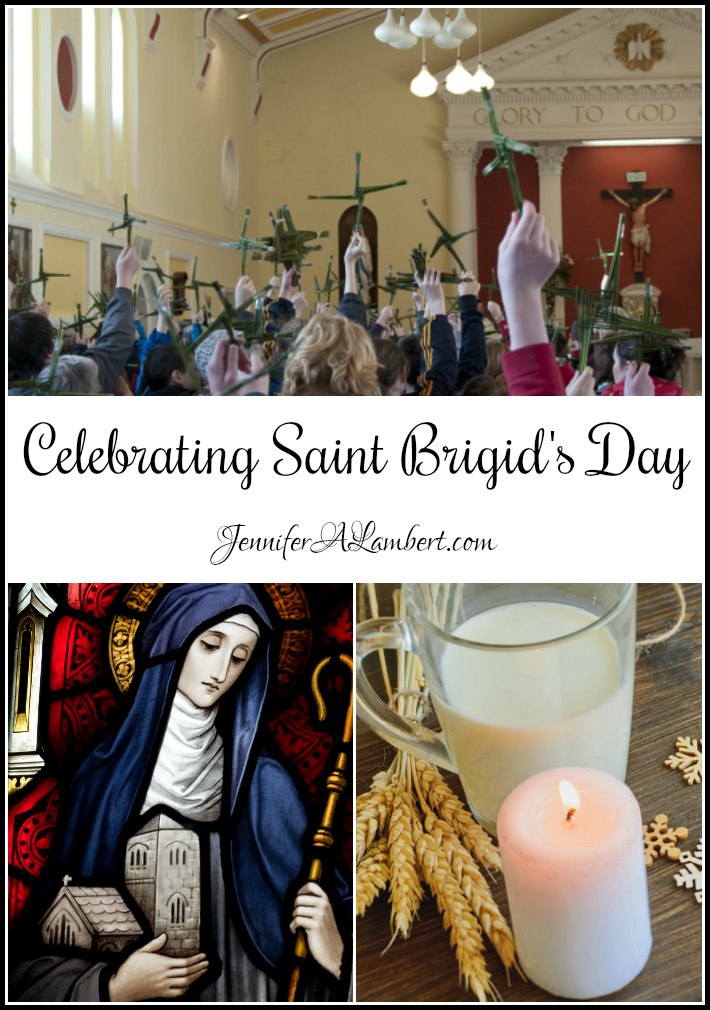
Celebrating Saint Brigid’s Day

This blog may contain affiliate links: disclosure.
Please see my suggested resources.

January 21, 2019 By Jennifer Lambert 11 Comments

Candlemas…Imbolc, the feast day of the Celtic goddess Brigid marks the beginning of spring, celebrates the arrival of longer, warmer days and the early nature signs of spring on February 1.

Born at a liminal time in a liminal place, Brigid is said to have been born on the threshold of a door (neither within or without the house) and at the breaking of dawn (neither day or night). There is ample proof that Brigid is most likely a continuation of the earlier goddess Brigid/ Brigantia who was worshipped in ancient Ireland.

The word Imbolc means “in the belly,” in the old Irish language, referring to the pregnancy of ewes.

Imbolc is one of the four major “fire” festivals (referred to in Irish mythology from medieval Irish texts. The other three festivals on the old Irish calendar are Beltane, Lughnasadh, and Samhain/Halloween).

St. Brigid is the patron saint of babies, blacksmiths, boatmen, cattle farmers, children whose parents are not married, children whose mothers are mistreated by the children’s fathers, Clan Douglas, dairymaids, dairy workers, fugitives, Ireland, Leinster, mariners, midwives, milkmaids, nuns, poets, the poor, poultry farmers, poultry raisers, printing presses, sailors, scholars, travelers, and watermen.

Celebrating Saint Brigid's Day

Celebrating Saint Brigid’s Day

  • Nature walk to look for signs of spring
  • Eat customary Irish foods
  • Read books!
  • Donate to charity or serve others
  • Make Brigid crosses out of straw
  • Visit a farm to learn about the cattle and sheep
  • Leave out scarves for blessings! Known as a “Bratog Bride” in Irish folklore, this special garment can then be used as a cure for headaches or sore throats.

Customs

Brigid would be symbolically invited into the house and a bed would often be made for her and corn dollies made as her representatives. Often a family member, representing Brigid, would circle the home three times carrying rushes. They would then knock the door three times, asking to be let in. On the third attempt they are welcomed in, the meal is had, and the rushes are then made into crosses.

Irish children, especially girls, often dress up in rags and go door to door like trick or treating, chanting:

“Here comes poor Brigid both deaf and blind,

Put your hand in your pocket and give her a coin

If you haven’t a penny, a halfpenny will do

If you haven’t a halfpenny, God bless you.”

One of the earliest references to the St. Brigid’s Cross is from a 1735 poem:

“St. Bridget’s cross hung over door

Which did the house from fire secure

O Gillo thought, O powerfull charm

To keep a house from taking harm;

And tho’ the dogs and servants slept,

By Bridget’s care the house was kept.”

Resources:

  • Recipes for a Feast of Light
  • St. Brigid’s Blessings and Poems from Brigidine Sisters
  • Shower of Roses
  • The Kennedy Adventures
  • PB Grace
  • Coloring Page from Waltzing Matilda
  • Irish Folklore: St. Brigid
  • Fish Eaters: St. Brigid
  • Imbolc Activities and Recipes

Books:

  • The Life of Saint Brigid: Abbess of Kildare by Jane G. Meyer
  • Brother Wolf, Sister Sparrow by Eric A. Kimmel
  • The Story Of Saint Brigid by Caitriona Clarke
  • Brigid and the Butter: A Legend about Saint Brigid of Ireland by Pamela Love
  • Brigid’s Cloak by Bryce Milligan
  • Saint Brigid and the Cows by Eva K. Betz
  • Folk Tales of St. Brigid by Fr. Joseph Irvin
  • Brigid’s Way: Reflections on the Celtic Divine Feminine by Bee Smith
  • Brigid: History, Mystery, and Magick of the Celtic Goddess by Courtney Weber
  • Brigid of Kildare: A Novel by Heather Terrell
  • Brigid: Meeting The Celtic Goddess Of Poetry, Forge, And Healing Well by Morgan Daimler
  • Brigid of Ireland by Cindy Thomson

Spring is just around the corner!

Linking up: Pinch of Joy, House on Silverado, Eclectic Red Barn, Grammy’s Grid, Random Musings, Suburbia, Mostly Blogging, Pam’s Party, Pieced Pastimes Shelbee on the Edge,, My Life Abundant, InstaEncoouragements, LouLou Girls, Ginger Snap Crafts, Fluster Buster, Ridge Haven Homestead, Jenerally Informed, Stroll Thru Life, My Wee Abode, Penny’s Passion, Bijou Life, Artful Mom, Try it Like it, Soaring with Him, Debbie Kitterman, Anchored Abode, Imparting Grace, Slices of Life, OMHG, Modern Monticello, Cottage Market, Answer is Choco, Momfessionals, Lyli Dunbar, CWJ, Hubbard Home, Lauren Sparks, Moment with Franca, Create with Joy,

Share
Pin54
Share
54 Shares
You might also like:

Filed Under: Faith Tagged With: faith, February, folklore, Ireland, saint, spring

Celebrating Epiphany

This blog may contain affiliate links: disclosure.
Please see my suggested resources.

December 31, 2018 By Jennifer Lambert 14 Comments

Three Kings Day or Epiphany or Twelfth Night on January 6 celebrates three events:

  1. the arrival of the Magi, or Three Wise Men, or Three Kings, in Bethlehem to see the child Jesus
  2. the baptism of Jesus
  3. Jesus’ first miracle.

In Germany and other places in Europe, chalk is used to write the initials of the three magi over the doors of churches and homes.

The letters stand for the initials of the Magi (traditionally named Caspar, Melchior, and Balthasar).

Also the phrase Christus mansionem benedicat, which translates as

“May Christ bless the house.”

In Spain, there are processions of the Three Kings through city main streets and big festivals.

In France, they eat lovely almond cake. And in New Orleans, it’s King Cake!

Read more about the extensive world traditions of Epiphany.

We were so happy to finally visit Köln/Cologne to see The Shrine of the Three Kings before we moved back to the States. It’s a beautiful cathedral.

I love this image so much from an old holiday card that I saved it:

We learn about frankincense and myrrh as we read books about the Magi. Reese’s Pieces represent gold so well!

I have our family nativity scene displayed through January 6, and have the magi travel throughout the living room until they reach the Holy Family.

May Christ Bless This House

And Yours.

Celebrating Epiphany

  • Make a King Cake or Galette des Rois
  • Read about Daniel (precursor to the Magi?)
  • Watch The Star (for little ones)
  • Watch The Star of Bethlehem (for older)
  • Put on a funny skit or play
  • Crafts
  • Read books about the Magi
  • Visit, make, or learn about the Nativity scene
  • Listen to Bach
  • Sing carols about the Wise Men (I love We Three Kings of Orient Are)

Activities:

  • Little Blots Printables
  • Paper Chain from First Palette
  • Coloring Page from Christian Preschool Printables
  • Kennedy Adventures
  • Sadlier
  • Wunder-Mom
  • Catholic Inspired
  • Catholic Icing
  • Living Montessori Now

Books:

  • The Legend of Old Befana: An Italian Christmas Story by Tomie dePaola
  • Three Wise Queens: A Story of the Nativity Gifts by James Allen
  • We Three Kings by Gennady Spirin
  • The Visit of the Wise Men by Martha Jander
  • The Other Wise Man by Henry Van Dyke
  • The Christmas Horse and the Three Wise Men by Isabelle Brent
  • Humphrey’s First Christmas by Carol Heyer
  • Home From Bethlehem: A Story of the Wise Men after They Came Home by Ghanda diFiglia
Share
Pin1K
Share
1K Shares
You might also like:

Filed Under: Faith Tagged With: Christmas, Epiphany, faith, saint

Celebrating Saint Lucia’s Day

This blog may contain affiliate links: disclosure.
Please see my suggested resources.

December 10, 2018 By Jennifer Lambert Leave a Comment

We enjoy celebrating holidays from around the world.

St. Lucia’s Day is a lovely celebration for children.

Celebrating Saint Lucia's Day

St. Lucia Day History

The celebration of St. Lucia comes from stories that were told by monks who first brought Christianity to Sweden.

December 13th was also the Winter Solstice, the shortest day of the year, in the old “Julian” calendar and a pagan festival of lights in Sweden was turned into St. Lucia’s Day.

St. Lucia’s Day is celebrated by a girl dressing in a white dress with  red sash and a wreath with candles on her head. Small children use electric candles, but from about 12 years old, real candles are often used. The crown is traditionally made of lingonberry branches which are evergreen and symbolise new life in winter.

A national Lucia is chosen in Sweden every year. Lucias visit hospitals and homes for the elderly, singing a song about St. Lucia and handing out Pepparkakor, ginger biscuits.

Boys might dress up as Stjärngossar (star boys) and small girls might be attendant Tärnor (like Lucia but without the candles).

A popular food eaten at St. Lucia’s day are Lussekatts, buns flavored with saffron and dotted with raisins which are eaten for breakfast.

St. Lucia Crafts and Activities

  • A fun recipe for St. Lucia Cookies
  • Catholic Icing paper dolls
  • St. Lucy Feast Day from Lights and Sweets
  • Felt crowns from JoyFilled Family
  • Lots of activities from The Kennedy Adventures
  • Paper crowns and star hats from Kiddley
  • Swedish holiday books from What Do We Do All Day
  • Arthur episode about St. Lucia on Arthur’s Perfect Christmas

St. Lucia Books

  • Lucia, Saint of Light by Katherine Bolger Hyde 
  • Lucia Morning in Sweden by Ewa Rydaker 
  • Who Are You Santa Lucia? : A timeless journey of inspiration and beauty through the eyes of a brave and kind saint whose legacy empowers us to be a force of good in the word by Glenda Cedarleaf
  • My First Saint Lucia Day Book by Belle Boss

What interesting holidays does your family celebrate?

Share
Pin146
Share
146 Shares
You might also like:

Filed Under: Faith Tagged With: Christmas, faith, saint

Celebrating Martinmas

This blog may contain affiliate links: disclosure.
Please see my suggested resources.

November 11, 2018 By Jennifer Lambert Leave a Comment

St. Martin is the patron saint of beggars, drunkards, and the poor.

His feast day falls during the wine harvest in Europe, he is also the patron saint of wine growers and innkeepers.

In the agricultural calendar it marks the beginning of the natural winter, but in the economic calendar it is seen as the end of autumn. Because it comes before the penitential season of Advent, it is seen as a mini “carnivale,” with feasting and bonfires.

St. Martin’s Feast is much like the American Thanksgiving – a celebration of the earth’s bounty.

Tradition says that if it snows on the feast of St. Martin, November 11, then St. Martin came on a white horse and there will be snow on Christmas day. However, if it doesn’t snow on this day, then St. Martin came on a dark horse and it will not snow on Christmas.

Children often dress up and go around with lanterns as beggars for sweets. Sound like Halloween?

Celebrating Martinmas

How to Celebrate Martinmas

Make a Lantern

I love these examples of homemade lanterns:

  • Shower of Roses
  • Lavender’s Blue Homeschool
  • Frontier Dreams
  • In These Hills
  • Myriad

St. Martin’s Bags

Ġewż, Lewż, Qastan, Tin
Kemm inħobbu lil San Martin.

Walnuts, Almonds, Chestnuts, Figs
I very much love Saint Martin.

Give to the Poor

Donating clothing to the poor is in remembrance of St. Martin cutting his cloak in half for the beggar during a snowstorm.

Pray for Military

St. Martin was a Roman soldier and November 11th is Armistice Day and Veterans Day.

Bonfires

Always festive in autumn.

Foods

Martinmas is the end of fall harvest, so breads and cakes are common.

Pretzels, croissants, and horseshoe-shaped almond sweets represent St. Martin’s white horse.

Goose is often eaten in Germany.

The legend goes that whilst trying to avoid being ordained bishop, St Martin hid in a goose pen only to be betrayed by the squawking of the geese. Around Europe, many people still celebrate Martinmas with roast goose dinners.

Beef is popular in Ireland and the UK.

Rhymes

If the wind is in the south-west on St Martin’s Day (11th), it will stay there right through to Candlemas in February, thus ensuring a mild and snow-free winter.

“Wind north-west at Martinmas, severe winter to come.”

“If ducks do slide at Martinmas
At Christmas they will swim;
If ducks do swim at Martinmas
At Christmas they will slide”

“Thunder in November means winter will be late in coming and going”

“If the geese at Martin’s Day stand on ice, they will walk in mud at Christmas.”

Ice before Martinmas,
Enough to bear a duck.
The rest of winter,
Is sure to be but muck!”

É dia de São Martinho;
comem-se castanhas, prova-se o vinho.
It is St. Martin’s Day,
we’ll eat chestnuts, we’ll taste the wine.

A cada cerdo le llega su San Martín.
Every pig gets its St Martin. The phrase is used to indicate that wrongdoers eventually get their comeuppance.

Martinmas celebrations begin at the eleventh minute of the eleventh hour of this eleventh day of the eleventh month (11:11 am on November 11).

Resources:

  • Martin of Tours: Soldier, Bishop, Saint by Regine Pernoud
  • Sword and the Cape by Pamela Love
  • Snow on Martinmas by Heather Sleightholm
  • Martin of Tours: The shaping of Celtic Christianity by Christopher Donaldson
  • The Life of St Martin of Tours by Suplitius Severus
  • Saint Martin of Tours by Saint Suplitius Serverus
Share
Pin198
Share
198 Shares
You might also like:

Filed Under: Faith Tagged With: faith, fall, folklore, saint

Pentecost Decorations

This blog may contain affiliate links: disclosure.
Please see my suggested resources.

May 20, 2018 By Jennifer Lambert Leave a Comment

Paul offers a theological and ontological foundation for human dignity and human flourishing that is inherent, universal, and indestructible by any evaluation of race, religion, gender, sexuality, nationality, class, education, or social position. He brings a deep new sense of the dignity of every human person, which of course is a social and political revolution and reveals the power of healthy religion. This is unheard of in history up to then—and unrealized even now!

The Acts account of Pentecost goes out of its way to emphasize that people from all over the world heard the Galileans speaking in the pilgrims’ individual languages after the descent of heavenly fire and wind (Acts 2:4-11). At least seventeen nations or groups are listed and “about three thousand persons” from these disparate groups were baptized and received the Holy Spirit that day (Acts 2:38-41). The message is clear: The Spirit of God is clearly and completely democratic, unmerited, and inclusive.

One of the reasons Paul’s teachings had so much influence in Asia Minor was that he restored human dignity at a time when perhaps four out of five people were slaves, women were considered the property of men, temple prostitution was a form of worship, and oppression and wholesale injustice toward the poor and the outsider were the universal norm. Into this corrupt and corrupting empire Paul shouts, “One and the same Spirit was given to us all to drink!” (1 Corinthians 12:13). Paul levels the playing field: “You, all of you, are sons and daughters of God, now clothed in Christ, where there is no distinction between male or female, Greek or Jew, slave or free, but all of you are one in Christ Jesus” (Galatians 3:26-28).

This is quite amazing, considering the culture at the time! In Paul’s estimation, the old world was forever gone and the new world was born. This was impossible and frightening to some people, but utterly attractive and hopeful to the 95% who had little dignity or power in the societies of that time. Recent sociological studies say this explains Paul’s success in a relatively short time, apart from attributing it to the Holy Spirit. Who does not want to be told they are worthy and good?

No longer was the human body a cheap thing, degraded by slavery and abuse. Paul is saying, “You are the very temple of God.” This affirmation of dignity began to turn the whole Roman Empire around. When you read Paul’s teaching on sexuality (1 Corinthians 6:12-20), it really isn’t the moralistic purity code many of us were given. Paul is saying that your body has dignity, so you have a right to demand respect and give respect! Because of this understanding, a woman could claim her own dignity and refuse to give her body away to every man who wanted it. (This probably explains the early admiration of virginity in Christian circles.) A man was told to respect and take responsibility for his body-temple.

This is a positive and dignifying message, not a finger-shaking, moralistic one. It gives the ego appropriate and much needed boundaries. Unfortunately, this morphed into guilt-based boundaries and prohibitions, which seems to happen in most early-stage religion, since humans carry their natural shame in their bodies. We do not see this in either Jesus or Paul, even though we have projected it onto them.

Reference:
Adapted from Richard Rohr, an unpublished talk, February 2015, at the Center for Action and Contemplation. 

I made an altarscape for our church for Pentecost Sunday.

I bought a fire silk and red flameless candles and sprinkled red silk rose petals on the altar.

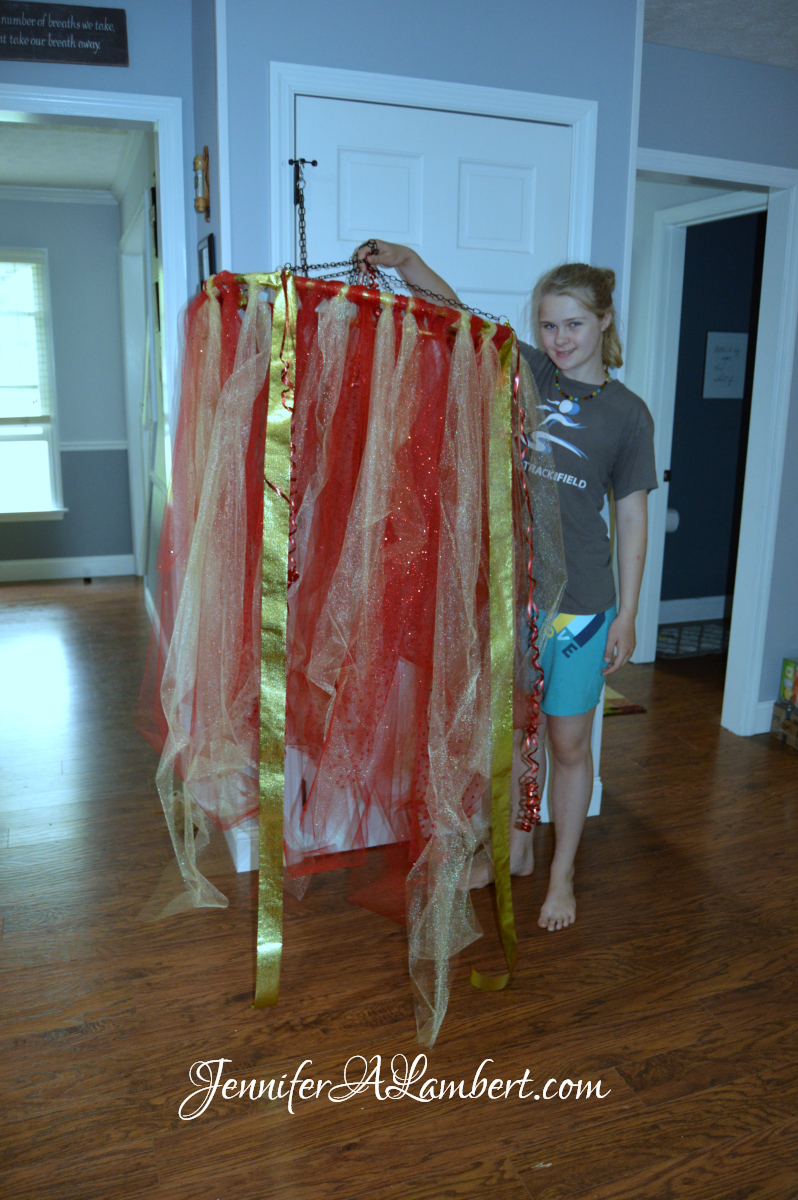
I create a fiery hoop to symbolize the Holy Spirit roof holes of older times.

I printed a card to explain the history and symbolism (see below).

I sewed a red ribbon banner.

I bought a red linen fabric remnant and sewed different red and gold ribbons with bells at the bottom corners.

I added a couple other fun elements.

I got red rose floating candles and a glass bowl and propped it in our baptismal to symbolize a baptism of fire.

I got a flameless candle and Tabasco sauce to symbolize “tongues of fire.”

The Projects:

Fiery Hoop

We drained the hula hoop of water and placed bolts in 4 places to attach a chain.

I wrapped the hoop with gold ribbon.

We knotted tulle strips onto the hoop.

We used several glittery reds, one orange, 2 gold, and 1 glittery yellow.

Glitter was everywhere. It’s still everywhere.

We added curling ribbon in just a few places.

Here’s our almost finished fiery hole.

I added seven cardstock doves on clear thread.

We added the yellow and orange and hung it up in the narthex of our church with a cute little windchime in the middle.

The Banner:

I bought a red linen fabric remnant and several red and gold ribbons.

I cut the ribbons into 3 feet long segments and laid it all out to get an idea.

I hemmed three sides and left an opening for the banner pole and pinned the ribbons and tassels on.

I sewed the ribbon and tassels on by hand and hemmed the sides for the pole so it was neat and tidy.

I use my hair flat iron to even out the seams.

I added some extra tassels and little bells to the corners.

The projects were expensive, always more than I originally think, but the kids and I were blessed in the making and had lots of fun together while creating these and we pray it brightens our church and someone’s Sunday.

Share
Pin1
Share
1 Shares
You might also like:

Filed Under: Faith Tagged With: altarscape, church, diy, homemade

Celebrating Passover

This blog may contain affiliate links: disclosure.
Please see my suggested resources.

March 29, 2018 By Jennifer Lambert 1 Comment

We started new traditions when we began learning about the Biblical feasts and Bible history during our Year 1 Tapestry of Grace studies. Back in 2011.

It’s become an annual tradition, along with our celebrating Hanukkah every December.

We enjoy the Pesach Seder ceremony and have a lovely lamb or brisket or roast poultry dinner.

Sometimes, Passover coincides with Easter and the holidays are combined for us, but other times, we celebrate the feasts on their designated days. 

The Jewish calendar is lunar while the Gregorian calendar is solar.

A simple Seder setup

We read from the Bible, Lenten books, and the Haggadah.

We added crafts and learning activities as the kids grew older and understood more.

We are not Jewish. We do our best to be very respectful of the culture and religion while learning.

Our entire church celebrated a Seder one year.

Each family or group at a table decorated how they wished.

We used our best china, olive wood candlesticks from Israel, and my Lenten cross candle holder.

Some years, we go more casual and simple, and other years we try to make it a fancier occasion.

Over the years, I have purchased a Messianic Seder plate and Kiddush cup with matching candlesticks. I plan to add to our collection with a matzah tray and cover soon.

I recently acquired a Miriam Cup.

What is Passover?

Passover, or Pesach in Hebrew, is an eight-day spring holiday that celebrates the Israelites’ exodus from Egypt.

The main ritual of Passover is the seder, a planned meal held on the first evening of the holiday. The seder is designed to provoke the Four Questions from children and to provide an opportunity for telling the story of how the Israelites were redeemed from slavery and given the gift of the Torah (the first 5 books of the Bible).

A number of symbolic foods are laid out on the seder table, including karpas (parsley with salt water or vinegar – represents the hyssop used to apply blood over the door lintels), beitzah (an egg usually roasted, but we often hard boil ours), matzah (unleavened bread), the maror (bitter herb) with salt water (tears), charoset (apples with wine and honey  – a favorite! – symbolizing mortar for bricks), and the lamb shankbone, which commemorates the Paschal sacrifice that was offered in the Temple. Sometimes an orange is included to show sweet welcome to strangers.

The four cups of wine at Passover are an integral part of the Passover celebration.

These four cups of wine represent the four promises the Lord makes to His people in Exodus 6:6-7.

The Cup of Sanctification: “I will bring you out from under the burdens of the Egyptians.”

The Cup of Deliverance: “I will rescue you from their bondage.”

The Cup of Redemption: “I will redeem you with an outstretched arm.”

The Cup of Praise: “I will take you as My people.”

The ministry of Messiah speaks to each of these four promises:

Messiah sanctifies us – “And for their sakes I sanctify Myself, that they also may be sanctified by the truth” (John 17:19).

Messiah delivers us – “And you shall know the truth, and the truth shall make you free” (John 8:32).

Messiah redeems us – “But when the fullness of the time had come, God sent forth His Son, born of a woman, born under the law, to redeem those who were under the law, that we might receive the adoption as sons” (Galatians 4:4-5).

Messiah is our joy – “These things I have spoken to you, that My joy may remain in you, and that your joy may be full” (John 15:11).

The Cup of Elijah is a fifth cup of wine, left undrunk, as we open the door to invite the prophet in. Read more about this tradition here. Should we include this in a Messianic Seder? Perhaps this could represent hope and the will of God on earth as it is in heaven.

Miriam’s Cup represents the strong history of women and holds water, serving as a symbol of Miriam’s Well, which was the source of water for the Israelites in the desert. Putting a Miriam’s Cup on your table is a way of making your seder more inclusive. Read more about this new tradition here.

The seder follows a script laid out in the haggadah, a book that tells the story of the Hebrews’ redemption from Egypt.

Resources:

  • The Maccabeats music
  • Passover Playlist
  • The Passover Story of the Four Sons…Video Haggadah For Your Seder!
  • Hebrew 4 Christians
  • The Four Questions
  • The Longest Night

Recipes from Kosher.com

  • Roasted Tomato Soup
  • Hush Puppy Potato Knishes
  • Zucchini Meat Pizza Bites
  • Potato-Crust Meat Pizza
  • Potato Latke Schnitzel
  • Pulled Beef and Gravy Fries
  • Sweet Potato Tots
  • Pesach Blondies
  • Gluten Free Apple Cinnamon Crumb Muffins

Books:

  • Chaveirim Kol Yisraeil: In The Fellowship of All Israel; a Project of The Progressive Chavurah Siddur Committee of Boston
  • My First Passover by Tomie De Paola
  • It’s Passover, Grover! by Jodie Shepherd
  • Ella and Noah celebrate Passover: sticker activity book 
  • My First Haggadah: Fun Seder Service For Children
  • Chad Gadya – Passover Story: About One Little Goat… by Rachel Minz

Do you celebrate Passover?

Share
Pin18
Share
18 Shares
You might also like:

Filed Under: Faith Tagged With: Easter, faith, history, Passover, Pesach

  • « Previous Page
  • 1
  • 2
  • 3
  • 4
  • 5
  • 6
  • …
  • 12
  • Next Page »
Suggested ResourcesCheckout 51NotebookingPages.com LIFETIME Membership

Archives

Popular Posts

10 DIY Gifts with Essential Oils10 DIY Gifts with Essential Oils
Natural Remedies for HeadacheNatural Remedies for Headache
10 Natural Remedies to Keep on Hand10 Natural Remedies to Keep on Hand
Henna Hands CraftHenna Hands Craft
Homemade Turkey Divan CasseroleHomemade Turkey Divan Casserole
This website uses cookies to improve your experience. We'll assume you're ok with this, but you can opt-out if you wish.Accept Reject Read More
Privacy & Cookies Policy

Privacy Overview

This website uses cookies to improve your experience while you navigate through the website. Out of these, the cookies that are categorized as necessary are stored on your browser as they are essential for the working of basic functionalities of the website. We also use third-party cookies that help us analyze and understand how you use this website. These cookies will be stored in your browser only with your consent. You also have the option to opt-out of these cookies. But opting out of some of these cookies may affect your browsing experience.
Necessary
Always Enabled
Necessary cookies are absolutely essential for the website to function properly. This category only includes cookies that ensures basic functionalities and security features of the website. These cookies do not store any personal information.
Non-necessary
Any cookies that may not be particularly necessary for the website to function and is used specifically to collect user personal data via analytics, ads, other embedded contents are termed as non-necessary cookies. It is mandatory to procure user consent prior to running these cookies on your website.
SAVE & ACCEPT