Jennifer Lambert

A Sacred Balance

Visit Us On FacebookVisit Us On PinterestVisit Us On InstagramVisit Us On Linkedin
  • Homeschool
    • Book Lists
    • How Do We Do That?
    • Notebooking
    • Subjects and Styles
    • Unit Studies
  • Travel
    • Europe
      • Benelux
      • France
      • Germany
      • Greece
      • Ireland
      • Italy
      • London
      • Porto
      • Prague
    • USA
      • Chicago
      • Georgia
      • Hawaii
      • Ohio
      • Utah
      • Yellowstone and Teton
  • Family
    • Celebrations
    • Frugal
  • Military Life
    • Deployment
    • PCS
  • Health
    • Recipes
    • Essential Oils
    • Fitness
    • Mental Health
    • Natural Living
    • Natural Beauty
  • Faith
  • About Me
    • Favorite Resources
    • Advertising and Sponsorship
    • Policies
  • Reviews

© 2025Jennifer Lambert · Copyright · Disclosure · Privacy · Ad

The Power of Now Chapter Six

This blog may contain affiliate links: disclosure.
Please see my suggested resources.

March 25, 2022 By Jennifer Lambert Leave a Comment

This chapter was short, but full of insight.

Many readers seem to struggle with this chapter and I think I know some reasons why.

As a recovering Christian, I had issues with some of the church teachings to deny the body and feelings. I am a very sensitive feeling individual and I felt betrayed having to stifle my innermost feelings as sinful or wrong. I learned to mistrust my gut intuition and that made me soul-sick.

I love how Eckart Tolle encourages us to feel our inner body and trust our inner Being.

This chapter recalled me to the teachings, writings, videos, and sessions of Joe Dispenza.

I think many of us fear what we don’t know or what we’ve been taught to believe as magic, witchcraft, new age, or otherwise false teachers. Some of what is out there is misinformation for sure. Some is oversimplified. If it doesn’t work for everyone all the time in the same way, then it is the teacher’s fault and surely not the student’s.

Western society wants quick fixes, instant gratification. But the irony is that we fear anything that seems too simplistic. Surely we must run a gauntlet to be healed? Surely we can’t just dip in the river seven times? That seems silly.

I love the idea that if we are connected to Inner Being, we can heal ourselves and stay young longer. I certainly can see this for people who have a glow and seem to exude positive energy vs. those who are negative and just look gray and haggard. My parents are very bitter people and have always seems old to me. I’ve known others their same age who look and seem decades younger.
Chapter Six: The Inner Body

Favorite quotes from this chapter:

Being can be felt as the ever-present I am that is beyond name and form. To feel and thus to know that you are and to abide in that deeply rooted state is enlightenment, is the truth that Jesus says will make you free.

This “illusion of the self,” as the Buddha calls it, is the core error. Free from fear in its countless disguises as the inevitable consequence of that illusion — the fear that is your constant tormentor as long as you derive your sense of self only from this ephemeral and vulnerable form. And free from sin, which is the suffering you unconsciously inflict on yourself and others as long as this illusory sense of self governs what you think, say, and do.

It is not a question of guilt. But as long as you are run by the egoic mind, you are part of the collective insanity.

You cannot stop thinking. Compulsive thinking has become a collective disease. Your whole sense of who you are is then derived from mind activity.

Why have so few seekers become finders?

Transformation is through the body, not away from it.

All spiritual teachings originate from the same Source.

As long as you are in conscious contact with your inner body, you are like a tree that is deeply rooted in the earth, or a building with a deep and solid foundation. The latter analogy is used by Jesus in the generally misunderstood parable of the two men who build a house. One man builds it on the sand, without a foundation, and when the storms and floods come, the house is swept away. The other man digs deep until he reaches the rock, then builds his house, which is not swept away by the floods.

Attention does not mean that you start thinking about it. It means to just observe the emotion, to feel it fully, and so to acknowledge and accept it as it is.

Non-forgiveness is often toward another person or yourself, but it may just as well be toward any situation or condition — past, present, or future — that your mind refuses to accept. Yes, there can be nonforgiveness even with regard to the future. This is the mind’s refusal to accept uncertainty, to accept that the future is ultimately beyond its control.

Forgiveness is to offer no resistance to life — to allow life to live through you.

The moment you truly forgive, you have reclaimed your power from the mind.

Feeling will get you closer to the truth of who you are than thinking.

If you are twenty years old now, the energy field of your inner body will feel just the same when you are eighty. It will be just as vibrantly alive.

As there is more consciousness in the body, its molecular structure actually becomes less dense. More consciousness means a lessening of the illusion of materiality.

Most illnesses creep in when you are not present in the body.

When you are unoccupied for a few minutes, and especially last thing at night before falling asleep and first thing in the morning before getting up, “flood” your body with consciousness. Close your eyes. Lie flat on your back. Choose different parts of your body to focus your attention on briefly at first: hands, feet, arms, legs, abdomen, chest, head, and so on. Feel the life energy inside those parts as intensely as you can. Stay with each part for fifteen seconds or so. Then let your attention run through the body like a wave a few times, from feet to head and back again. This need only take a minute or so. After that, feel the inner body in its totality, as a single field of energy. Hold that feeling for a few minutes. Be intensely present during that time, present in every cell of your body. Don’t be concerned if the mind occasionally succeeds in drawing your attention out of the body and you lose yourself in some thought. As soon as you notice that this has happened, just return your attention to the inner body.

Conscious breathing, which is a powerful meditation in its own right, will gradually put you in touch with the body.

We could say: don’t just think with your head, think with your whole body.

When listening to another person, don’t just listen with your mind, listen with your whole body. Feel the energy field of your inner body as you listen. That takes attention away from thinking and creates a still space that enables you to truly listen without the mind interfering. You are giving the other person space — space to be. It is the most precious gift you can give. Most people don’t know how to listen because the major part of their attention is taken up by thinking. They pay more attention to that than to what the other person is saying, and none at all to what really matters: the Being of the other person underneath the words and the mind. Of course, you cannot feel someone else’s Being except through your own. This is the beginning of the realization of oneness, which is love. At the deepest level of Being, you are one with all that is.

Most human relationships consist mainly of minds interacting with each other, not of human beings communicating, being in communion.

We are all connected. We all have Inner Being.

You might also like:

  • Chapter One
  • Chapter Two
  • Chapter Three
  • Chapter Four
  • Chapter Five
Share
Pin
Share
0 Shares
You might also like:

Filed Under: Faith

The Power of Now Chapter Five

This blog may contain affiliate links: disclosure.
Please see my suggested resources.

March 18, 2022 By Jennifer Lambert Leave a Comment

This week, I read chapter five of The Power of Now.

Many years ago, I remember trying to formulate words to ask an intelligent question to a well-respected Christian homeschool author and teacher and mentor. I began with: “Can we ever reach that point…” but she didn’t even allow me time to explain what I was thinking before she cut me off with “NO!” I remember feeling humiliated.

What I was feeling was “Is there hope? Will there ever be time, even a moment when I am at peace?”

And this spiritual elder told me no.

I wrote briefly about seeking that confidence in faith here.

That was the beginning of the end for me with that side of American evangelical Christianity. I always knew deep down in my soul that there was something more, something different than what was shallowly preached from pulpits and Sunday school by mediocre white men and women.

I began reading and seeking and trusting my inner self for guidance toward Being. I have come such a long way and it’s so encouraging to find like-minded spiritual siblings and elders who don’t just dismiss what they will never understand.

Chapter Five: The State of Presence

Favorite quotes:

What is the power of Now? None other than the power of your presence, your consciousness liberated from thought forms.

“Be like a servant waiting for the return of the master,” says Jesus. The servant does not know at what hour the master is going to come. So he stays awake, alert, poised, still, lest he miss the master’s arrival. In another parable, Jesus speaks of the five careless (unconscious) women who do not have enough oil (consciousness) to keep their lamps burning (stay present) and so miss the bridegroom (the Now) and don’t get to the wedding feast (enlightenment). These five stand in contrast to the five wise women who have enough oil (stay conscious).

Even the men who wrote the Gospels did not understand the meaning of these parables, so the first misinterpretations and distortions crept in as they were written down. With subsequent erroneous interpretations, the real meaning was completely lost. These are parables not about the end of the world but about the end of psychological time. They point to the transcendence of the egoic mind and the possibility of living in an entirely new state of consciousness.

Presence is needed to become aware of the beauty, the majesty, the sacredness of nature.

To become aware of such things, the mind needs to be still. You have to put down for a moment your personal baggage of problems, of past and future, as well as all your knowledge; otherwise, you will see but not see, hear but not hear. Your total presence is required.

Because we live in such a mind-dominated culture, most modern art, architecture, music, and literature are devoid of beauty, of inner essence, with very few exceptions. The reason is that the people who create those things cannot — even for a moment — free themselves from their mind.

Since Being, consciousness, and life are synonymous, we could say that presence means consciousness becoming conscious of itself, or life attaining self-consciousness.

Everything that exists has Being, has God-essence, has some degree of consciousness.

The parable [of the Prodigal Son] describes a journey from unconscious perfection, through apparent imperfection and “evil” to conscious perfection.

Through you, consciousness is awakening out of its dream of identification with form and withdrawing from form. This foreshadows, but is already part of, an event that is probably still in the distant future as far as chronological time is concerned. The event is called — the end of the world.

The collective egoic mind is the most dangerously insane and destructive entity ever to inhabit this planet. What do you think will happen on this planet if human consciousness remains unchanged?

If it weren’t for alcohol, tranquilizers, antidepressants, as well as the illegal drugs, which are all consumed in vast quantities, the insanity of the human mind would become even more glaringly obvious than it is already. I believe that, if deprived of their drugs, a large part of the population would become a danger to themselves and others. These drugs, of course, simply keep you stuck in dysfunction. Their widespread use only delays the breakdown of the old mind structures and the emergence of higher consciousness. While individual users may get some relief from the daily torture inflicted on them by their minds, they are prevented from generating enough conscious presence to rise above thought and so find true liberation.

Christ is your God-essence or the Self, as it is sometimes called in the East. The only difference between Christ and presence is that Christ refers to your indwelling divinity regardless of whether you are conscious of it or not, whereas presence means your awakened divinity or God-essence.

Jesus attempted to convey directly, not through discursive thought, the meaning of presence, of self-realization.

The “second coming” of Christ is a transformation of human consciousness, a shift from time to presence, from thinking to pure consciousness, not the arrival of some man or woman.

If “Christ” were to return tomorrow in some externalized form, what could he or she possibly say to you other than this: “I am the Truth. I am divine presence. I am eternal life. I am within you. I am here. I am Now.”

Avatars, divine mothers, enlightened masters, the very few that are real, are not special as persons. Without a false self to uphold, defend, and feed, they are more simple, more ordinary than the ordinary man or woman. Anyone with a strong ego would regard them as insignificant or, more likely, not see them at all.

Egos are drawn to bigger egos. Darkness cannot recognize light. Only light can recognize light.

I love that I can glimpse The Now and Being more and more as I mature in my faith.

I love experiencing the Holy in Nature. I love that still quietness that settles my mind and relieves my stresses of everyday life.

I love watching my children in awe. I made them yet they are their own Selves.

I love that soul swell when someone is kind and I can return that kindness.

I am proud to be Insignificant and less and less Ego as I turn toward the Light.

Share
Pin
Share
0 Shares
You might also like:

Filed Under: Faith

The Power of Now Chapter Four

This blog may contain affiliate links: disclosure.
Please see my suggested resources.

March 4, 2022 By Jennifer Lambert Leave a Comment

This is a season of stresses, so many ups and downs.

I find it difficult to sit and be still and not worry about the future or regret the past.

What’s the difference between change and transformation?

Many of us make new year’s resolutions or go to therapy, hoping to change our habits. But that’s just conditioning and often doesn’t stick beyond a few weeks.

Then there’s inner transformation and it’s really much more difficult. There seems to be a lot of resistance to real metamorphosis.

I feel bombarded by outside influences all the time, every day. It takes so much effort to quiet my mind and realize that so much conflict is not about me, I shouldn’t take it personally. While I have responsibilities and duty, I know I must take time to meditate for renewal and self-care to protect myself so I can continue to serve my family.

Chapter Four: Mind Strategies for Avoiding the Now

Favorite quotes:

To be free of time is to be free of the psychological need of past for your identity and future for your fulfillment.

Most humans alternate not between consciousness and unconsciousness but only between different levels of unconsciousness.

What I call ordinary unconsciousness means being identified with your thought processes and emotions, your reactions, desires, and aversions. It is most people’s normal state. In that state, you are run by the egoic mind, and you are unaware of Being. It is a state not of acute pain or unhappiness but of an almost continuous low level of unease, discontent, boredom, or nervousness — a kind of background static.

In ordinary unconsciousness, habitual resistance to or denial of what is creates the unease and discontent that most people accept as normal living.

Why are you always anxious? Jesus asked his disciples. “Can anxious thought add a single day to your life?” And the Buddha taught that the root of suffering is to be found in our constant wanting and craving.

Resistance to the Now as a collective dysfunction is intrinsically connected to loss of awareness of Being and forms the basis of our dehumanized industrial civilization.

This collective dysfunction has created a very unhappy and extraordinarily violent civilization that has become a threat not only to itself but also to all life on the planet.

Make it a habit to monitor your mental-emotional state through self-observation. “Am I at ease at this moment?” is a good question to ask yourself frequently. Or you can ask: “What’s going on inside me at this moment?” Be at least as interested in what goes on inside you as what happens outside. If you get the inside right, the outside will fall into place. Primary reality is within, secondary reality without.

The pollution of the planet is only an outward reflection of an inner psychic pollution: millions of unconscious individuals not taking responsibility for their inner space.

If you had a choice, or realized that you do have a choice, would you choose suffering or joy, ease or unease, peace or conflict? Would you choose a thought or feeling that cuts you off from your natural state of well-being, the joy of life within?

it is certainly true that when you accept your resentment, moodiness, anger, and so on, you are no longer forced to act them out blindly, and you are less likely to project them onto others.

To complain is always nonacceptance of what is. When you complain, you make yourself into a victim. When you speak out, you are in your power. So change the situation by taking action or by speaking out if necessary or possible; leave the situation or accept it.

Are you resisting your here and now? Some people would always rather be somewhere else. Their “here” is never good enough. If you find your here and now intolerable and it makes you unhappy, you have three options: remove yourself from the situation, change it, or accept it totally. If you want to take responsibility for your life, you must choose one of those three options, and you must choose now. Then accept the consequences. No excuses.

Surrender is not weakness. There is great strength in it. Only a surrendered person has spiritual power.

Stress is caused by being “here” but wanting to be “there,” or being in the present but wanting to be in the future.

Is your goal taking up so much of your attention that you reduce the present moment to a means to an end? Is it taking the joy out of your doing? Are you waiting to start living?

Your life’s journey has an outer purpose and an inner purpose. The outer purpose is to arrive at your goal or destination, to accomplish what you set out to do, to achieve this or that, which, of course, implies future…the journey’s inner purpose, which has nothing to do with where you are going or what you are doing, but everything to do with how.

What is the power of Now? None other than the power of your presence, your consciousness liberated from thought forms.

We don’t have to live with excuses.

We can have freedom from unhappiness.

It’s interesting to read this book through the lens of Christianity and with the axioms of all Jesus taught, along with all the knowledge I’ve gleaned from other religious texts and teachers through the years.

There’s nothing really new in this book. It repeats and quotes and emphasizes the same concepts that have been known by spiritual masters for centuries. But I love the format and simplicity.

I am also reminded by the teachings of Richard Rohr in the two halves of life in Falling Upward. In the first half, we are often constrained by rules and outside influences. In the second half, we become more mature, more open-minded, and more able to listen to that inner stillness or be in The Now.

I am realizing more and more as I get older. I turn 46 next week! I am encouraging my teens not to sweat the small stuff. Everything is a crisis to young people! I realize how it feels to them, but that it won’t really matter in the long run. It’s a delicate balance to respect their feelings while trying to guide them into The Now.

We can escape the background static of perpetual discontent.

Other posts:

  • Week One
  • Week Two
  • Week Three
Share
Pin
Share
0 Shares
You might also like:

Filed Under: Faith

The Power of Now Chapter Three

This blog may contain affiliate links: disclosure.
Please see my suggested resources.

February 25, 2022 By Jennifer Lambert Leave a Comment

The news has been bad this week.

I realize how difficult these lessons of living in The Now are when circumstances try to invade.

I am constantly seeking balance and trying to rest in between our busy schedule and obligations.

Chapter Three: Moving Deeply into the Now

My favorite quotes:

You have already understood the basic mechanics of the unconscious state: identification with the mind, which creates a false self, the ego, as a substitute for your true self rooted in Being. You become as a “branch cut off from the vine,” as Jesus puts it.

Here is the key: End the delusion of time. Time and mind are inseparable. Remove time from the mind and it stops — unless you choose to use it.

What you think of as the past is a memory trace, stored in the mind, of a former Now. The future is an imagined Now, a projection of the mind. When the future comes, it comes as the Now.

The reason why some people love to engage in dangerous activities, such as mountain climbing, car racing, and so on, although they may not be aware of it, is that it forces them into the Now — that intensely alive state that is free of time, free of problems, free of thinking, free of the burden of the personality.

Since ancient times, spiritual masters of all traditions have pointed to the Now as the key to the spiritual dimension. Despite this, it seems to have remained a secret. It is certainly not taught in churches and temples. If you go to a church, you may hear readings from the Gospels such as “Take no thought for the morrow; for the morrow shall take thought for the things of itself,” or “Nobody who puts his hands to the plow and looks back is fit for the Kingdom of God.” Or you might hear the passage about the beautiful flowers that are not anxious about tomorrow but live with ease in the timeless Now and are provided for abundantly by God. The depth and radical nature of these teachings are not recognized. No one seems to realize that they are meant to be lived and so bring about a profound inner transformation.

Meister Eckhart, the thirteenth-century spiritual teacher, summed it all up beautifully: “Time is what keeps the light from reaching us. There is no greater obstacle to God than time.”

The mind cannot know the tree. It can only know facts or information about the tree. My mind cannot know you, only labels, judgments, facts, and opinions about you. Being alone knows directly. There is a place for mind and mind knowledge. It is in the practical realm of day-to-day living.

Most people find it difficult to believe that a state of consciousness totally free of all negativity is possible. And yet this is the liberated state to which all spiritual teachings point. It is the promise of salvation, not in an illusory future but right here and now.

In the Bhagavad Gita, one of the oldest and most beautiful spiritual teachings in existence, nonattachment to the fruit of your action is called Karma Yoga. It is described as the path of “consecrated action.”

I feel that I need to shift my goals and focus while quieting my mind and narrowing my path to this moment.

I am impressed by the idea of psychological time and real time. This makes such sense to me and now I have a way to express what my soul knew.

It’s been a rough week with the news and my child recently broke their leg and had ankle surgery. I don’t like feeling rushed or stressed or bound by real time in stressful ways and I have felt all of that recently. I haven’t had my downtime as much as I would like. I have found it difficult to focus and be aware. I have felt unbalanced and it’s been hard to just accept circumstances. I want to fix it and heal my child and fast forward to summer.

Other posts:

  • Week One
  • Week Two
Share
Pin
Share
0 Shares
You might also like:

Filed Under: Faith

The Power of Now Chapter Two

This blog may contain affiliate links: disclosure.
Please see my suggested resources.

February 18, 2022 By Jennifer Lambert Leave a Comment

I’ve had a chance this week to really start putting into practice: Living in the Now.

My 14 year old broke their leg and tore the ankle ligaments at ice skating lesson and it’s been a rough time. So many doctors. Surgery scheduled. And so much disappointment with canceled events. It will be a long road to healing.

It’s been an emotional rollercoaster.

I have had to stop many times to take deep breaths and sit with my emotions and realize I am not in control. I could not prevent or change events and I shouldn’t worry about the future.

I don’t like being busy or feeling rushed.

This week is a lot of appointments and scrambling to work out schedules to accommodate the doctors visits. I have to make sure my other daughter gets to and from work and gymnastics and my son gets to baseball practices.

Chapter Two – Consciousness: The Way Out of Pain

Of course we all want to avoid pain, but sometimes it seems unavoidable.

I have to stop multiple times this week to realize that I am not in control.

What happened happened and there’s nothing I can do to change that.

I can and should control my thoughts and use my mind as a tool when needed, but I shouldn’t let it overwhelm me and cause anxiety.

Not to be able to stop thinking is a dreadful affliction, but we don’t realize this because almost everybody is suffering from it, so it is considered normal.

Eckhart Tolle

Being still or quieting the mind is a lesson in almost every world religion, faith, spiritual practice. It’s not easy or widely taught.

I am trying to learn this concept of inner stillness so I can better help my children be spiritually healthy.

Pleasure is always derived from something outside you, whereas joy arises from within.

Eckhart Tolle

I think Western society has its priorities all wrong. And the Western church perpetuates those values and projects those worldly ideas on to Jesus, who never taught those concepts.

We are all seeking wholeness, but we don’t really know how to achieve that.

This is the esoteric meaning of the ancient art of alchemy: the transmutation of base metal into gold, of suffering into consciousness. The split within is healed, and you become whole again. Your responsibility then is not to create further pain.

Eckhart Tolle

Our society is so, so sick and it’s odd for anyone to be truly healthy and happy.

In John 5:6, Jesus asked: “Do you want to get well?”

If you have lived closely identified with your emotional pain-body for most of your life and the whole or a large part of your sense of self is invested in it. What this means is that you have made an unhappy self out of your pain-body and believe that this mind-made fiction is who you are.

Eckhart Tolle

The biggest lie of the world is FEAR. Knowing everyone is living in fear helps me to have compassion instead of retaliating or being angry.

The number of people who have gone beyond mind is as yet extremely small, so you can assume that virtually everyone you meet or know lives in a state of fear.

Eckhart Tolle

Many faith traditions and spiritual practices have a concept of “death to ego” leading to enlightenment.

It’s really hard to relinquish ego and live in the now with responsibilities as a parent.

In the next chapter, we move more deeply into The Now.

Share
Pin
Share
0 Shares
You might also like:

Filed Under: Faith

The Power of Now Online Book Club

This blog may contain affiliate links: disclosure.
Please see my suggested resources.

February 6, 2022 By Jennifer Lambert 2 Comments

I’m sharing information about an online book club I’m participating in.

These posts will be to help keep me accountable and give a place for me to take my notes and share if you want to follow along.

The Power of Now Book Club

Week #1: Introduction and Chapter One: You Are Not Your Mind

Maybe as you read you can take notes or highlight anything you might be drawn to in the journal or a notebook.

You could consider questions like the following:

1. What do you think about the title and subtitle of this book?

The title is simple. While it can be interpreted differently by people on various spiritual paths, it’s pretty straightforward and encompasses most religions while trying not to alienate anyone.

2. Will you be able to read this with an open mind, and read over things that might seem to be at odds with your current beliefs?

Oh, I am very open-minded and eager to learn and relearn what western society and mainstream religion has taught.

3. What in this first section resonates with you?

I like the format of the information with some Q&A from the editor. The language is simple and easy to understand. It is broad enough that it shouldn’t offend any religion. I love Tolle’s use of Being as a benign word for Creator or God.

It struck me that Tolle skimmed the idea that western society values of rushing and worrying about time with our collective and personal trauma history seem to explain a lot of physical and mental illness in our bodies. I hope he explores more of this later.

Tolle uses the term “watching the thinker” to disidentify from our busy minds. He says compulsive thinking can be an addiction. Did he just explain away anxiety and depression?

I feel we as a society are in constant pain, fear, and anger. If we learned to identify the causes of those feelings, sit with them, learn from them, and heal them, we could really advance towards love, peace, and joy.

I highlighted many sections to review for later.

4. What in this first section creates an object of aversion for you?

I didn’t have any real aversions. I had to reread some parts to make sure I understood. This is not easy or narrative material. It’s a spiritual study and I feel I could reread it often and get more from it each time.

I don’t feel there is anything especially new in this first chapter. I have read extensively and this echoes many other authors and spiritual teachers.

5. Tolle says at the end of this first section, “You also realize that all the things that truly matter – beauty, love, creativity, joy, inner peace – arise from beyond your mind. You begin to awaken.” Is this something that you have ever experienced in any way before personally?

I am slowly realizing the significant spiritual aspects of living more and more. For the past ten years have been a breaking down and rebuilding of my values and I feel I am gravitating toward more spiritual maturity.

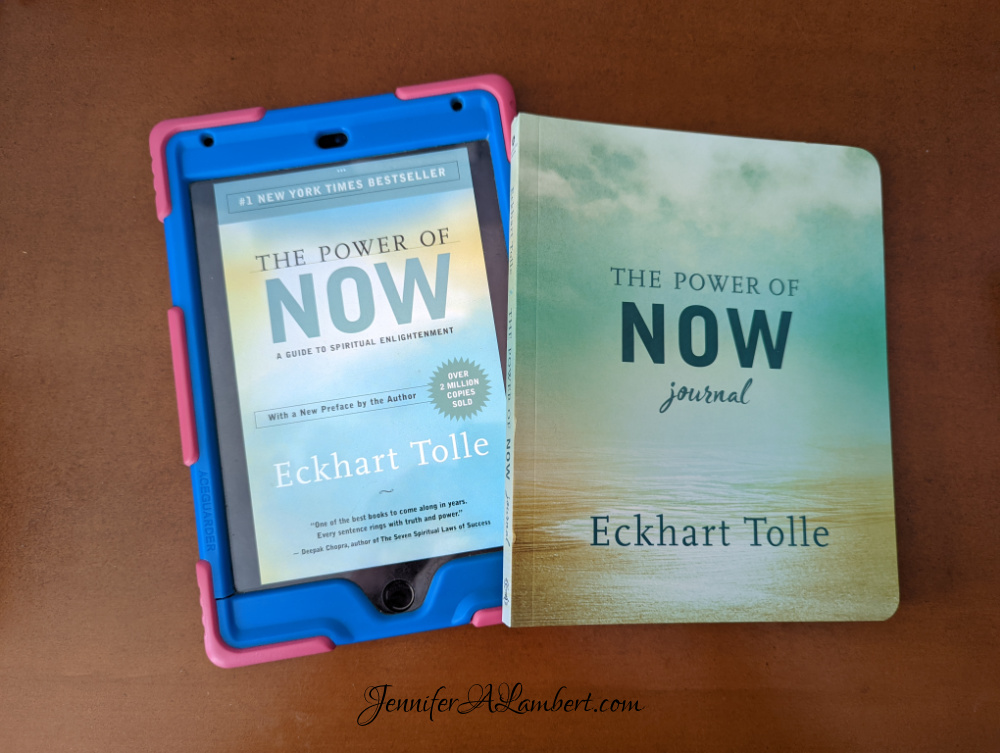
The Power of Now: A Guide to Spiritual Enlightenment by Eckhart Tolle

Summary:

To make the journey into the Now we will need to leave our analytical mind and its false created self, the ego, behind. From the very first page of Eckhart Tolle’s extraordinary book, we move rapidly into a significantly higher altitude where we breathe a lighter air. We become connected to the indestructible essence of our Being, “The eternal, ever present One Life beyond the myriad forms of life that are subject to birth and death.” Although the journey is challenging, Eckhart Tolle uses simple language and an easy question and answer format to guide us.

A word of mouth phenomenon since its first publication, The Power of Now is one of those rare books with the power to create an experience in readers, one that can radically change their lives for the better.

Read an excerpt from the book here.

Also available: Practicing the Power of Now: Essential Teachings, Meditations, and Exercises from the Power of Now and The Power of Now Journal

Click here

About the Author:

Eckhart Tolle is widely recognized as one of the most inspiring and visionary spiritual teachers in the world today. With his international bestsellers, The Power of Now and A New Earth—translated into 52 languages—he has introduced millions to the joy and freedom of living life in the present moment. The New York Times has described him as “the most popular spiritual author in the United States,” and in 2011, Watkins Review named him “the most spiritually influential person in the world”.

Eckhart’s profound, yet simple teachings have helped countless people around the globe experience a state of vibrantly alive inner peace in their daily lives. His teachings focus on the significance and power of Presence, the awakened state of consciousness, which transcends ego and discursive thinking. Eckhart sees this awakening as the essential next step in human evolution.

Eckhart Tolle also has many educational and inspirational videos on YouTube.

You might also like:

  • You Are Here: Discovering the Magic of the Present Moment by Thich Nhat Hanh 
  • The Naked Now: Learning to See as the Mystics See by Richard Rohr
  • Living Beautifully: with Uncertainty and Change by Pema Chödrön
  • Walking Each Other Home: Conversations on Loving and Dying by Ram Dass
  • The Body Keeps the Score: Brain, Mind, and Body in the Healing of Trauma by Bessel van der Kolk
  • Gabor Maté

Comment your thoughts about the book!

Share
Pin16
Share
16 Shares
You might also like:

Filed Under: Faith

Have Hope

This blog may contain affiliate links: disclosure.
Please see my suggested resources.

December 13, 2021 By Jennifer Lambert 16 Comments

As a new year approaches, I linger over memories of the past two years. Good and bad and ugly.

Isolation, fear, rage.

Pandemic.

I am torn between the toxic positivity of some writers and the loathsome depression and anxiety, the futility of others.

It’s been hard for some of us. Hard to stay and feel safe. Hard to make decisions. Hard to weigh risks. Hard to hope.

I don’t have any trite resolutions to offer this new year.

I have some changes I need and want to make in myself, in my family, in my home. I want systemic changes in our society, government, schools.


Hope
Smiles from the threshold of the year to come,
Whispering 'it will be happier'...
~The Foresters by Alfred, Lord Tennyson

I long for God’s kingdom come, here and now. Bring it. May we welcome Him with open arms. May we do the work.

Tikkun olam

The very least you can do in your life is figure out what you hope for. And the most you can do is live inside that hope. Not admire it from a distance but live right in it, under its roof.

Barbara Kingsolver, Animal Dreams

What is hope?

Hope is reconciliation.

Hope is freedom and liberty.

Hope is equality and equity.

Hope is justice.

Hope is having faith in something unseen. It might never come to fruition.

Yet, still I hope.


Hope is the thing with feathers
That perches in the soul
And sings the tune without the words
And never stops at all.
~Emily Dickinson

Hope is gratitude.

Hope is loving even the most unlovable.

Hope is sometimes being the stoic one.

Hope is being the strong one.

Hope is showing vulnerability.

Hope is crying with the sorrowful and smiling with the joyful.

Hope is laying down my pride.

Hope is a hug or a handshake.

Hope is holding hands in silence.

Hope is sometimes not desiring touch.

Hope is a wish on a dandelion fluff.

Hope is another birthday candle.

Hope is having no debts.

Hope is an Amazon wishlist.

Hope can be silence.

Hope can be whispering fuck but then carrying on.

Hope is selfcare.

Hope is forgiving yourself.

Hope is setting goals.

Hope is dreaming of a better way.

Hope is teaching.

Hope is starting another book.

Hope is a child’s smile.

Hope is contagious laughter.

Hope is courtesy.

Hope can be sacrifice…or indulgence.

Hope is trying something new.

Hope is adopting a puppy or kitten.

Hope is courage.

Hope is asking for help.

Hope is offering the help that is wanted or needed. Despite what I think they should do.

Hope is nodding along in compassion for feelings I haven’t experienced.

Hope is a doctor’s visit. Good or bad news.

We must learn to sit in hope even when we don’t know how. Accept not knowing.

Hope offers choices.

How do I continue to hope in crisis?

How do we hope when it seems hopeless?

How can we say we still hope when we cry out in the silent darkness?

Hope can exist alongside rage, fear, desolation.

Hope keeps us awake at night. Sometimes it’s even called anxiety.

Hope gets us up in the morning.

Hope helps us to put dinner on the table each and every night.

Hope says be careful.

Hope is that text, “Did you get there all right?”

Hope is the kiss goodnight even if you’re mad at each other.

Hope is forgiveness.

Hope is remembering.

Hope is the action-anger to make it better.

Hope is radical excessive reckless love.

Tell your heart that the fear of suffering is worse than the suffering itself. And that no heart has ever suffered when it goes in search of its dreams, because every second of the search is a second’s encounter with God and with eternity.

Paulo Coelho, The Alchemist

May you never give up on hope.

Do you not know? Have you not heard? The LORD is the everlasting God, the Creator of the ends of the earth. He will not grow tired or weary, and his understanding no one can fathom. He gives strength to the weary and increases the power of the weak. Even youths grow tired and weary, and young men stumble and fall; but those who hope in the LORD will renew their strength. They will soar on wings like eagles; they will run and not grow weary, they will walk and not be faint.

Isaiah 40:28-31

What does hope look like to you?

You might also like:

  • Hope in the Dark
  • Blue Christmas
  • 5 Ways to Cultivate Relationships
  • How to Have a Debt-Free Christmas
  • Obstacles to Being Frugal During Holidays
  • How We Had the Best Christmas Ever
  • Do They Know it’s Christmas?

Resources:

  • WinterSong
  • Unplug the Christmas Machine
  • Preparing for Christmas
  • Watch for the Light
  • Keep Watch with Me

Linking up: Grammy’s Grid, Pinch of Joy, Eclectic Red Barn, House on Silverado, Random Musings, April Harris, Anita Ojeda, Mostly Blogging, Stroll Thru Life, Jenerally Informed, Shelbee on the Edge, LouLou Girls, InstaEncouragements, Thistle Key Lane, OMHG, Ducks in a Row, Anchored Abode, Fluster Buster, Ginger Snap, Note Me Happy, Penny’s Passion, Debbie Kitterman, Artful Mom, Suburbia, Imparting Grace, Ridge Haven Homestead, Slices of Life, Try it Like it, Simply Beautiful, Modern Monticello, Cottage Market, Hubbard Home, Being a Wordsmith, Answer is Choco, Momfessionals, Lauren Sparks, Pieced Pastimes, CWJ, Pam’s Party, Create with Joy,

Share
Pin27
Share
27 Shares
You might also like:

Filed Under: Faith Tagged With: hope, New Year

Today’s Proverbs 31 Person

This blog may contain affiliate links: disclosure.
Please see my suggested resources.

January 4, 2021 By Jennifer Lambert 4 Comments

We love to hate it.

All the pressure to live up to an impossible standard.

Generations of wives and mothers admonished, scolded, humiliated by church leaders for not being perfect.

I’ve known people to try to follow these verses to the very letter, even going into debt to actually plant a vineyard.

Perhaps, we should just look for the intent behind the lines.

We all want our children to be healthy and happy and kind, to love others and be loved well.

This chapter consists of two poetic sections. The first nine verses detail the qualities needed to be a wise ruler, and the second part are the qualities describing an excellent wife.

In most translations, verses 1-9 are called The Words of Lemuel. In The Message, verses 1-9 are entitled: Speak Out for Justice.

In The Message, verses 10-31 are entitled: Hymn to a Good Wife. The ESV calls the verses The Woman Who Fears the Lord. The Amplified Bible calls these verses Description of a Worthy Woman. The HCSB calls these verses In Praise of a Capable Wife.

For reference, here is the Bible version that many of us memorized.

Proverbs 31, KJV:

The Words of King Lemuel

1 The words of king Lemuel, the prophecy that his mother taught him.

2 What, my son? and what, the son of my womb? and what, the son of my vows?

3 Give not thy strength unto women, nor thy ways to that which destroyeth kings.

4 It is not for kings, O Lemuel, it is not for kings to drink wine; nor for princes strong drink:

5 Lest they drink, and forget the law, and pervert the judgment of any of the afflicted.

6 Give strong drink unto him that is ready to perish, and wine unto those that be of heavy hearts.

7 Let him drink, and forget his poverty, and remember his misery no more.

8 Open thy mouth for the dumb in the cause of all such as are appointed to destruction.

9 Open thy mouth, judge righteously, and plead the cause of the poor and needy.

The Virtues of Noble Woman

10 Who can find a virtuous woman? for her price is far above rubies.

11 The heart of her husband doth safely trust in her, so that he shall have no need of spoil.

12 She will do him good and not evil all the days of her life.

13 She seeketh wool, and flax, and worketh willingly with her hands.

14 She is like the merchants’ ships; she bringeth her food from afar.

15 She riseth also while it is yet night, and giveth meat to her household, and a portion to her maidens.

16 She considereth a field, and buyeth it: with the fruit of her hands she planteth a vineyard.

17 She girdeth her loins with strength, and strengtheneth her arms.

18 She perceiveth that her merchandise is good: her candle goeth not out by night.

19 She layeth her hands to the spindle, and her hands hold the distaff.

20 She stretcheth out her hand to the poor; yea, she reacheth forth her hands to the needy.

21 She is not afraid of the snow for her household: for all her household are clothed with scarlet.

22 She maketh herself coverings of tapestry; her clothing is silk and purple.

23 Her husband is known in the gates, when he sitteth among the elders of the land.

24 She maketh fine linen, and selleth it; and delivereth girdles unto the merchant.

25 Strength and honour are her clothing; and she shall rejoice in time to come.

26 She openeth her mouth with wisdom; and in her tongue is the law of kindness.

27 She looketh well to the ways of her household, and eateth not the bread of idleness.

28 Her children arise up, and call her blessed; her husband also, and he praiseth her.

29 Many daughters have done virtuously, but thou excellest them all.

30 Favour is deceitful, and beauty is vain: but a woman that feareth the Lord, she shall be praised.

31 Give her of the fruit of her hands; and let her own works praise her in the gates.

Yes, the poetry is beautiful, but I find some of the phrasing and word choice problematic. I like the footnotes on the text here.

The text-poem of the 31st proverb is a wish list of a queen for her prince-son’s wife-to-be. It was written in an ancient time and place with patriarchal values, when women were property and often nameless and powerless.

It was never really meant to be read as a checklist for Christian women to aspire to achieve. It’s not even possible and alluded to the idea of a supermom, which is exhausting and depressing.

As the mother of four children: three biological daughters and one biological son, I often dream of what their lives might be like when they become independent adults.

I too have a wish list for my children and their futures, whether or not they choose to get married or have children of their own.

Today’s Proverbs 31 Person

Child, do not listen to the admonitions of society, the prophecies written on the subway walls, as taught by the media, relatives, spouses, partners, friends, acquaintances, eBook authors, bloggers, wannabe therapists whose advice no one asked for.

Love one another.

Love one another.

Love one another.

Be a social justice warrior. Don’t just hide behind a keyboard. Get out and work for change. Teach your kids, friends, or anyone you know to love everyone and be kind always. Notice differences and privilege and strive to be anti-racist and inclusive. Yes, one person can make a difference.

Just say no to drugs. Try even to eschew the prescription drugs that American doctors seem to yearn to prescribe as bandaids in lieu of relationship. Find healthy outlets for your emotions and embrace all the feelings. Sit in your feelings until you understand them and find healing. Look to mindfulness and simplify, de-stress, slow down.

Virtue is subjective and often colonialist. Every society has different values. Know your worth and be unashamed. Claim it and proclaim it and don’t let anyone disrespect you. Don’t disrespect others.

Trust in your inner self, your intuition. Don’t believe everything that you breathe.

Have integrity before all, especially children. Lead by example.

Be a servant leader, knowledgeable in running an efficient household or business. Don’t ask others what you can do for yourself. Don’t ask others to do what you’re unwilling to do.

Be kind and think before speaking. Practice nondefensive and nonviolent communication.

Prepare for the future with investments. Be proactive but not anxious. Life of Fred Financial Choices recommends saving at least 25% of income. Yes, it’s hard during some seasons. Learn the value of not getting instant gratification.

Get that side hustle on. Or not. Use your unique skills and talents. But take care not to burn out. We are more than our performance.

Be grateful in all you do and joy will surely follow. Think positive and when you feel down, renew yourself in nature, in wide open spaces, or art, music, something awe-inspiring to remind you of your divinity.

Shop for the best deals on groceries, but don’t become a hoarder or extreme couponer. Add the digital coupons to the Kroger and iBotta apps each week. It’s just a few minutes of tedium but it does pay off quite a bit. Don’t buy something you don’t need. Don’t buy something just because it’s on sale.

Empty the cat litter before trash day. Do the dishes and laundry before they pile up. Guide children and others to do chores regularly. Recycle and reduce waste. Be efficient and proactive to limit anxiety.

We are not responsible for what others think of us or say to us. We can live rent free in someone’s mind for years and that’s on them. Be at peace in your words and actions.

Learn to accessorize and what’s attractive for your body type and coloring, but don’t be vain or obsessed with appearance. Everyone has a unique beauty.

It’s important that we don’t compare ourselves to others or to fictional characters. We are individuals – each with our own histories, perhaps even traumas to overcome. Own yourself and all your flaws, imperfections, and your glory.

Be a blessing to others.

I am blessed to have four amazing children who I get to interact with every day as I seem them bloom and grow in our home and homeschool.

While I do dream of grandchildren, like most people, but I dream more for happiness and health. I want my children to experience great relationships with all people they come into contact with, romantic or not. I pray that my children are role models for others.

Children don’t just need to be loved; they need to know that nothing they do will change the fact that they’re loved.

Alfie Kohn, The Myth of the Spoiled Child

I embrace my children for who they are and who they will become – whether they are cishet, nonbinary, trans, genderless, genderfluid, gay, or ace.

I love my children beyond what they can offer me.

It’s not about my comfort or what society told me my dreams and wishes should be for my children who are their own individual selves.

My children owe me nothing while I owe them everything.

You might also like:

  • Statement of Faith
  • We Stopped Going to Church
  • I Don’t Want to Be a Christian Blogger
  • I Don’t Teach Purity

Linking up: Create with Joy, Mostly Blogging, Little Cottage, Marilyn’s Treats, April Harris, Anita Ojeda, LouLou Girls, InstaEncouragements, Our Three Peas, Anchored Abode, Grandma’s Ideas, Soaring with Him, Ducks in a Row, Girlish Whims, Fluster Buster, Ginger Snap Crafts, Katherine’s Corner, Penny’s Passion, Debbie Kitterman, Slices of Life, CKK, OMHG, Everyday Farmhouse, Being Wordsmith, Answer is Choco, Simply Sweet Home, Embracing Unexpected, Crystal Storms, Lyli Dunbar, Momfessionals, Grammy’s Grid, CWJ, Suburbia,

Share
Pin26
Share
26 Shares
You might also like:

Filed Under: Faith Tagged With: relationships

How We Celebrate Christmastime

This blog may contain affiliate links: disclosure.
Please see my suggested resources.

December 21, 2020 By Jennifer Lambert 5 Comments

Christmas is probably the biggest holiday of the year in Western culture.

The Christmas season surpasses most of the religious significance to be a commercial, capitalist month-long (or more) event.

Every year, I’m on a quest to make this holiday simpler and more spiritual and less commercial. I don’t want the focus and memories just to be expensive presents.

When my kids were little, I stressed every year how to celebrate holidays to make them memorable.

We never celebrated with extended family. As a military family, we choose to stay home and have a quiet celebration with ourselves or travel over the holiday break to make it special. We went to Maui when we were stationed in Hawaii and Rome when we were stationed in Germany.

We lay off much academic homeschool work for fun holiday themes for a month or a few weeks. My kids enjoy a school break.

  • Christmas Unit Study
  • Gingerbread Unit Study
  • Christmas Preschool
  • Christmas Tot School

Now that my kids are teens, I feel I laid a good foundation for holiday traditions and we continue to choose what’s most important for our family each year.

How We Celebrate the Winter Holidays

The Christmas season begins with the first Sunday of Advent. We light candles in our wreath each week and do readings each day.

We continue to limit the importance of gift giving and focus on debt-free holidays. Check out my 5 Ways to Cultivate Relationships Over Stuff.

December is a time of slowing down for us. We look over the year and remember. We curl up with tea and books and candles – hygge.

We celebrate Saint Nicholas and other saints days. We don’t do Santa.

We love watching holiday movies and listening to holiday music.

We read lots of holiday books each year, adding to our library.

We celebrate the Winter Solstice with some fun traditions. We love learning new ways to celebrate and keep magic alive. (We also enjoy lighting Hanukkah candles and reading about the miracle and eating latkes.)

All grown-ups were once children… but only few of them remember it.

Antoine de Saint-Exupéry, The Little Prince

My favorite hymns are Lo, How a Rose E’er Blooming and In the Bleak Midwinter. I also love the Alabama Christmas album and Dolly Parton and The Carpenters.

We all look forward to special meals and foods to celebrate – prime rib or tenderloin, ham and twice-baked potatoes, cookies and sweet baked goods to share or have with tea. My middle daughter is usually in charge of setting the table with the pretty holiday tablecloth and great-grandma’s china and silverware. The kids love to try out new napkin folding patterns.

Some years we listen or watch The Queen’s address and the Pope’s address or Doctor Who. We almost always watch National Lampoon’s Christmas Vacation on Christmas Eve.

Christmas doesn’t quite end on the 25th of December. We celebrate Epiphany and Candlemas. It helps to get through the dark and dreary winter days.

Christmastide is about hope and love.

What’s your favorite part of Christmas?

Resources:

  • Watch for the Light: Readings for Advent and Christmas
  • Advent: The Once and Future Coming of Jesus Christ by Fleming Rutledge
  • Low: An Honest Advent Devotional by John Pavlovitz
  • Honest Advent: Awakening to the Wonder of God-with-Us Then, Here, and Now by Scott Erickson
  • Calm Christmas and a Happy New Year: A little book of festive joy by Beth Kempton
  • Have Yourself a Minimalist Christmas: Slow Down, Save Money & Enjoy a More Intentional Holiday by Meg Nordmann
  • Hundred Dollar Holiday: The Case For A More Joyful Christmas by Bill McKibben
  • Unplug the Christmas Machine: A Complete Guide to Putting Love and Joy Back into the Season by Jo Robinson and Jean C Staeheli

You might also like:

  • Introvert Holiday Survival Guide
  • Gift Guides for Everyone
  • Holiday Blues
  • Introvert Holiday Survival Guide
  • Celebrating Holidays During Deployment
  • Blue Christmas
Share
Pin72
Share
72 Shares
You might also like:

Filed Under: Faith Tagged With: Christmas, December, winter

Celebrating Summer Solstice

This blog may contain affiliate links: disclosure.
Please see my suggested resources.

June 19, 2020 By Jennifer Lambert Leave a Comment

In the Northern Hemisphere, the summer solstice usually falls between June 20 and June 22.

The summer solstice symbolizes rebirth or return of the light.

The word “Solstice” is derived from the Latin words Sol+systere, meaning “Sun”+ “standing still.”  The Summer Solstice is the longest day and the shortest night of the year. Following this Solstice, the days get shorter and the nights longer.

Many traditions celebrated the Solstices — Ancient Egyptians, the Aztecs of Mexico, Chinese, Chumash Indians of California, Indigenous Europeans.

In China, people mark the day by honoring Li, the Chinese Goddess of Light. The Dragon Boat Festival is a major event celebrated on the fifth day of the fifth lunar month, placing it near enough to the summer solstice that many people associate the two.

In Sweden, Litha (to illuminate, to shine, light) is celebrated with bonfires and maypoles and festival celebration.

The main features of the Tirgan festival in Iran are dancing, reading poetry, splashing water on others, and eating traditional foods such as spinach soup and saffron rice pudding. People also like to wear rainbow colored bands tied to their wrists for 10 days, then tossing them into the water or traditionally “giving them to the god of the wind.”

In North America, many Native American tribes held ritual dances to honor the sun. The Sioux were known to hold one of the most spectacular rituals— The Sun Dance. Their bodies were decorated in the symbolic colors of red (sunset), blue (sky), yellow (lightning), white (light), and black (night).

On the morning of the summer solstice, the sun rises above the Stonehenge Heel Stone in England on the avenue leading up to the monument’s Stone Circle, and the morning sun rays shine directly into the center of the monument. English Heritage will Live Stream the event for the first time ever in 2020!

St. John’s Day

Usually, a saint’s feast day is celebrated on the day that the saint died. St. John along with the Virgin Mary are the only two saints whose birthdays are celebrated.

St. John’s Day is one of the oldest festivals celebrated by Christians. It is celebrated six months before Christmas and is one of the principle festivals of the Christian religion. Like Christmas, this day is marked with three masses; first a vigil, second a dawn mass, and finally another at midday.

The feast day of Saint John the Baptist is a popular feast day in many European countries. It coincided nicely with much older pagan holidays that celebrated the summer solstice. It is still celebrated as a religious feast day in several countries, such as Denmark, Norway, Sweden, Finland, Estonia, Latvia, and Lithuania. A central theme in the celebrations is the lighting of bonfires.

Typical customs may include the gathering of the perennial herb St. John’s Wort for medicinal, religious, or spiritual use. The collection of flowers for floral wreaths is popular. The wreaths are dried and hung in the house all year until the next St. John’s Day.

The feast falling around the time of the solstice is considered by many to be significant, recalling the words of John the Baptist with regard to Jesus: “He must increase, but I must decrease” (John 3:30).

The radiant beauty of the world
Compels my inmost soul to free
God-given powers of my nature
That they may soar into the cosmos,
To take wing from myself
And trustingly to seek myself
In cosmic light and cosmic warmth.

Calendar of the Soul

Midsummer

In the town of Kuldīga in Latvia, many people participate in a naked jog through the town on June 24th, at 3 a.m., taking them over the Venta River where they’re greeted with beer.

In Estonia, the lighting of the bonfire and jumping over it is an important tradition, done to bring prosperity and luck as well as protect the home.

In Austria the midsummer solstice is celebrated each year with a spectacular procession of ships down the Danube River as it flows through the wine-growing Wachau Valley just north of Vienna. Up to thirty ships sail down the river in line as fireworks erupt from the banks and hill tops while bonfires blaze and the vineyards are lit up. Lighted castle ruins also erupt with fireworks during the 90-minute cruise downstream.

How to Celebrate Summer Solstice

Sunbathing. Wear sunscreen of course!

Make a flower crown or wreath.

Suncatcher crafts.

Gardening.

Go to a butterfly house or garden.

Make or buy or be a sundial.

Learn about and play with shadows.

Read summer books. Read Midsummer’s Night’s Dream by Shakespeare!

Visit a local farmer’s market.

Gather healing plants and herbs.

Bonfire. Fire is used symbolically throughout summer solstice celebrations in praise of the sun, to bring luck and to ward off the darkness.  And the spiral is also a symbol associated with the solstices. It’s a great night to host a backyard bbq with marshmallows!

Happy Summer!

You might also like:

Celebrating Winter Solstice

Celebrating Lammas Day

Celebrating May Day

Celebrating Candlemas, Groundhog Day, St. Brigid

Celebrating Halloween and All Saints Day

Share
Pin46
Share
46 Shares
You might also like:

Filed Under: Faith Tagged With: faith, folklore, saint, summer

  • « Previous Page
  • 1
  • 2
  • 3
  • 4
  • …
  • 12
  • Next Page »
Suggested ResourcesFind Weird Books at AbeBooks.com

Archives

Popular Posts

10 DIY Gifts with Essential Oils10 DIY Gifts with Essential Oils
Natural Remedies for HeadacheNatural Remedies for Headache
10 Natural Remedies to Keep on Hand10 Natural Remedies to Keep on Hand
Henna Hands CraftHenna Hands Craft
Homemade Turkey Divan CasseroleHomemade Turkey Divan Casserole
This website uses cookies to improve your experience. We'll assume you're ok with this, but you can opt-out if you wish.Accept Reject Read More
Privacy & Cookies Policy

Privacy Overview

This website uses cookies to improve your experience while you navigate through the website. Out of these, the cookies that are categorized as necessary are stored on your browser as they are essential for the working of basic functionalities of the website. We also use third-party cookies that help us analyze and understand how you use this website. These cookies will be stored in your browser only with your consent. You also have the option to opt-out of these cookies. But opting out of some of these cookies may affect your browsing experience.
Necessary
Always Enabled
Necessary cookies are absolutely essential for the website to function properly. This category only includes cookies that ensures basic functionalities and security features of the website. These cookies do not store any personal information.
Non-necessary
Any cookies that may not be particularly necessary for the website to function and is used specifically to collect user personal data via analytics, ads, other embedded contents are termed as non-necessary cookies. It is mandatory to procure user consent prior to running these cookies on your website.
SAVE & ACCEPT