Jennifer Lambert

A Sacred Balance

Visit Us On FacebookVisit Us On PinterestVisit Us On InstagramVisit Us On Linkedin
  • Homeschool
    • Book Lists
    • How Do We Do That?
    • Notebooking
    • Subjects and Styles
    • Unit Studies
  • Travel
    • Europe
      • Benelux
      • France
      • Germany
      • Greece
      • Ireland
      • Italy
      • London
      • Porto
      • Prague
    • USA
      • Chicago
      • Georgia
      • Hawaii
      • Ohio
      • Utah
      • Yellowstone and Teton
  • Family
    • Celebrations
    • Frugal
  • Military Life
    • Deployment
    • PCS
  • Health
    • Recipes
    • Essential Oils
    • Fitness
    • Mental Health
    • Natural Living
    • Natural Beauty
  • Faith
  • About Me
    • Favorite Resources
    • Advertising and Sponsorship
    • Policies
  • Reviews

© 2025Jennifer Lambert · Copyright · Disclosure · Privacy · Ad

Celebrating Epiphany

This blog may contain affiliate links: disclosure.
Please see my suggested resources.

December 31, 2018 By Jennifer Lambert 14 Comments

Three Kings Day or Epiphany or Twelfth Night on January 6 celebrates three events:

  1. the arrival of the Magi, or Three Wise Men, or Three Kings, in Bethlehem to see the child Jesus
  2. the baptism of Jesus
  3. Jesus’ first miracle.

In Germany and other places in Europe, chalk is used to write the initials of the three magi over the doors of churches and homes.

The letters stand for the initials of the Magi (traditionally named Caspar, Melchior, and Balthasar).

Also the phrase Christus mansionem benedicat, which translates as

“May Christ bless the house.”

In Spain, there are processions of the Three Kings through city main streets and big festivals.

In France, they eat lovely almond cake. And in New Orleans, it’s King Cake!

Read more about the extensive world traditions of Epiphany.

We were so happy to finally visit Köln/Cologne to see The Shrine of the Three Kings before we moved back to the States. It’s a beautiful cathedral.

I love this image so much from an old holiday card that I saved it:

We learn about frankincense and myrrh as we read books about the Magi. Reese’s Pieces represent gold so well!

I have our family nativity scene displayed through January 6, and have the magi travel throughout the living room until they reach the Holy Family.

May Christ Bless This House

And Yours.

Celebrating Epiphany

  • Make a King Cake or Galette des Rois
  • Read about Daniel (precursor to the Magi?)
  • Watch The Star (for little ones)
  • Watch The Star of Bethlehem (for older)
  • Put on a funny skit or play
  • Crafts
  • Read books about the Magi
  • Visit, make, or learn about the Nativity scene
  • Listen to Bach
  • Sing carols about the Wise Men (I love We Three Kings of Orient Are)

Activities:

  • Little Blots Printables
  • Paper Chain from First Palette
  • Coloring Page from Christian Preschool Printables
  • Kennedy Adventures
  • Sadlier
  • Wunder-Mom
  • Catholic Inspired
  • Catholic Icing
  • Living Montessori Now

Books:

  • The Legend of Old Befana: An Italian Christmas Story by Tomie dePaola
  • Three Wise Queens: A Story of the Nativity Gifts by James Allen
  • We Three Kings by Gennady Spirin
  • The Visit of the Wise Men by Martha Jander
  • The Other Wise Man by Henry Van Dyke
  • The Christmas Horse and the Three Wise Men by Isabelle Brent
  • Humphrey’s First Christmas by Carol Heyer
  • Home From Bethlehem: A Story of the Wise Men after They Came Home by Ghanda diFiglia
Share
Pin1K
Share
1K Shares
You might also like:

Filed Under: Faith Tagged With: Christmas, Epiphany, faith, saint

Homemade Pasta

This blog may contain affiliate links: disclosure.
Please see my suggested resources.

December 24, 2018 By Jennifer Lambert 9 Comments

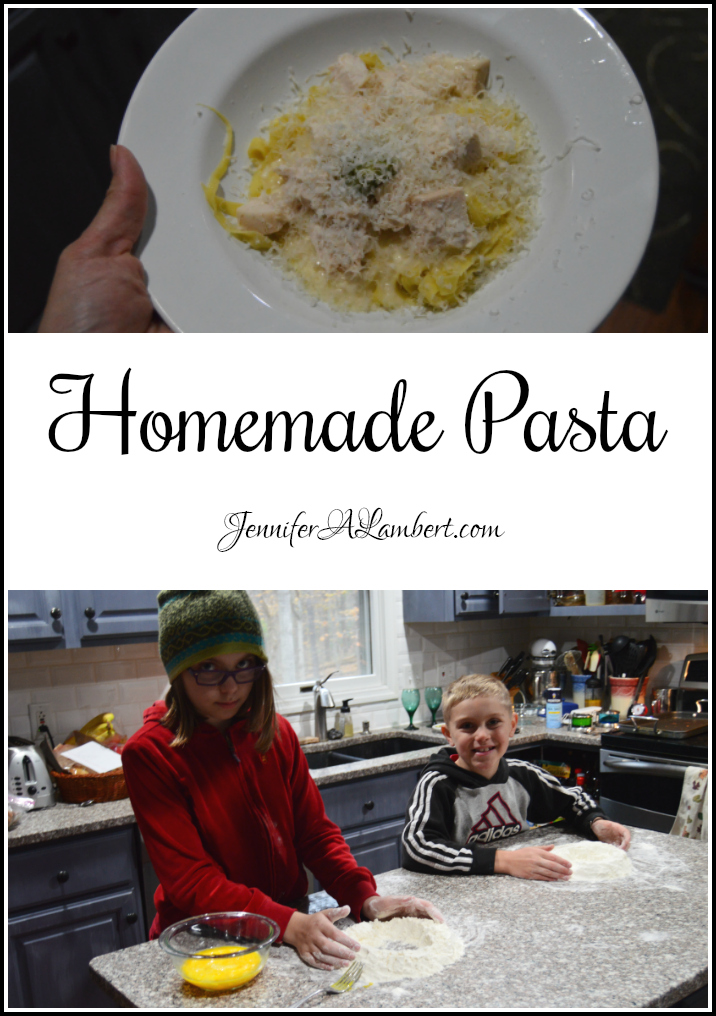
Homemade pasta is really the best. There’s just nothing like it.

It’s super fun and easy for kids.

It is a little more time consuming than throwing a box of spaghetti into boiling water, but it’s oh so worth it.

It starts out kind of messy, with eggs and flour.

We really love our KitchenAid mixer and all the attachments.

Katie is really a pro when it comes to making pasta.

She folds and rolls, folds and rolls.

Everybody likes to cut the pasta into wide and thin noodles.

We also make our own sauces like marinara and alfredo and pesto.

We hardly ever have any leftover noodles!

5 from 3 votes
Print

Egg Noodles

Ingredients

  • 2 cups AP flour
  • 2 eggs
  • 4 egg yolks
  • 1 t salt

Instructions

  1. To Make the Dough: Pour flour in a mound. Make a well in the center of flour. Pour whole eggs, egg yolks, and salt into well. Use a fork to mix. Knead dough with hands until all is incorporated into a dough ball.

  2. Wrap ball of dough tightly in plastic wrap and rest on countertop for 30 minutes.

  3. To Roll the Pasta: Put down a sheet of parchment paper and dust lightly with flour. Cut dough into quarters. Set one quarter on work surface and re-wrap remaining dough. Flatten the quarter of dough into an oblong shape about 1/2 inch thick.

  4. Set pasta maker to widest setting and pass dough 3 times through the machine at this setting.

  5. Place dough on a lightly floured work surface. Fold both ends in so that they meet at the center of the dough, and then fold the dough in half where the end points meet, trying not to incorporate too much air into the folds. Flatten dough to 1/2-inch thick. Pass through the rollers 3 additional times.

  6. Reduce the setting by 1 notch and repeat. Continue passing the dough through the rollers, reducing the thickness by 1 setting each time until it reaches the desired thickness. It should now be very delicate and elastic to the touch and slightly translucent.

  7. Place rolled dough onto a work surface or baking sheet lightly dusted with flour or on parchment paper. Sprinkle with flour or line with parchment between folds to prevent sticking.

    Cover dough with plastic wrap or a kitchen towel to prevent drying, then repeat steps with remaining dough quarters. 

  8. To Cut Noodles: Adjust pasta machine to noodle setting of your choice. Working one dough segment at a time, feed dough through the pasta cutter. 

  9. Divide the cut noodles into individual portions, dust lightly with flour, and curl into a nest. Place on parchment-lined rimmed baking sheet and gently cover with kitchen towel until ready to cook. Pasta can be frozen directly on the baking sheet, transferred to a zipper-lock freezer bag, and stored in the freezer for up to three weeks before cooking. Cook frozen pasta directly from the freezer.

  10. To Cook: Bring a large pot of salted water to a rolling boil. Add pasta, stir gently with a wooden spoon, chopsticks, or a cooking fork, and cook, tasting at regular intervals until noodles are just set with a definite bite, about 1 1/2 to 2 minutes. Drain, toss with sauce, and serve.


Share
Pin24
Share
24 Shares
You might also like:

Filed Under: Recipes Tagged With: noodle, recipe

Stop Saying Sorry

This blog may contain affiliate links: disclosure.
Please see my suggested resources.

December 17, 2018 By Jennifer Lambert 17 Comments

Do you find yourself saying sorry all the time?

Do you feel guilty, ashamed, or blamed for things beyond your control?

Research shows women apologize more frequently than men.

Saying sorry all the time can be a sign of anxiety, OCD, or abuse.

Saying sorry too often affects our relationships.

Girls constantly receive mixed messages:

  • Be confident, but not conceited
  • Be smart, but no one likes a know-it-all
  • Ambition is good, but trying too hard is bad
  • Be assertive, but only if it doesn’t upset anyone else

What are we teaching our children (and especially our daughters) when we say sorry all the time?

When an apology is warranted, of course it should be offered, but acting a victim and saying sorry for instances outside our control isn’t healthy.

There’s a big difference between a real apology and just saying sorry.

I am raising servant leaders and precision of language is important. We’re respectful but unapologetic when we express our needs.

I don’t want my kids to feel they have to be sorry for being who they are.

Stop Saying Sorry

Stop Saying Sorry…

Stop saying sorry for emotions.

Don’t say sorry for being sensitive, emotional, or passionate.

Stop saying sorry for getting angry.

Stop saying sorry about asking for help.

Stop saying sorry about speaking your mind.

Stop saying sorry for your past.

Stop saying sorry for telling the truth.

Stop saying sorry for being successful.

Feel.

Love.

Emote.

Express.

Be emotionally intelligent.

Stop saying sorry at home.

My house is messy and I won’t be sorry for it since we live here – all day, every day.

I don’t say sorry for asking my spouse or kids to contribute to our household care and cleaning.

I changed my language to be assertive and express my needs.

I am polite but firm when I request the dishwasher unloaded or laundry put away. I can’t and won’t do it all when we all must work together for a smooth-running household.

I stopped saying sorry for needing “me time.” Self-care is important and as an introvert, I need more alone time than the rest of my family members.

Stop saying sorry at church.

Sorry seems to be a very churchy word.

It doesn’t have to be. Change the narrative.

Empathize without using the word sorry.

When we hear bad news, we often automatically say, “I’m sorry.” We express sorrow and sympathy the way we have been conditioned. But we could use better precision of language than saying sorry for things totally beyond our control. When people confide bad news, by all means I sympathize and empathize, but I don’t have to apologize for it unless it is truly my fault.

I can tell someone that I understand (if I really do.) I can say, “That’s unfortunate.” or “That sucks.” Most people don’t want advice or to hear if I’m sorry; they just want me to listen.

When people ask me for something I can’t or don’t want to do, I don’t have to say a sorry no. No means no. I don’t have to offer an apology or explanation. I protect myself and my time.

Stop saying sorry socially.

As a large homeschooling family, we could do so many activities and attend so many field trips and classes, and get so over-involved – and never be home.

No means no. I am very careful about our time and how much we’re involved in. I say no often and unapologetically. I don’t have to offer reasons to anyone.

It’s easier to say no and change to a yes later than the other way around. People don’t handle disappointment well.

When my kids have a scheduling conflict, we all have to compromise. Someone has to arrive early or get picked up late so we all get to where we need to be.

Stop saying sorry at work.

Stop saying sorry for taking time to respond or to do a job well.

Stop saying sorry, even if you’re at fault for a mistake. Use better and more positive language.

I found myself saying “sorry” a lot, even for small errors or something that was completely out of my control, so turning regret into gratitude really helps. Not to mention keeps everything professional, neutral, and not off emotion. ~Maya

Alternatives to Saying Sorry at Work:

  • Thanks for flagging!
  • Good catch! I will make the updates/changes.
  • Many thanks for noticing the error, [name], we will [verb].
  • Thank you for bringing this to our attention. We will [verb].
  • Thank you for clarifying.
  • Thanks for the nudge! (If you missed a previous email)
  • We appreciate your inputs; moving forward, we will [verb].
  • Thank you for your feedback; we will incorporate this into our process.

I used to get all prickly and sweaty and my stomach was in knots when I got emails citing any mistake, even if it wasn’t my fault. I recently tried this out in work emails a couple times and it worked like a charm! I feel more in control and not at all anxious. And I got lovely “thank you” replies from my colleagues.

And never, ever say sorry for asking for payment for your work. Bloggers, artists, and other creators should be compensated for their time and work.

Don’t make the kids say they’re sorry.

We’ve all been there. Maybe we’ve done this.

Kids do something thoughtless or even mean.

We expect them to be and say “sorry.” We want to teach manners and social acceptance.

Making kids say they’re sorry doesn’t teach them anything.

Making kids say they’re sorry is more about us than them.

What to do instead of making kids say they’re sorry?

  • Role model.
  • Affirm feelings.
  • Offer choices.
  • Let them work it out on their own.

Kids often empathize better than adults can. We can learn from them!

Sorry is an overused word and doesn’t even mean what it should most of the time.

I’m a firm believer of saying what you mean and meaning what you say.

How often do you say sorry when you don’t have to?

Share
Pin41
Share
41 Shares
You might also like:

Filed Under: Family Tagged With: apology, relationships

Celebrating Saint Lucia’s Day

This blog may contain affiliate links: disclosure.
Please see my suggested resources.

December 10, 2018 By Jennifer Lambert Leave a Comment

We enjoy celebrating holidays from around the world.

St. Lucia’s Day is a lovely celebration for children.

Celebrating Saint Lucia's Day

St. Lucia Day History

The celebration of St. Lucia comes from stories that were told by monks who first brought Christianity to Sweden.

December 13th was also the Winter Solstice, the shortest day of the year, in the old “Julian” calendar and a pagan festival of lights in Sweden was turned into St. Lucia’s Day.

St. Lucia’s Day is celebrated by a girl dressing in a white dress with  red sash and a wreath with candles on her head. Small children use electric candles, but from about 12 years old, real candles are often used. The crown is traditionally made of lingonberry branches which are evergreen and symbolise new life in winter.

A national Lucia is chosen in Sweden every year. Lucias visit hospitals and homes for the elderly, singing a song about St. Lucia and handing out Pepparkakor, ginger biscuits.

Boys might dress up as Stjärngossar (star boys) and small girls might be attendant Tärnor (like Lucia but without the candles).

A popular food eaten at St. Lucia’s day are Lussekatts, buns flavored with saffron and dotted with raisins which are eaten for breakfast.

St. Lucia Crafts and Activities

  • A fun recipe for St. Lucia Cookies
  • Catholic Icing paper dolls
  • St. Lucy Feast Day from Lights and Sweets
  • Felt crowns from JoyFilled Family
  • Lots of activities from The Kennedy Adventures
  • Paper crowns and star hats from Kiddley
  • Swedish holiday books from What Do We Do All Day
  • Arthur episode about St. Lucia on Arthur’s Perfect Christmas

St. Lucia Books

  • Lucia, Saint of Light by Katherine Bolger Hyde 
  • Lucia Morning in Sweden by Ewa Rydaker 
  • Who Are You Santa Lucia? : A timeless journey of inspiration and beauty through the eyes of a brave and kind saint whose legacy empowers us to be a force of good in the word by Glenda Cedarleaf
  • My First Saint Lucia Day Book by Belle Boss

What interesting holidays does your family celebrate?

Share
Pin146
Share
146 Shares
You might also like:

Filed Under: Faith Tagged With: Christmas, faith, saint

Boonshoft Museum of Discovery

This blog may contain affiliate links: disclosure.
Please see my suggested resources.

December 9, 2018 By Jennifer Lambert Leave a Comment

Our favorite event every month is the Boonshoft Homeschool Day.

It’s the first Thursday of the month from September through May.

Boonshoft Museum of Discovery

I purchase a membership each year since we all attend the homeschool days each month and it pays for itself in two sessions.

My middle girls attended invitation only Summer Field Camp and loved it.

There are homeschool science activities all day long. The earlier activities are geared for younger kids.

We like to show up for the 1:30 Do Lab activity.

They usually have stations set up at lab tables around the theme of the day. My kids like to learn together.

Safety first!

We’ve learned about ponds.

They have great equipment we don’t otherwise have access to, like microscopes.

The kids have learned about coding and robotics.

We’ve learned about African American inventors and their inventions.

We’ve learned about Native American history and archaeology.

We like chemistry and physics.

Testing water salinity from the pond.

We all shocked pennies and watched them change color.

Biology is not a favorite.

Bone density day was ok.

We dissected eyeballs and a heart for the last homeschool day last year!

After the 1:30 Do Lab, there are often animal meet and greets at 2:15 and science theatre at 3:30.

Boonshoft offers a small zoo, StarLab, hands-on science exhibits, special exhibits, NOVA weather station, archaeology exhibits, space exhibits, a children’s museum with a fun playground, treehouse birdwatching, pond and walking paths through the woods. There are fun special events throughout the year.

Boonshoft is a fun afternoon for our whole family!

Hours

Monday – Saturday: 9:00 a.m. – 5:00 p.m.
Sunday: Noon – 5:00 p.m.

Admission

Children (3-17) $11.50
Adults $14.50
Seniors (60+) $12.50
Children (under 3) Free
DSNH Members are FREE

Check for discounts and deals or how to become a member.

Share
Pin5
Share
5 Shares
You might also like:

Filed Under: Ohio Tagged With: museum, ohio

The Danger of Mixing Meds with Alcohol

This blog may contain affiliate links: disclosure.
Please see my suggested resources.

December 3, 2018 By Jennifer Lambert Leave a Comment

There’s a reason why prescription and some over the counter medication packages are marked with a “Do not mix with alcohol” — it’s dangerous. Mixing medicine and alcohol can have all kinds of negative side effects. Unfortunately, many people overlook this.Maybe they’re having too much fun at a party and decide to pop a few pills while they’re already drunk. Perhaps they take prescription medication and forget that they can’t drink booze. Or, maybe they struggle with alcoholism and are just seeking a stronger high.Dr. Duy Nguyen, D.O., is a Board-Certified Psychiatrist in General Psychiatry practicing at Beachway Therapy Center, a drug and alcohol rehab in Boynton Beach, Florida.  He says, “Whatever the case, it’s important for everyone to know how dangerous it is. After all, when you combine alcohol with some drugs, the results can be deadly. More than 100 drugs interact with wine, beer, champagne, and hard liquor, triggering problems ranging from nausea and headaches to life-threatening issues, such as internal bleeding and difficulty breathing.”

More problematic for women than men

Dr. Nguyen says, “This is more of a problem for women than for men. After consuming the same amount of alcohol, females are more likely to achieve higher blood alcohol concentrations than males because females have less gastric alcohol dehydrogenase activity (breaking down alcohol through digestion) and proportionally less body water.”

What does alcohol do to my medication?

Dr. Nguyen explains, “Alcohol may interfere with the absorption, metabolism, or excretion of medications which can either increase or oppose the effects of your medication. With some drugs, alcohol competes with the enzymes metabolizing your medications, increasing the amount of drug in the body—along with any side effects. Mixing alcohol and other medications may have short-term side effects like drowsiness, nausea, and vomiting.”

Common drugs you should not mix with alcohol:

Allergy, Cold, and Flu Medications

You should avoid drinking if taking allergy medications and any multi-symptom cold and flu formulation. Drowsiness and dizziness are common, interfering with your ability to drive or operate heavy machinery. Because the combined use can impair judgment, there is also an increased risk of overdose.

Angina Medications

Angina, also known as ischemic chest pain, is a type of pain caused by reduced blood flow to the heart. Taking alcohol with the angina medication nitroglycerin can lead to a rapid heartbeat (tachycardia), sudden changes in blood pressure, dizziness, and fainting. Avoid drinking when taking any brand of nitroglycerin.

Anti-Anxiety and Epilepsy Medications

The combined use of alcohol and anti-anxiety and epilepsy medications can cause drowsiness, dizziness, slowed breathing, breathing restriction, impaired motor control, abnormal behavior, liver damage, and memory loss.

Antidepressants

As a rule, the combined use of alcohol and antidepressants can cause drowsiness, dizziness, increased feelings of depression, or suicidal thoughts (especially in young people).

Anti-Seizure Medications

The combined use of alcohol and anti-seizure medications can cause drowsiness, dizziness, and even the very seizures they are meant to prevent.

Muscle Relaxants

The combined use of alcohol and muscle relaxants can cause drowsiness, dizziness, slowed or impaired breathing, impaired motor control, abnormal behavior, memory loss, and seizures.

Sleep Aids

The combined use of alcohol and sleep medications should be avoided. It can cause slowed or impaired breathing, impaired motor control, abnormal behavior, memory loss, and fainting.

Opioids

The combination of painkillers and alcohol is also of great concern, and should always be avoided, considering the U.S. opioid epidemic. The use of alcohol and pain medications like narcotics together can disrupt breathing and may be fatal. Without enough oxygen, the brain will begin to shut down organ systems, and the person can eventually suffer brain damage or death due to lack of oxygen.

Final Advice

Dr. Nguyen says that, “If you have combined prescription or OTC drugs with alcohol and begin to feel side effects that could be dangerous, contact your doctor immediately or go to the nearest emergency room. Always read medicine labels carefully.  If you are deliberately mixing drugs and alcohol to “get high” you may have a substance abuse problem and should seek the advice of a psychiatrist or consider an in- patient treatment center.
Share
Pin
Share
0 Shares
You might also like:

Filed Under: Health Tagged With: health

How Deployment Affects Kids

This blog may contain affiliate links: disclosure.
Please see my suggested resources.

November 26, 2018 By Jennifer Lambert 12 Comments

Our first deployment, the kids were young.

Our kids were 9, 4 1/2, 3 1/2, and 9 1/2 months.

He left for Kandahar, Afghanistan, in mid-January. I was all alone in Utah – far from family, and friends were almost non-existent.

I’m pretty self-sufficient.

Sure, I had some bad days.

We had a blizzard. I burned the garlic toast one night at dinner. We had a basement flood on Memorial Day.

Overall, we did well, considering.

Our second deployment, the kids are older.

They’re 18, 12, 11, and 8.

It’s so different, but not necessarily easier.

As a homeschooling mom of 4, deployment can be lonely and difficult at times. We have no help – no family nearby, no support system. We are self-reliant. I am an introvert.

I simplify for sanity some days, or even weeks. Sometimes, I buy storebought baked goods, rotisserie chickens for dinner, canned biscuits, and these new natural Lunchables. My time is valued and these shortcuts help us a lot when life gets hectic. We’ve even gone out to eat a few times!

Cutting corners is fine. I have to give myself a break.

I don’t want to drive 4 kids all over town every day or all weekend. I limit errands and activities to save time and money and yes, it’s hard to say no sometimes. I have to judge what’s the best use of our time and money. I can’t be in two places at once. We participate in activities together as much as possible – art lessons, classes at our local craft stores, rec sports at the same park.

Bedtime is earlier. After dinner, I’m just spent. I want to take a bubble bath and lie in bed watching Netflix with my cats.

My kids are older now and they can help a lot more around the house. The kids understand. I use Facebook Messenger Kids to remind them to load the dishwasher.

Holidays can be different. We don’t have to eat turkey at Thanksgiving. We can celebrate Christmas on a different, more convenient, day. We can eat a picnic in the living room with the TV on.

We maintain routines as much as possible for our comfort and my sanity.

We pray and read and cook and eat. We get outside and exercise almost every day, no matter the weather. We snuggle and love the cats.

We allow the tears and sadness because it’s healthy to express all emotions.

How Deployment Affects Kids

How Does Deployment Affect Kids?

Most people think deployment must just be really hard and negative for families. While there are certainly sad times, I think deployment can help families grow stronger.

Infants

My son didn’t much seem to notice anything different. I was his primary caretaker and that didn’t change. If he noticed or wondered why Dad wasn’t home evenings or weekends all of a sudden, he couldn’t communicate that question.

My son was mostly oblivious to everything during the first deployment. It was just regular life for him. Of course, he picked up on my emotions and stress. It seemed like Dad missed so much – his first steps and his first birthday. So much growth.

It was a little awkward with the homecoming and he sorta remembered Dad, but it took a little while for them to get comfortable with each other again.

Toddlers

Kids in this age group are not known for flexibility or handling change well. I think it’s hard to explain something complex like deployment to small children.

They wonder if he’s coming back, if he’ll be safe or get hurt. They develop abandonment issues. They become very clingy. It’s hard for them to express emotions and handle stress.

My youngest daughter was and is pretty independent and I don’t think she was too concerned about Dad being gone, but she wasn’t really able to process or express anything about it.

I kept the kids on a routine to help us all adjust more easily.

Preschoolers

It was so super hard on my middle daughter during the first deployment. She pretty much slept in my bed the entire time Dad was gone. She struggled with abandonment feelings. She struggled with middle child issues. She couldn’t process her emotions nor express her fears. She’s always been our sensitive one.

It helped her to grow. She’s strong now as a 12 year old and amazes me every day as my helper in all things.

Elementary

My eldest daughter has always had to be strong for her siblings, and sometimes even for me. She’s had to be responsible from a very young age. She was a huge help during the first deployment.

My 8 year old son is feeling it hardest for this second deployment. He’s gotten better into a routine now that we’re about halfway through. There are lonely times for him as the only boy in a houseful of girls. I help him use his time serving, helping, and learning.

He misses his Dad.

Tweens

My middle girls at age 11 and 12 are pretty indifferent about this second deployment. They chat and FaceTime with Dad frequently and they don’t really feel (or don’t express) the distance. They send him photos on email and chat and create drawings for the care packages we send. Maybe they’re just well adjusted and accepting.

Teens

My eldest is now eighteen, and fairly independent. She still relies on me for advice and help, especially during crises. She hasn’t taken her driving test yet for her license yet.

But sometimes, she thinks she knows everything. She’s not very affected by the deployment. She helps at home and works with me on schedules so I can do everything we need to do. I know she’s angry and wishes her life had been different.

Don’t we all have regrets? Military life has its ups and downs but we’ve had amazing opportunities. She realizes this, but sometimes feels disappointment at our lack of roots.

She’s learning valuable lessons about fidelity, duty, love, and relationships.

It’s different at every stage. Babies and toddlers feel uncomfortable. Young kids are often confused and scared. Tweens and teens feel diffident and abandoned.

Military life builds resilience, flexibility, independence, value, and perspective.

I’m making memories with these kids – who are living for 8ish months without a father, except on FaceTime, messenger, and email. I have to make it as special and good as possible. I do try to hide my negative emotions and I try never, ever, to lash out at them when I’m stressed. I don’t want Dad to only hear about problems. He needs to be part of the joy and celebration too, so he doesn’t feel he’s missing so much.

After close to a year apart, we have to learn each other again.

Yes, it’s hard sometimes.

They know we’re in this together.

You might also like My Tips for Surviving Motherhood During Deployment.

Resources:

  • This Is Where You Belong: Finding Home Wherever You Are by Melody Warnick 
  • Almost There: Searching for Home in a Life on the Move by Bekah DiFelice
  • God Strong: The Military Wife’s Spiritual Survival Guide by Sara Horn
  • Tour of Duty: Preparing Our Hearts for Deployment: A Bible Study for Military Wives by Sara Horn
  • Chicken Soup for the Military Wife’s Soul: 101 Stories to Touch the Heart and Rekindle the Spirit by Jack Canfield, Mark Victor Hansen, and Charles Preston
  • Faith Deployed: Daily Encouragement for Military Wives by Jocelyn Green
  • Faith Deployed…Again: More Daily Encouragement for Military Wives by Jocelyn Green
  • Faith, Hope, Love, & Deployment: 40 Devotions for Military Couples by Heather Gray
Share
Pin24
Share
24 Shares
You might also like:

Filed Under: Military Tagged With: deployment, mental health, military, milkid

Making Sense of It Book Review

This blog may contain affiliate links: disclosure.
Please see my suggested resources.

November 25, 2018 By Jennifer Lambert 2 Comments

Making Sense of “It” by Alison Macklin is a new guide to help you navigate sex ed with your kids.

Sex is an uncomfortable topic for many and this book offers a great outline of what and how to discuss various topics surrounding sexuality with our children.

My Review

I learned about sex in school. The very basics with a little film strip in 5th grade. And health class in 9th grade—anatomy, STIs, and pregnancy – from the football coach!

Our kids have lots of questions about sex.

It’s up to me as a parent to be available to answer questions and even initiate a conversation about sex.

What about masturbation? Is it ok to have sexual fantasies? What about kissing, blowjobs, or taking The Pill? If you touch someone’s penis, can you get pregnant? If you douche after sex, you won’t get pregnant…right? Is porn ever ok?

Making Sense of “It” goes beyond the basics of the birds and the bees to give teens a realistic, no-holds barred, nonjudgmental guide on everything having to do with sex and sexuality. With this book, teens can learn about “it” all from the best contraception methods to what to expect at a clinic, even to the signs of an unhealthy relationship.

In a world where teens are bombarded with bad information on social media, are meant to feel ashamed of something so natural, Making Sense of “It” counters that with trustworthy, gender-neutral advice on how to be safe, informed, and honest about “it.”

I want my kids to have healthy relationships and that includes a healthy sexuality. We don’t buy into the evangelical purity movement. I want my kids to have real information and I have to feel comfortable talking about it and answering the hard questions. If I don’t help my kids navigate through these waters, they will Google it, ask their peers, or find the information they seek somewhere and it might not be the best answer.

This book may not be for everyone but these topics come up more and more – on social media, in classrooms, at college, in youth group, Sunday school, the playground. I want my kids to have a good, healthy foundation about their personal values before they are bombarded with uncomfortable circumstances.

I like the conversation starters at the end of each chapter. They can be used as an outright script, or as a journaling activity, or as a casual conversation.

The introduction is entitled “Dear Teen” and it is perfect.

Nineteen chapters cover most sexual topics in this 2018 climate. The last chapter offers resources for more info.

I feel this is a book that should be introduced to tweens and revisited often with teens by parents, keeping an open conversation throughout the growing years.

It’s important to discuss healthy relationships when so few of my generation had a model or knows how.

About the Book

  • Go-to introductory resource on sex ed for teens, college students, parents, educators, social workers, and health professionals.
  • Can be read separately or together as a family to meet everyone’s different needs.
  • Includes helpful sections specifically written for parents and teens to help break the ice and foster mutual understanding.
  • Conversation starters (a list of suggested questions for teens and parents) accompany each chapter to keep the conversation going and to foster connections on a more meaningful level.
  • Includes “fun facts” throughout the book that delve more deeply into certain topics like average penis sizes, female ejaculation, and the need for regular STI screenings.
  • Covers many different topics not often covered in health class/sex ed:
    • the human brain in relation to sex and puberty,
    • defining sexuality,
    • the need for human touch,
    • sexual identity and orientation,
    • gender roles,
    • feeling horny,
    • various levels of “risk” in sexual behaviors, and
    • signs of healthy and negative relationships.
  • Also touches upon more progressive and sex-positive topics like:
    • consent culture,
    • sex toys, fetishes, and fantasies,
    • pornography,
    • choosing when to become sexually active,
    • tactics to improve communication with sexual (current or potential) partners,
    • how to get help and be an active bystander when witnessing sexual harassment and assault, and
    • abortion.

About the Author

Alison Macklin has been with the Responsible Sex Education Institute at the Planned Parenthood of the Rocky Mountains (PPRM) for over fourteen years and is currently Vice President of Education and Innovation. Macklin is an award-winning, nationally recognized leader in sex education and holds a Master’s in Social Work from the University of Denver. She is a mother of two who lives in Colorado.

Praise for the Book

“Kudos to Alison Macklin for creating a book to help parents and teens talk more honestly and frequently about sex and sexuality. This fun, up to date, accurate, and easy-to-understand guide will help families to connect more about these absolutely critical issues.”
— Leslie M. Kantor, PhD, MPH, Vice President, Education, Planned Parenthood Federation of America

“Making Sense if ‘It’ is the Our Bodies, Our Selves for today: comprehensive, unbiased, medically accurate, and respectful. This should be on the bookshelf and nightstand of every household so that caregivers and youth alike can read it, discuss it, and learn from it.”
— Pat Paluzzi, DrPH, CNM, President and CEO Healthy Teen Network

“This book is a must read for all teenagers and parents of teens, about a subject that is often hard to talk about: sex. Author Alison Macklin gives great, practical, actionable advice on how to keep communication open and honest.”
— Jason Woods MD, Assistant Professor of Pediatrics, creator of Little Patients, Big Medicine

“I loved it! Alison Macklin offers teen readers honest, engaging, and at times humorous information about puberty, sex and sexuality. The book is chock-full of useful suggestions for parents as well, providing tips to start conversations with their teens and keep the lines of communication open during the sometimes bumpy road through puberty and adolescence.”
— Debra Hauser, President of Advocates for Youth

“This book provides excellent information about sexual health and important advice for staying healthy and having good relationships. The overview of sex and sexuality will be extremely useful for teens and parents alike.”
— Connie Newman, MD Adjunct Professor of Medicine, New York University School of Medicine, and President 2018-2019 American Medical Women’s Association

“In this rapidly changing world of sexuality, gender and relationships Alison Macklin’s new book is just the resource teens need be ready for the wonderful world of sex and relationships. With her smarts, experience, and guidance, teens of all genders and orientations will get just what they need to make great choices.”
— Amy Lang, MA, founder Birds & Bees & Kids and author, Dating Smarts – What Every Teen Needs to Date, Relate or Wait!

Book Trailer:

Buy the book:

Share
Pin15
Share
15 Shares
You might also like:

Filed Under: Book Reviews Tagged With: book review, relationships, sex

Holiday Essential Oil Blends

This blog may contain affiliate links: disclosure.
Please see my suggested resources.

November 22, 2018 By Jennifer Lambert 10 Comments

Get in the Holiday Spirit with these Essential Oil Blends for your Diffuser!

The holidays can be stressful for many.

I love diffusing essential oils to get rid of cooking smells, freshen and clear the air, perk up a low mood, or calm us for bedtime.

I recently completed my aromatherapy certification course. I’m excited to share more with you about the benefits of plants and aromatherapy.

Orange oil is a favorite and frugal essential oil and I often use it as a base note for diffusing blends.

Most love the scent of citrus and there are few contraindications with diffusing. Citrus is uplifting.

I am very careful about diffusing mints, especially around young children or those with sensitivities.

Spice oils should be used sparingly and carefully as well so they don’t irritate mucous membranes.

Evergreen oils are balancing – like cypress, fir, spruce, juniper, rosemary, cedar, pine. They’re refreshing.

Florals are cozy and feminine but add a bright touch to blends as a topnote.

Diffusers only hold so much water and 5-6 drops of oils are plenty for diffusing up to 3 hours in most diffusers.

Holiday Essential Oil Blends

StressAway essential oil blend is perfect for diffusing all the time. The warm scents of vanilla and lime are perfect for the holidays.

My absolute favorite diffuser blend:

3 drops Rosemary (Rosmarinus officinalis)
2 drops Lavender (Lavandula angustifolia)
2 drops Lemon (Citrus limon)

Holiday Diffuser Blends

Three Trees

1 drop Palo Santo (Bursera graveolens)
1 drop Myrrh (Commiphora myrrha)
2 drops Cedarwood (Juniperus virginiana)

Magi

1 drop Frankincense (Boswellia carterii)
1 drop Myrrh (Commiphora myrrha)
2 drops Cedarwood (Juniperus virginiana)
optional: 2 drops Orange (Citrus sinensis)

Spiced Cider

3 drops Orange (Citrus sinensis)
1 drop Cinnamon (Cinnamomum verum)
1 drop Ginger (Zingiber officinale)

Pumpkin Spice

1 drops Cinnamon (Cinnamomum verum)
1 drops Clove (Syzygium aromaticum)
2 drops Nutmeg (Myristica fragrans)
1 drop Ginger (Zingiber officinale)

Gingerbread

2 drops Ginger (Zingiber officinale)
1 drops Clove (Syzygium aromaticum)
1 drops Nutmeg (Myristica fragrans)
1 drops Cinnamon (Cinnamomum verum)
1 drop Orange (Citrus sinensis)

Pick Me Up

2 drops Grapefruit (Citrus paradisi)
2 drops Lemon (Citrus limon)
1 drop Spearmint (Mentha spicata)

Tropical Getaway

1 drops Eucalyptus (Globulus)
2 drops Lime (Citrus aurantifolia)
1 drop Ylang Ylang (Cananga odorata)

Christmas Tree

2 drops Pine (Pinus sylvestris)
2 drops Spruce or Fir (Picea mariana or Abies alba)
2 drops Juniper (Juniperus communis)

Try combining your favorite scents. Less is more and goes a long way. I love florals with evergreen and citrus.

What’s your favorite essential oil?

You might also like:
20 Diffuser Blends
15 Diffusers under $50
10 Gifts with Essential Oils
10 Natural Living Gifts

Share
Pin25
Share
25 Shares
You might also like:

Filed Under: Essential Oils Tagged With: diffuser, essential oils

Celebrating Holidays During Deployment

This blog may contain affiliate links: disclosure.
Please see my suggested resources.

November 19, 2018 By Jennifer Lambert 6 Comments

Deployment.

The HoLidAyS.

Halloween to New Years.

Can you say S-T-R-E-S-S?

The holidays get me down anyway, and doing them alone is no fun at all. If it were just me, I would forego the whole winter season completely.

I do it for the kids.

Celebrating Holidays During Deployment

October to January. It feels like so many expectations to make everything perfect, all by myself.

The kids are older now and they have a say. They like to stay home, mostly.

We don’t want potlucks with strangers. We don’t participate in events on base. We don’t know the people Dad works with at all.

We stopped going to church because it was so fake. I don’t want pity or questions. I’m healing in my solitude.

How We Celebrate the Holidays During Deployment:

Tradition

For many families and certainly for young kids, maintaining tradition is important. It offers continuity and comfort. We have certain expectations every year. Some things can be omitted or mixed up, but other things are just necessary for the holiday to feel special.

I’m an only child, so we really never did much on holidays, except with my grandmothers and they passed when I was a teenager.

My husband’s parents passed the first year we married. We’ve never celebrated holidays with family.

It was a blank slate.

We could create our own traditions!

We like to keep things simple. It keeps my stress levels down, knowing I don’t have to make everything perfect and Pinterest-worthy. We don’t do Santa. We do St. Nicholas, but they know it’s me.

For our family of six, we have several traditions.

We make and eat latkes the first night of Hanukkah, even though we’re not Jewish. We learned about Judaism in depth for homeschool church and world history and we’ve just always continued with some of the Jewish traditions.

We like to drive around, looking at Christmas lights. This is the first year in ages that we didn’t do that. I just couldn’t fit it in with the weather, kids’ schedules, and my parents visiting.

We try new recipes for cookies, muffins, cakes.

We watch certain movies during the holiday season.

New Traditions

Shopmas, er, Thanksgiving, is kind of a worthless holiday for us. We practice gratitude year-round.

My eldest doesn’t even like turkey. Only one child likes dressing/stuffing. There’s hardly a point making a lot of food for Thanksgiving that no one likes. We don’t care about or watch football. We can have pizza on Thanksgiving if we want to. I can make a mini buffet of lots of little snacks or appetizers and we can all eat what we like. We can do what we want. We can go to the movies. It doesn’t matter. No one dictates to us! Maybe it will even become a new tradition.

My son just announced that he can’t wait for Thanksgiving! He loves turkey and my homemade pie. Well, then. Guess there will be no deviating from that tradition at this time.

We don’t do Black Friday or Cyber Monday. I’ve been finished with holiday shopping for weeks. We want a debt-free holiday.

We eat an awful lot of ham year-round so it’s just not special. I’m not making a prime rib without my husband here to enjoy it. We can have Chinese food, Italian, or anything we want for Christmas Eve and Christmas Day dinners! There’s a scary freedom to that.

There are some things only Dad can do or do well. So without him here, I have to mix things up.

We normally make chicken wings on New Year’s Eve, but I’m kinda scared of the deep fryer. We may have a living room picnic with a movie or even go out. Update: I did great frying chicken wings!

We can go to a movie on New Year’s Day. We usually have the traditional Southern pork, greens, and black-eyed peas for dinner.

We really like Chinese New Year and often make Asian food or go out for a special meal.

Travel

We used to travel over holidays.

The long 4-day Thanksgiving weekend offered great opportunities when we lived in Germany – and we went to Prague, Porto, and Venice. We went to Maui and Rome over Christmas.

We’ve been saving money and I don’t know if I want to venture out too far in snow or ice. I’m from Georgia.

My parents are 12 hours away by car.

My eldest works more when school is out.

I know lots of families move in with family or visit extensively to stave off the loneliness.

Presents

We are always trying to be frugal and debt-free, but I’m doing presents this year.

Yes, there is a bit of guilt that Dad’s not here and I probably spent more than I would have if he were home.

We may open some gifts during the nights of Hanukkah. We may open them all on Christmas Eve. I’m letting the kids decide but they can’t complain later.

Presents aren’t the most important part of the holidays, but they’re fun. The anticipation is exciting.

Presence

There’s only me, so I feel obligated to do all the things.

We celebrate Advent with reading and candles every evening.

We spent the cold dreary days and nights together playing board games, Wii, reading, puzzles, baking.

Sometimes the togetherness gets to be a bit much and we separate to draw, read, cook, watch Netflix, or sit with the cats.

I want to rest in the presence of Jesus during Advent.

I want to model calm presence throughout the holidays in spite of the chaos and loneliness.

Junktastic Creations

How do you celebrate holidays when your spouse is deployed?

Resources:

  • This Is Where You Belong: Finding Home Wherever You Are by Melody Warnick 
  • Almost There: Searching for Home in a Life on the Move by Bekah DiFelice
  • God Strong: The Military Wife’s Spiritual Survival Guide by Sara Horn
  • Tour of Duty: Preparing Our Hearts for Deployment: A Bible Study for Military Wives by Sara Horn
  • Chicken Soup for the Military Wife’s Soul: 101 Stories to Touch the Heart and Rekindle the Spirit by Jack Canfield, Mark Victor Hansen, and Charles Preston
  • Faith Deployed: Daily Encouragement for Military Wives by Jocelyn Green
  • Faith Deployed…Again: More Daily Encouragement for Military Wives by Jocelyn Green
  • Faith, Hope, Love, & Deployment: 40 Devotions for Military Couples by Heather Gray

You might also like:

  • 10 Gifts for a Military Family
  • How Deployment Affects Marriage
  • How Deployment Affects Kids
  • Navigating Motherhood During Deployment
  • Homeschooling During Deployment
  • Surviving Deployment as an Introvert Spouse
Share
Pin33
Share
33 Shares
You might also like:

Filed Under: Military Tagged With: Christmas, deployment, military, milspouse

  • « Previous Page
  • 1
  • …
  • 35
  • 36
  • 37
  • 38
  • 39
  • …
  • 137
  • Next Page »
Suggested ResourcesFetchRakuten Coupons and Cash Back

Archives

Popular Posts

10 DIY Gifts with Essential Oils10 DIY Gifts with Essential Oils
Natural Remedies for HeadacheNatural Remedies for Headache
10 Natural Remedies to Keep on Hand10 Natural Remedies to Keep on Hand
Henna Hands CraftHenna Hands Craft
Homemade Turkey Divan CasseroleHomemade Turkey Divan Casserole
This website uses cookies to improve your experience. We'll assume you're ok with this, but you can opt-out if you wish.Accept Reject Read More
Privacy & Cookies Policy

Privacy Overview

This website uses cookies to improve your experience while you navigate through the website. Out of these, the cookies that are categorized as necessary are stored on your browser as they are essential for the working of basic functionalities of the website. We also use third-party cookies that help us analyze and understand how you use this website. These cookies will be stored in your browser only with your consent. You also have the option to opt-out of these cookies. But opting out of some of these cookies may affect your browsing experience.
Necessary
Always Enabled
Necessary cookies are absolutely essential for the website to function properly. This category only includes cookies that ensures basic functionalities and security features of the website. These cookies do not store any personal information.
Non-necessary
Any cookies that may not be particularly necessary for the website to function and is used specifically to collect user personal data via analytics, ads, other embedded contents are termed as non-necessary cookies. It is mandatory to procure user consent prior to running these cookies on your website.
SAVE & ACCEPT