Jennifer Lambert

A Sacred Balance

Visit Us On FacebookVisit Us On PinterestVisit Us On InstagramVisit Us On Linkedin
  • Homeschool
    • Book Lists
    • How Do We Do That?
    • Notebooking
    • Subjects and Styles
    • Unit Studies
  • Travel
    • Europe
      • Benelux
      • France
      • Germany
      • Greece
      • Ireland
      • Italy
      • London
      • Porto
      • Prague
    • USA
      • Chicago
      • Georgia
      • Hawaii
      • Ohio
      • Utah
      • Yellowstone and Teton
  • Family
    • Celebrations
    • Frugal
  • Military Life
    • Deployment
    • PCS
  • Health
    • Recipes
    • Essential Oils
    • Fitness
    • Mental Health
    • Natural Living
    • Natural Beauty
  • Faith
  • About Me
    • Favorite Resources
    • Advertising and Sponsorship
    • Policies
  • Reviews

© 2025Jennifer Lambert · Copyright · Disclosure · Privacy · Ad

Celebrating Holidays

This blog may contain affiliate links: disclosure.
Please see my suggested resources.

June 29, 2020 By Jennifer Lambert 5 Comments

Maybe some of us didn’t grow in healthy homes or with families who celebrated holidays in ways we want to continue with our own children.

I grew up an only child and I felt so much pressure to make birthdays, Mother’s Day, and Father’s Day special since I had no one to share it with.

I feel pretty whiny about writing this, but it seems like it needs to be said.

I spent my own money that my grandma sent to buy thoughtful presents for my parents. They were seldom appreciative. I remember my father demanding I buy my mother flowers for their anniversary one year when I was a teenager and I bristled at that chore since I felt it was not my responsibility. I remember many birthdays and Mother’s Day when she unwrapped perfumes and whatnot that my father purchased and said were from me. We usually went out to dinner for steak on birthdays.

My mother always wants more and loves shopping as entertainment. I don’t share that hobby. It stresses me out.

I remember most of my birthdays were when my father was out of town on business trips. My mother invited her family and my school mates and neighborhood friends. I realized when I got older that my father didn’t like gatherings.

Christmases were always pretty stressful when I was young. My mom is the youngest child of six and everyone getting together on Christmas Eve was bound to end in negativity on someone’s part. I was mostly too young to notice, but I knew my parents fought about it before and afterwards. Most years, my dad stayed at home while I accompanied my mother to the Christmas Eve party. My grandmother passed when I was 16, and it all deteriorated after that.

My parents usually send me a check, not divisible by 6, so I wonder every year who they don’t like. They’ve started wrapping and packaging weird handmedowns for my kids and it’s always a confusion when the kids ask me about their presents. Sometimes, I don’t know what to say. And apparently my mother thinks I need and use an inordinate amount of kitchen towels.

My parents possess three SUVs, pay a $850 mortgage for a 3500+ sq ft house, receive 3 retirement checks each month, and yet do not buy me or the kids anything for holidays. They constantly complain that they don’t have enough money.

It’s hard for me when my parents ask what I want for my birthday or Christmas and I tell them an item I really want, but they say, “oh, no, not that; what else do you want?” So I usually just say: “I don’t really need anything, thanks.”

As a mom of four, I am dealing with my own issues and trauma. I don’t want my kids to feel pressure. If they don’t want to celebrate my birthday or Mother’s Day per society convention, that should be ok.

I just want to feel cared for too.

I want my kids to realize that some people might have gift giving/receiving as their love language. It’s important to show people we love them in ways they can understand. I know my grandparents had this love language, but it might be only because I saw my grandma a few times a year and she felt a need to make up for a shallow relationship with things.

I am trying to work out my own hurt feelings when my birthday passes by with nothing. It seems that something or other always tries to ruin the day. I try to look at where I failed and how I can live better and model a better reaction to anger or fear and we can still celebrate more appropriately, perhaps without pressure or presents but still a rather cheerful greeting or hug.

I’ve tried to model celebrating with my kids’ birthdays, serving special meals, homemade cake, and presents. I ask their preferences which vary year to year as they get older. I hope I’ve done well. We’ve done away with flashy parties since we have no one to invite and we’re never invited anywhere. Perhaps they’re resentful but the younger three kids surely have little memory of the time before when I stressed over keeping up with others in that way.

I wanted a Pinterest-perfect holiday season before there was even social media. I wanted it to look like something out of style magazines on my husband’s lieutenant budget. Every year without fail, I cried over a failed expectation or the wine spilled or the pork roast was still raw in the middle.

I used to make myself physically ill planning events and holidays. Surely it wasn’t worth it. I don’t think anyone really noticed except that I was very upset if things weren’t living to my impossible level of perfection.

I needed to calm down and reflect on what was most important: relationships.

What memories do I want my family to have of holidays?

There were some recent Christmases when we traveled and minimally decorated and didn’t do presents, but the kids are too young to trade that and asked if we could do it more traditional from now on.

My husband has never shown interest in birthdays or holidays and all the work falls to me and I feel resentful. Years go by and things get forgotten until they roll around on the calendar again. Yet he bragged when we were dating what a thoughtful unique gift giver he was.

The stress of all the past years are like a tidal wave of trauma.

I don’t like knick knacks or presents that will just sit around and collect dust. I’ve purged and minimized so much over the years with all our military moves. I’ve streamlined and curated our possessions. While I have some regrets of items we had to sell or donate, I’m pretty content and I don’t just need more “stuff.”

When we first married, he bought himself a DVD player and surround sound system but wrote my name on the wrapped presents under the tree. I was maybe more upset by memories of my first husband only buying items for himself. I don’t care anything about electronics. If it weren’t for him and the kids, I wouldn’t own a TV.

He tried to buy me jewelry a couple times. The jade pearl necklace and bracelet set was obviously on sale because it’s missing some beads, but surely he didn’t know or look closely enough. He once bought me a children’s pearl necklace set that I returned to the store and he got very upset.

I told my husband just not to buy me presents anymore and he didn’t. He hasn’t.

Fifteen years have gone by.

He bought me caramel chocolates for our anniversary when he was last deployed. Everyone who has ever known me knows I loathe caramel.

My husband never showed appreciation for the presents the kids made him or that I purchased “from” them. I guess he didn’t have a good model for that. He doesn’t much remember what his family did on Father’s Day, Mother’s Day, birthdays. Christmas was a huge affair, focused on the kids. I stopped buying anything for my husband on holidays. We were strapped for money for many years anyway and I convinced myself this was best.

I mentioned last year that maybe it’s not healthy for the kids to see us not give each other presents on holidays. The kids asked me about it and I didn’t have a good answer for them.

I need us to model for the kids a healthy relationship, healthy holidays, healthy celebrations. We need to do better.

He bought me a hoodie for Christmas and kept asking all.day.long did I like it; did he do good? It became exhausting.

We have no relationship with my husband’s family so I felt so inauthentic and impersonal sending them gift cards for every birthday and Christmas. They probably misinterpreted my desire and reason to end that practice but I found it almost impossible to find gift cards for them when we lived in Germany and we never found a replacement tradition. I want more than a gift card relationship. I’m not sure what kind of holidays he had with his two sisters and parents while growing up. I know Christmases were huge affairs with piles of presents. I can’t and won’t recreate that.

My parents are not generous with their time, affection, money, or things and it makes holidays difficult when I am torn between being their daughter and also a wife and mom to my own family.

My daughter works part time and I would never ask her or expect her to spend her own money on presents for me or her siblings, but she doesn’t have to brazenly announce that we are not worth her time, effort, or money. She needs to learn to express her frustration in healthier ways.

It is exhausting and painful for me to try to please everyone all the time.

Perhaps I should practice more what I preach: say what I mean and mean what I say. Precision of language.

Most people can’t really handle bluntness or boldness. They need things sugar coated because they’re used to word and mind games.

Children know what they want and aren’t shy about asking for it.

I collect presents for my children all year round for Christmas and birthdays. I pay attention to what they say they like and want.

I focus on food during holidays because those are good memories for me. My aunt always had a gorgeous spread on Christmas Eve, Easter, Independence Day. I learned a lot about decorating and cooking from her.

And my daughter criticized me for cooking too well that holidays aren’t even that special. What a backwards compliment.

Should I speak up and ask specifically for what I want on my birthday and Mother’s Day? It seems selfish and greedy. I’m not one to spend money on myself often.

It feels like a “Mommie Dearest” kind of a moment to sit them down and demand that that my kids do something for me.

But they all miss the point: The true gift any mother wants is not to do anything.

Lyz Lenz

I’m often overlooked and I don’t want my kids to grow up thinking that’s how to treat people, especially their own future in-laws. I want them to have healthier families than mine was and is, what I’m trying to teach them even with my mistakes.

It’s up to me to end abusive or traumatic cycles and this includes making holidays and celebrations a cheerful, not stressful time. I want my kids to have good memories. I don’t my kids remembering their mom sulking every Christmas because the cinnamon rolls overbaked a tiny bit and complaining about not getting anything for her birthday again this year.

Maybe my family doesn’t really know or remember my preferences, likes, dislikes so they just don’t do anything. Maybe they really are thoughtless and don’t even want to put forth the effort. But maybe my family just wants a bulleted list or PowerPoint presentation about what to get Mom on Mother’s Day, Christmas, my birthday.

Yes, I realize we are privileged. We don’t struggle financially or medically. We have nothing but time and effort to improve our relationships with each other.

How I like to celebrate holidays:

Breakfast: spinach onion Parmesan omelet or veggie frittata

Dinner: seafood. I especially love salmon and scallops.

Presents: Always welcome are books from my wish list, bird feeders, experiences, gardening items.

I like to keep things simple.

How do you celebrate holidays?

Share
Pin29
Share
29 Shares
You might also like:

Filed Under: Family Tagged With: Christmas, holiday, motherhood, relationships

Children and Loss: Stages of Grief

This blog may contain affiliate links: disclosure.
Please see my suggested resources.

June 25, 2020 By Jennifer Lambert Leave a Comment

There is nothing in a child’s life to prepare them for death. While children pass through the same stages of grief as adults, due to their limited life experiences, they will grieve differently. It is important to remember that every person and child grieves differently and at his or her own pace. 

Children experience loss and grief in many different circumstances. The sadness they feel due to the loss of a parent or other loved one may be experienced in many different ways over time.

Swiss psychiatrist, Elizabeth Kubler-Ross, described grief as having at least five specific stages, moving from denial to anger to bargaining, then to depression and finally acceptance. In fact, while this is a useful framework for describing the components of grief, people do not move through the stages in a linear fashion. Recent research supports a more dynamic experience with movement in and out of these states over time.

Denial

This is the first stage of grief. Children want to continue to believe that everything is okay and that nothing bad has actually happened. If they were to take in all the emotion related to the loss right away, it would be too overwhelming so they may deny the loss thus giving their body and mind have a little time to adjust to the way things are now without the deceased.

Anger

During this stage, a child may blame others for their difficulties. This particular stage can last for days, weeks, months and years. It is when the earliest feelings are replaced by frustration and anxiety. Kids may be angry, irritable, and difficult to get along with. It is best for your child and others involved with your child to encourage expression of and discussion about their angry feelings.

Bargaining

A child may start to exhibit behaviors that seem very positive, including appearing to be very mature. School work may improve dramatically. The child may believe that doing everything “just right” will fix the situation. Bargaining is often accompanied by guilt. This is basically our way of negotiating with the hurt and pain of the loss.

Depression

This phase may be a delayed but often occurs when reality really sinks in. During this stage of grief, intense sadness, decreased sleep, reduced appetite, and loss of motivation are common.

Acceptance

Finally, children often enter this stage once they have processed their initial grief emotions, are able to accept that the loss has occurred and cannot be undone, and are once again able to plan for their futures and re-engage in daily life.

It is important to recognize that children, like adults, may move between the different stages at different rates and can jump around between each phase. Recovery is more of a process than an event.

Parents can help their children by grieving with them, listening, offering love and reassurance, helping memorialize the deceased, encouraging questions, and seeking professional help if needed.

About Charlene Khaghan:

A mother of five children, Charlene’s husband passed away suddenly when their youngest child was only three years old. Not only was she forced to deal with her own pain from the loss, she had to find ways to help her children deal with their own feelings of grief and sadness.

Khaghan has a master’s degree in special education and LMSW in social work. She taught high school special education for many years and currently works as a therapist in a university counseling center.

In her newly released book, A Tiny Step Forward, author Charlene Khaghan lets young children know that if they have lost someone close, be it friend, pet or family member, it is okay to feel upset and miss the person they are grieving. And, in the days that follow, it is okay to once again feel happy and to enjoy life as their loved one would have wanted for them.

When it comes to explaining grief to a child, this book can help children know they are not alone and normalize what they are experiencing. 

Share
Pin
Share
0 Shares
You might also like:

Filed Under: Book Reviews Tagged With: book review, grief

How To Encourage Your Children to Read Over the Summer

This blog may contain affiliate links: disclosure.
Please see my suggested resources.

June 22, 2020 By Jennifer Lambert Leave a Comment

During the summer, you might try to find ways to keep your children productive and busy. While you do not want to interrupt their well-deserved break, you also want to encourage skills they will need for their upcoming school year, such as reading. If you want your kids to keep reading throughout the season, consider following these tips. 

Use Technology to Help You

The younger generations are more familiar with technology than before. Your kids may be more comfortable with a computer or a tablet than with a regular book. For more text-heavy books, you can try using an e-reader for e-books. These tablets allow the young ones to read a book from a screen and change pages or settings via simple touches. You can even modify elements like amount of lines per page and text size to make it easier for them to read.  

Connect Books With Adaptations 

Adaptations of books to other media such as movies, television series and video games are increasingly popular, especially when it comes to children’s material. There is a strong chance your children might have consumed them, such as the streaming series based on Daniel Handler‘s books. If they like certain adaptations, you can recommend them their book versions and tell them how they offer additional content featuring their favorite characters or stories. 

Pick Age-Appropriate Books 

Children may sometimes lose interest because they are reading books that are either too advanced or not sophisticated enough for them. For instance, the deadpan humor of author Daniel Handler‘s works may fly over the heads of very young readers. Make sure the books have the appropriate reading level. If you find it difficult to tell which books are right for your kids, talk to the local librarian or see if the e-reader divides book by age levels. 

Reading is a wonderful skill to develop and an excellent way for your children to entertain themselves. Encourage their interest over the break with this advice. 

Literature Study (or Book Report) Notebooking Pages
Share
Pin
Share
0 Shares
You might also like:

Filed Under: Homeschool Tagged With: reading, summer

Teaching Sex Ed

This blog may contain affiliate links: disclosure.
Please see my suggested resources.

June 22, 2020 By Jennifer Lambert 12 Comments

We are born trusting our bodies and our instincts for what our bodies need.

For most of us, something interrupted that trust long before puberty.

We can’t just allow our kids to grow almost all the way up and then one day realize they are sexual beings and break out some library books to teach them what goes where, the end, amen.

Like my mom did.

She just called me into the dining room and there sat a stack of library books and she said, “have at it” and left me there to look through them.

I don’t remember being able to ask any questions.

I found The Joy of Sex on my bachelor uncle’s bookshelf when I was a preteen. He never censored my reading.

I remember reading one of my mom’s magazines on the living room floor, probably Glamour, when I was about 12 and asking my dad what is an orgasm? He yelled at me, “What the hell are you reading?” and he never answered my question. I felt like I was in trouble. The dictionary definition didn’t help me. There was no internet in 1988. I couldn’t ask my equally ignorant friends or acquaintances at school.

While I understood the biology of puberty and even the mechanics of sex and procreation, it was still a shock when I got my first period.

I was 12, one month shy of my thirteenth birthday. My father was tickling me and we were wrestling around on the floor. Suddenly, he sat up, and told me through clenched teeth to go to my mother. I didn’t know what I had done wrong, why I was in trouble for nothing.

Through some unknown communication, my mother somehow knew and took me to the bathroom and bathed me like I was a toddler. I was stunned, speechless, and helpless. I looked like a skinny ten-year-old. I had no breasts, but had developed public hair the last year. Nothing seemed textbook. The memory is a huge embarrassment to me.

I still wonder where my breasts went. I only grew during pregnancy and nursing and then they went back to flat nippled pancakes. I couldn’t find any clothing that fit or looked right.

I was another disappointment to my mother that I never looked like her in all her mesomorph glamorous hourglass glory.

I had to use my mother’s sanitary products. I didn’t get to go to the store to choose a variety to try or discover for myself what worked best or was more comfortable for me. I wasn’t allowed to wear tampons. Those weren’t for virgins. I eventually began wearing tampons when I was about 16. I was also no longer a virgin then.

My father discovered condoms in my purse when I was 18. Why was he going through my purse in the first place? He stormed into my bathroom when I was getting out of the bath. I never had any privacy. I stood there dripping, trying to cover myself with a towel while he berated me, lectured me, yelled at me.

I couldn’t think quick enough. I could’ve lied that they were leftovers from when we had handed them to the principal during high school graduation, which was true.

The scenario dissolved into my parents forbidding me to see my boyfriend anymore. They told me I could leave with the clothes on my back if I didn’t like. I prepared to leave. I was already a sophomore in college with a part-time job. But I had nowhere else to go, nowhere to live. No family or friends would take me in. My boyfriend’s parents wouldn’t intervene to let me live there. The best they could offer was maybe I could move in with his sister, a single mom. It wasn’t appealing to me.

I was lost and alone and on the cusp of adulthood, with my parents treating me like a juvenile delinquent.

The relationship never improved.

I snuck around for months with my boyfriend only to break up with him in an ugly immature way because of the stress.

It ruined many future relationships for me. I didn’t know how to have healthy relationships. I was in my early twenties, living at home and going to college, having to pretend I was an adult while having to sneak around with friends, dates, boyfriends.

I want to help my children grow up more healthy than I did.

Children need mentors instead of gatekeepers.

We have to start the conversation about sexual health when children are very young, with those first innocent and precious, maybe uncomfortable for us, questions.

Where do babies come from?

How are boys and girls different?

What are those bugs or animals doing together?

Talking about sexual health with the children in your world encompasses many topics, not just sex, puberty and reproduction. The exciting part is that we generally have about 18 years to roll it all out. Starting early, approaching subjects gradually using age-appropriate language throughout their development, makes it a lot less overwhelming or awkward than trying to cram it into one talk.

Sex Positive Families

We need to answer honestly, but not overwhelmingly, according to the child’s age and ability.

I think it’s best to avoid cartoons, fruit, cutesy birds and bees analogies.

I often panicked and overtalked when my son wanted a very simple answer.

It’s best to keep it simple and teach the proper names for all body parts for both male and female to our sons and daughters.

Maybe we should stop projecting our own sexual hangups onto others. My parents and The Church didn’t give useful or healthy advice.

And stop sexualizing children and teens. Stop assuming, joking, encouraging, or asking kids about romantic relationships. They’re children.

Comprehensive sex education gives kids & teens the resources to make the healthiest decisions for themselves. This isn’t radical; it’s ethical.

Eric Sprankle, Psy.D.

Sexual health is more than sex.

Comprehensive Sex Education:

  • Human Development (including reproduction, puberty, sexual orientation, and gender identity)
  • Relationships (including families, friendships, romantic relationships and dating)
  • Personal Skills (including communication, negotiation, and decision-making)
  • Sexual Behavior (including abstinence and sexuality throughout life)
  • Sexual Health (including sexually transmitted diseases, contraception, and pregnancy)
  • Society and Culture (including gender roles, diversity, and sexuality in the media)

Teaching human development seems like the easy part! It’s science. It is unemotional. This goes here and this happens and sometimes there is procreation. This is neutral ground.

Relationships are a bit more difficult as we are almost all still dealing with our own issues and navigating through them. It’s important that kids and teens know what a healthy relationship looks like, especially since I am still learning how to do this myself.

We all are still learning personal skills and how to get along well.

As far as behavior, health, and culture, that’s where things tend to get more difficult!

We cannot just focus on abstinence and STIs and call it a day. When generations of people fear sex and think it’s all bad and struggle with healthy relationships, we have to change something.

I have witnessed some disturbing acts this past year.

On two separate occasions, with two different families, parents teased their children and laughed at their cries of “No!” and “Stop!” The two incidents took place while I was a spectator at my son’s baseball games.

One father squirted a water bottle onto his tween daughter and the mother, father, extended family all admonished her for saying, “Stop!” and she cried while they continued to make fun of her and got her shirt all wet.

The other incident, a mother squirted her baseball player son with a water bottle – a little too much in the face, trying to clean out his sandy eyes. He started crying and getting angry and she ridiculed him and told him he was fine, but then proceeded to empty the water bottle onto his head and he got rather hysterical at that invasion. She continued to laugh at him and other parents chuckled at the scene.

I was horrified. These kids are learning that consent doesn’t matter. They are learning they are not safe. They are learning their parents won’t believe them nor do their feelings matter. They are learning that “no” or “stop” don’t mean anything. And they might do things to others and wonder why it’s not ok.

Teaching Consent

Consent through Fear, Guilt, Pestering, Begging, Pleading is not Consent.

Teaching about autonomy and consent should begin when children are babies. It has nothing to do with sex.

Children should have bodily autonomy.

Kids can and should choose what and when to eat, clothing, when to sleep, and how to control their bodies, including touch.

Kids should learn at a young age that they can make their own decisions based on their bodies needs and desires. I assist, coach, and guide them to make healthier decisions. Sometimes, it’s inconvenient for me. (We compromise on meals and sleep schedules. Our family has privilege and freedom with this.)

Model asking permission before touching kids or their belongings and teach them to do the same with others.

Ask permission before picking up, tickling, or engaging in any activity that involves touching a person or their possessions.

Teach kids their bodies are their own. They don’t have to touch, kiss, hug, or high five relatives or friends or anyone.

Teach kids to ask before hugging their siblings or friends and other adults.

Practice asking teens and other adults if it’s a good time for conversation. Show respect for space.

Teach kids and teens not to give out personal information in person or online.

We have to talk about harassment, assault, and rape.

We have to end these ridiculous attitudes about sexual violence.

I don’t want to know his swim scores. I don’t care what she was wearing. I don’t care if she did drugs or how much she had to drink. I don’t care if they had sex before. I don’t care if they were watching porn.

No means no.

Kids have the right to say no and we as parents must accept their no. If and when a situation arises when we must compromise, we have to do so respectfully and lovingly. Connected parents who are not controlling are more likely to have children willing to cooperate and desiring to find solutions that makes everyone happy.

I’ve had the hard conversations with my three daughters about not wearing this or that, about not running, skating, biking, hiking alone. They must constantly be vigilant and aware of their surroundings and who might pose a threat. I warn them about not accepting a drink from anyone or setting food or drink down and coming back to it. I constantly remind my daughters to take up space. I want to believe all women because I think all of us has experienced sexual assault at some point, even if we don’t want to admit it or be really honest about it.

We have to also talk to our sons about respecting all people all the time. We have to discuss his privilege to go anywhere he likes and how he might seem threatening just by his size and strength compared to women. I teach my son to make room for others. I try to calmly point out to my husband and son when they use inappropriate or questionable language, gestures, or block a space with their physical presence.

According to male rape myths, boys and men cannot be sexually abused. The truth is, the figure is staggering. 

If we don’t have these constant conversations, then sexual assault will continue and be more and more accepted in our society.

Anyone can be a victim and it is never his or her fault, no matter the clothing choices, or being alone, or being under the influence of a substance.

Sex is rarely about just sex.

When teens and young adults begin dating, sex is bound to become an issue or a topic of conversation. This is normal and natural. How we react as parents is of paramount importance.

The images of dads with guns and interviews and applications to date their daughters is disturbing. Girls are not property to be sold or bought or even protected like she is fragile.

Boys are not all predators only “out for one thing” as media and society would tell us. “Boys will be boys” and they can’t control themselves, we are taught by almost everyone, and especially by The Church.

Sexual harassment and inappropriate jokes aren’t funny.

Intimacy is not about sex. Intimacy is about TRUTH. When you trust someone, when you can tell someone your truth, when you show your real self to someone, when you can stand in front of someone and their response is: “You are safe with me.” THAT is intimacy.

Happy teens with healthy family relationships seldom rush into early sexual relationships with other dysfunctional partners.

It’s almost considered a normal rite of passage for teens to engage in sexual acts. I remember being curious what all the fuss was about when I was a teenager. Then at 16, I was pretty disappointed and society sure labels the girls and boys differently.

I certainly don’t have a healthy sexual history. I want more for my kids.

I’ve asked myself many times to quell my anxiety and do some soul searching:

“What’s the worst that can happen?”

  • What if my daughter gets pregnant?
  • What if my son gets a girl pregnant?
  • What if my child gets an STI?
  • What if my daughter gets assaulted or raped?
  • What if my son harasses, assaults, or rapes?
  • What if my child is nonbinary or LGBTQ+?

I want my kids to know what contraceptives are and what are the risks and how they can be obtained and used. I don’t want them ignorant or afraid. I hope and pray that they come to me if or when something happens that could be life-changing or life-threatening.

Unfortunately, we still live in a society with a government that wants to dictate what happens to a woman’s body.

Most of these questions concern most parents. Of course we have big emotions if these things happen. No one wishes for a teen pregnancy, violence, or the ostracization that comes from an alternative lifestyle.

I hope that I have the right reactions and love to help my child through anything.

Sometimes [sex] is about a hunger to be desired. It may be an escape from boredom or loneliness. It may also be a way of staking territory or claiming a possession, or may serve as an attempt to lock into an exclusive relationship with another. Sex can be a powerful symbol of status and recognition. It can be about scoring or about belonging or fitting in or clinging and holding on. It may be about dominance or submission or may function to please someone. Sex, in some cases, reflects a lack of boundaries and an inability to say no. It can, of course, express love, heartfelt passion, and true intimacy. Nearly always, in one form or another, sex is about attachment. In the lives of our adolescents it is, most often, an expression of unfulfilled attachment needs.

Hold On to Your Kids: Why Parents Need to Matter More Than Peers by Gordon Neufeld and Gabor Maté, MD

It’s important for people to realize that sex should feel good. We are so enamored of sin and purity in American culture and history that it’s easy to push an agenda that sex is bad, wrong, dirty, or sinful.

There is no “switch” to turn on when a person walks down the aisle into a marriage and sex is suddenly considered ok by society, especially religious people. We are doing young people a huge disservice when we teach that sex is bad.

To those struggling with “sexual sin” (e.g., masturbation, same sex attraction), just know that it’s the person who taught you about sin that is causing the struggle, not your sexuality.

Eric Sprankle, PsyD

As a Christian, I started off with the biblical curriculum that seems to be pretty approved across the evangelical board. Most of it is ok. It also misses many marks that affect our society.

Do I want gaps in my kids’ education? Of course not. Do I want my kids learning from their friends, the media, Netflix shows, Hollywood? Not without an open conversation, a safe space where they can ask me questions, and discuss difficult topics with me.

I want my kids and teens and young adults to be able to ask me the hard questions, even if it makes me uncomfortable, even if I don’t know the best answer. We can discuss it and discover the best course of action or philosophy together.

The body is much sinned against, even in a religion based on the Incarnation. Religion has often presented the body as the source of evil, ambiguity, lust, and seduction. This is utterly false and irreverent. The body is sacred.

John O’Donohue, Anam Ċara

Pornography is not real life.

Sexual media is fantasy. Kids and teens are exposed to a lot of fake bodies and abusive sexual and relationship circumstances in the media.

It’s important to talk about these issues with kids and teens before we realize they’re viewing porn online, on smartphones, or with their friends.

Internet and social media makes everything instantly accessible. It doesn’t seem to matter if there are parental controls on devices. If kids are curious, they will find a way.

We have to discuss the dangers of pornography and its exploitation of males and females. We have to talk about sexting before we discover photos of underage teens on devices.

I am blessed that my nineteen year old daughter feels safe to be open with me about her life. I don’t have to agree, but it is her life and her body. I can only guide her and tell her about my past and help her make good choices for herself.

Many people regardless of faith or background feel fear or even disgust regarding many sexual topics. It’s important to move past issues that are uncomfortable for me. That means that I have to learn about things that I never knew before.

Sex is about pleasure. It should never be degrading or demeaning or humiliating.

We have to talk about gender.

If our teen speaks up about sex, sexuality, or gender…listen, love, and be humble.

The concepts of gender and sexual orientation are awkward for many of us whether we grew up in religious homes or not. Gender fluidity wasn’t acceptable until recently. We are still working out LGBTQ+ equality in our society.

For people who cannot accept gender or sexual differences other than binary cishet, please ask yourself why and don’t just wrongly quote religious texts to justify your hatred and intolerance.

I want to be respectful of everyone. I am learning how to do this.

I had students who were abused because their Christian parents couldn’t accept who they are.

The discovery of one’s sexual preference doesn’t have to be a trauma. It’s a trauma because it’s such a traumatized society.

James Baldwin 

When I was in college, I didn’t know sexual slang or anything about pornography. I was sheltered and naïve.

As a student and even after I graduated, I was the butt of many jokes from classmates, partners, and then from my high school students during my first few years of teaching.

I don’t want my kids to feel shame because they don’t know something that everyone else seems to know.

A couple books that really helped me as a parent heal from all the lies our society teaches about sex:

The Great Sex Rescue: The Lies You’ve Been Taught and How to Recover What God Intended by Sheila Wray Gregoire

Come As You Are: Revised and Updated: The Surprising New Science That Will Transform Your Sex Life by Emily Nagoski

Sex is a difficult topic for many parents. We just have to do better.

I’ve written about sex ed before and my philosophy is evolving as my kids grow up and I learn how to parent better.

  • Is it Time for The TALK?
  • Having The TALK
  • Healthy Sexuality and Relationships
  • Why I Don’t Teach Purity
  • 10 Things I Want to Tell My Children
  • In the Middle
  • Parenting Teens
  • Teaching Kids About Relationships
  • Making Sense of It Book Review
  • Shameless Book Review

Book List

Maybe preview so you’re prepared before you read these to your kids or hand them to your kids to read.

  • My Body! What I Say Goes!: A book to empower and teach children about personal body safety, feelings, safe and unsafe touch, private parts, secrets and surprises, consent, and respectful relationships by Jayneen Sanders
  • Amazing You: Getting Smart About Your Private Parts by Gail Saltz
  • It’s Not the Stork!: A Book About Girls, Boys, Babies, Bodies, Families and Friends by Robie H. Harris
  • It’s Perfectly Normal: Changing Bodies, Growing Up, Sex, and Sexual Health by Robie H. Harris (My husband read this with our son.)
  • It’s So Amazing!: A Book about Eggs, Sperm, Birth, Babies, and Families by Robie H. Harris
  • The Period Book: A Girl’s Guide to Growing Up by Karen Gravelle and Jennifer Gravelle
  • Body Drama: Real Girls, Real Bodies, Real Issues, Real Answers by Nancy Amanda Redd
  • Cycle Savvy: The Smart Teen’s Guide to the Mysteries of Her Body by Toni Weschler
  • Malia’s Magnificent Moontime: A Holistic Guide to Menstrual Self-Care by Angela Shabazz and Kendi Shabazz Muhammad
  • Moon Mother, Moon Daughter by Janet Lucy and Terri Allison 
  • Celebrate Your Body by Sonya Renee Taylor and Book 2 by Dr. Carrie Leff
  • The Girls’ Guide to Sex Education: Over 100 Honest Answers to Urgent Questions about Puberty, Relationships, and Growing Up by Michelle Hope, M.A.
  • Asking About Sex & Growing Up: A Question-and-Answer Book for Kids by Joanna Cole
  • Sex is a Funny Word: A Book about Bodies, Feelings, and YOU by Cory Silverberg
  • Consent: The New Rules of Sex Education: Every Teen’s Guide to Healthy Sexual Relationships by Jennifer Lang, MD
  • S.E.X., second edition: The All-You-Need-To-Know Sexuality Guide to Get You Through Your Teens and Twenties by Heather Corinna
  • Changing Bodies, Changing Lives: Expanded Third Edition: A Book for Teens on Sex and Relationships by Ruth Bell
  • Unprotected Texts: The Bible’s Surprising Contradictions About Sex and Desire by Jennifer Wright Knust
  • The Gender Wheel: a story about bodies and gender for every body by Maya Christina Gonzalez
  • It Feels Good to Be Yourself: A Book About Gender Identity by Theresa Thorn
  • Pink Is for Boys by Robb Pearlman
  • Sparkle Boy by Leslea Newman
  • Julián Is a Mermaid by Jessica Love
  • Gracefully Grayson by Ami Polonsky
  • Small Gods by Terry Pratchett
  • Sense and Goodness Without God: A Defense of Metaphysical Naturalism by Richard Carrier
  • Tell Me: What Children Really Want to Know About Bodies, Sex, and Emotions by Katharina von der Gathen. Read a review.
  • Who Are You? The Kid’s Guide to Gender Identity by Brook Pessin-Whedbee
  • Maybe He Just Likes You by Barbara Dee
  • That’s What Friends Do by Cathleen Barnhart 
  • Express Yourself by Emily Roberts
  • Stand Up for Yourself and Your Friends by Patti Kelley Criswell
  • What Does Consent Really Mean? by Pete and Thalia Wallis
  • C is for Consent by Eleanor Morrison
  • Consent (for Kids!): Boundaries, Respect, and Being in Charge of YOU by Rachel Brian
  • Consent: The New Rules of Sex Education: Every Teen’s Guide to Healthy Sexual Relationships by Jennifer Lang
  • Making Sense of “It”: A Guide to Sex for Teens (and Their Parents, Too!)  by Alison Macklin
  • A Better Way to Teach Kids about Sex by Laura Padilla-Walker, Dean M. Busby, Chelom E. Leavitt, and Jason S. Carroll

Resources

  • Kelly Grove The “Sex Lady” Who Teaches Us to Do Better and The Things Sex Education Failed To Teach You
  • Lily Isobella, especially these posts: Not My Son and What Did You Need to Know?
  • Born in an Age of Porn
  • Don’t tell the kids to just look away
  • How Sex Ed Perpetuates Rape Culture
  • How to Talk to Kids About Consent
  • Scarleteen
  • Get the Sex Education You Never Had With These 9 Books
  • Our Whole Life Curriculum
  • These are Our Bodies Curriculum
  • Fast Times at Ridgemont High

These books and resources can be a great education for those of us with gaps and questions. We should want to do better and have a more open, trusting relationship with our children than we perhaps did with our parents. I’ve read and watched a lot of it with my own teens so we can discuss the concepts, issues, and scenes.

When young people are not informed early that their bodies can be a safe place for them to get to know, to explore, and that it can be pleasurable to do so… or when they’re taught about sex only from a reproductive standpoint without discussion of pleasure, we do not adequately prepare them with the necessary awareness, language and interpersonal skills that best ensure their safety and satisfaction within sexual experiences.
An attempt to deny or dismiss pleasure contributes to higher incidences of “consenting” to sex when it isn’t truly desired; being less aware of the non-verbal cues and unique needs of partners; faking orgasms; and, not being aware of and confident within one’s own body.
When young people are ill-informed and under-prepared, they cannot make informed choices.
Sex education discussions must be shame-free, must include the nuances of pleasure and must be early and ongoing to truly make a meaningful impact.
Ideally, children live long enough to grow into adults. Let’s do our part to prepare them for safer, mutually satisfying sexual experiences when they get there.

When we erase pleasure from sexual health talks with young people, we fail to fully prepare them for safer, mutually satisfying experiences into adulthood.

Sex Positive Families

Our conversations about sex must evolve if we want society to be healthy.

Share
Pin28
Share
28 Shares
You might also like:

Filed Under: Family Tagged With: relationships, sex

Celebrating Summer Solstice

This blog may contain affiliate links: disclosure.
Please see my suggested resources.

June 19, 2020 By Jennifer Lambert Leave a Comment

In the Northern Hemisphere, the summer solstice usually falls between June 20 and June 22.

The summer solstice symbolizes rebirth or return of the light.

The word “Solstice” is derived from the Latin words Sol+systere, meaning “Sun”+ “standing still.”  The Summer Solstice is the longest day and the shortest night of the year. Following this Solstice, the days get shorter and the nights longer.

Many traditions celebrated the Solstices — Ancient Egyptians, the Aztecs of Mexico, Chinese, Chumash Indians of California, Indigenous Europeans.

In China, people mark the day by honoring Li, the Chinese Goddess of Light. The Dragon Boat Festival is a major event celebrated on the fifth day of the fifth lunar month, placing it near enough to the summer solstice that many people associate the two.

In Sweden, Litha (to illuminate, to shine, light) is celebrated with bonfires and maypoles and festival celebration.

The main features of the Tirgan festival in Iran are dancing, reading poetry, splashing water on others, and eating traditional foods such as spinach soup and saffron rice pudding. People also like to wear rainbow colored bands tied to their wrists for 10 days, then tossing them into the water or traditionally “giving them to the god of the wind.”

In North America, many Native American tribes held ritual dances to honor the sun. The Sioux were known to hold one of the most spectacular rituals— The Sun Dance. Their bodies were decorated in the symbolic colors of red (sunset), blue (sky), yellow (lightning), white (light), and black (night).

On the morning of the summer solstice, the sun rises above the Stonehenge Heel Stone in England on the avenue leading up to the monument’s Stone Circle, and the morning sun rays shine directly into the center of the monument. English Heritage will Live Stream the event for the first time ever in 2020!

St. John’s Day

Usually, a saint’s feast day is celebrated on the day that the saint died. St. John along with the Virgin Mary are the only two saints whose birthdays are celebrated.

St. John’s Day is one of the oldest festivals celebrated by Christians. It is celebrated six months before Christmas and is one of the principle festivals of the Christian religion. Like Christmas, this day is marked with three masses; first a vigil, second a dawn mass, and finally another at midday.

The feast day of Saint John the Baptist is a popular feast day in many European countries. It coincided nicely with much older pagan holidays that celebrated the summer solstice. It is still celebrated as a religious feast day in several countries, such as Denmark, Norway, Sweden, Finland, Estonia, Latvia, and Lithuania. A central theme in the celebrations is the lighting of bonfires.

Typical customs may include the gathering of the perennial herb St. John’s Wort for medicinal, religious, or spiritual use. The collection of flowers for floral wreaths is popular. The wreaths are dried and hung in the house all year until the next St. John’s Day.

The feast falling around the time of the solstice is considered by many to be significant, recalling the words of John the Baptist with regard to Jesus: “He must increase, but I must decrease” (John 3:30).

The radiant beauty of the world
Compels my inmost soul to free
God-given powers of my nature
That they may soar into the cosmos,
To take wing from myself
And trustingly to seek myself
In cosmic light and cosmic warmth.

Calendar of the Soul

Midsummer

In the town of Kuldīga in Latvia, many people participate in a naked jog through the town on June 24th, at 3 a.m., taking them over the Venta River where they’re greeted with beer.

In Estonia, the lighting of the bonfire and jumping over it is an important tradition, done to bring prosperity and luck as well as protect the home.

In Austria the midsummer solstice is celebrated each year with a spectacular procession of ships down the Danube River as it flows through the wine-growing Wachau Valley just north of Vienna. Up to thirty ships sail down the river in line as fireworks erupt from the banks and hill tops while bonfires blaze and the vineyards are lit up. Lighted castle ruins also erupt with fireworks during the 90-minute cruise downstream.

How to Celebrate Summer Solstice

Sunbathing. Wear sunscreen of course!

Make a flower crown or wreath.

Suncatcher crafts.

Gardening.

Go to a butterfly house or garden.

Make or buy or be a sundial.

Learn about and play with shadows.

Read summer books. Read Midsummer’s Night’s Dream by Shakespeare!

Visit a local farmer’s market.

Gather healing plants and herbs.

Bonfire. Fire is used symbolically throughout summer solstice celebrations in praise of the sun, to bring luck and to ward off the darkness.  And the spiral is also a symbol associated with the solstices. It’s a great night to host a backyard bbq with marshmallows!

Happy Summer!

You might also like:

Celebrating Winter Solstice

Celebrating Lammas Day

Celebrating May Day

Celebrating Candlemas, Groundhog Day, St. Brigid

Celebrating Halloween and All Saints Day

Share
Pin46
Share
46 Shares
You might also like:

Filed Under: Faith Tagged With: faith, folklore, saint, summer

Making a House a Home

This blog may contain affiliate links: disclosure.
Please see my suggested resources.

June 15, 2020 By Jennifer Lambert 16 Comments

We bought a house!

The dream of a house can be the eternally postponed preliminary step to taking up the lives we wish we were living…If you lived in your heart, you’d be home right now.

Rebecca Solnit

We’ve rented this house for almost three years. I’m tired of paying high rent when we could be earning equity.

Aaron has about a year and a half until retirement from the Air Force.

We’re settling down in Dayton, Ohio.

Having always rented a house made us feel like we never had a home. We often wanted to do updates or improvements, but we didn’t want to sink a lot of money into a rental and landlords are often weird.

Home is another word for the Spirit that we are, our True Self in God.

Richard Rohr, Falling Upward

My husband and I have lived together in five houses:

  1. My little 3 BR that I bought and sold within a year in the town where I grew up. It doesn’t even count because we had just met, married, and he was going away for a year, but then we moved.
  2. The tiny hot ranch we rented in Texas where I had my two middle girls
  3. The handicapped accessible Hawaii house on Hickam AFB that the kids still call home
  4. The huge ramshackle rental behind the Mormon curtain in Salt Lake City, with our big vegetable garden
  5. The German house over the Getränke shop in a little village

Now, our Ohio suburban with a creek in the backyard. 

When we moved in, our son asked us if this was our forever home. He was tired of moving. We all were and are. We didn’t know then that we would be able to purchase this house and stay here.

The ache for home lives in all of us. The safe place where we can go as we are and not be questioned.

Maya Angelou, All God’s Children Need Traveling Shoes

I lived in the same house for my first sixteen years. We moved to another house until I moved out. My parents now live in a house that will never be my home. I have no memories there.

My husband grew up in the same town – in two houses – where he lived all his youth and young adult life. His sisters still live there. His middle sister still lives in the house where they all grew up.

It’s hard looking back at all the houses I’ve lived in, all the houses our family has lived in during our military moves. I often get confused when I am sleepy or sick, my memories getting befuddled in all the hallways and rooms in my mind.

Home is that youthful region where a child is the only real living inhabitant. Parents, siblings, and neighbors, are mysterious apparitions, who come, go, and do strange unfathomable things in and around the child, the region’s only enfranchised citizen.

Maya Angelou, Letter to My Daughter

I can finally throw out all the boxes I’ve saved over the years since we had to pack some items in their original boxes for the movers to ship them, like our flat screen TV.

I love getting rid of the clutter! I don’t have to save anything “just in case” we might need it at our next destination.

I only have to keep things I find beautiful, special, nostalgic.

I can paint walls, update the garden, remove and replace fixtures. I can do anything I want!

At a crossroad, a kind soul asked aloud,

“Which way shall I turn? Which way is best?”

Quietly the Universe responded,

“Go until it feels like home.”

Adrian Michael

How I’m Decorating Our First Home

Entry Way

We usually enter our home through the garage.

We have some hooks for bags, hats, and jackets.

We can go straight through another door to the backyard. I have a shoe rack there blocking the seldom used door and I don’t like it, but it’s what it is for now.

We have a large pantry where we store seldom used and bulky kitchen appliances.

The coolest thing is there is a laundry chute from my closet to that pantry and I can scoot the clothes into the laundry room!

Laundry Room

I love having a large laundry room with lots of storage.

I have room for my chest freezer at the end of the counter. We store our baking molds, raclette, fondue, ice cream maker, and slicer on the shelf above the counter.

We often use it as a mud room since it’s right by the doors to the backyard and garage.

I have a huge pantry on the right and a big sink.

There are wire shelves over the washer and dryer and I would like to replace those with cabinets and solid shelves.

We may replace the tile floor. It seems like it needs regrouting or something.

Kitchen

All the flooring on our main level was updated with Pergo wood grain and it’s nice.

The cabinets were painted a weird textured grey and we plan to update those by painting the lower cabinets black and upper cabinets white. It should brighten the room immensely.

I love the granite countertops.

The stainless GE appliances are the best I’ve ever had.

On the right side is our fridge and coffee nook with the pantry we redid when we first moved in.

Breakfast Nook

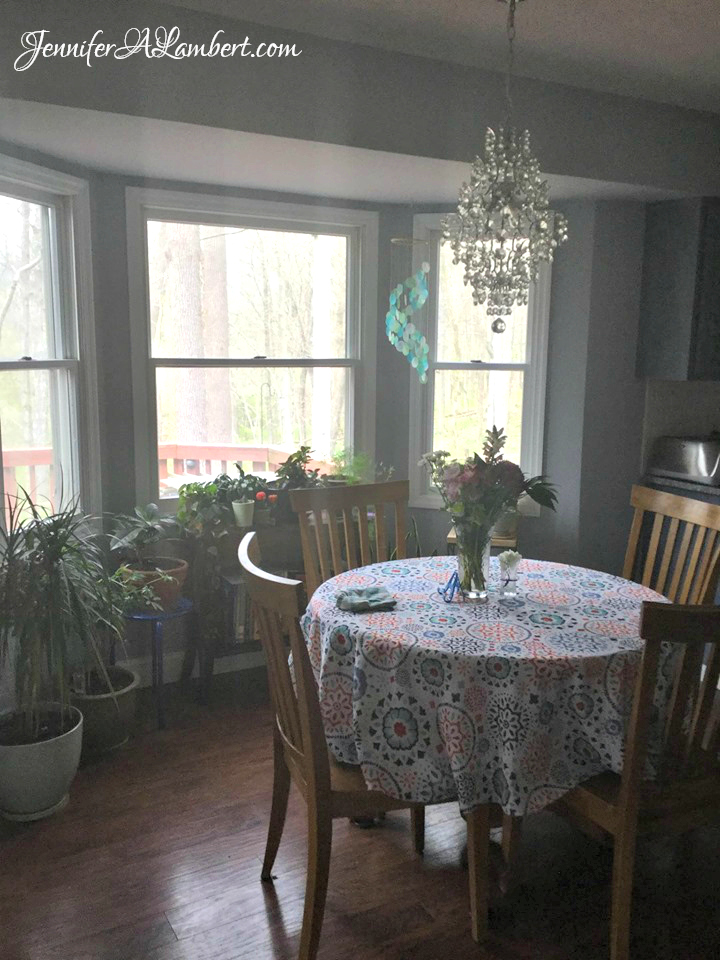
I love my bay windows and mini jungle in our breakfast nook.

I scored this table and chairs in Utah over ten years ago- at two different yard sales – for a total of $30!

I loathe the little chandelier and will replace it soon with something less ostentatious.

Dining Room

The china cabinet and dishes belonged to Aaron’s grandma.

We all eat dinner together here almost every evening.

Fridays, we have homemade pizza in the basement with a movie on our TV.

Powder Bathroom

Could you believe we lived here almost three years and suffered with these light fixtures being upside down? And I would hit my head when I washed my hands!

We plan to get a better mirror, repaint, and maybe wallpaper an accent wall, buy a small cabinet vanity in place of the tiny pedestal sink and perhaps a shelf or cabinet over the commode. New rugs too.

Living Room

We have six people in our family, so all the cutesy seating arrangements for four I see on design sites aren’t right for us.

I bought a new sofa and loveseat last year. I love the sleek design. I chose the La-Z-Boy Dixie Sofa and Loveseat in Mocha.

The pink gooseneck rocker belonged to my grandma. My parents bought me the Harbor Town recliner last year.

I’m getting a new rug soon. I already have the smaller one by our sliding door to the deck and a runner and little rug at the front door.

It looks a little crowded, but it’s working for now.

  • C-Shaped Accent Table 
  • Teal Glass Lamps
  • Square Coffee Table
  • Velvet Pillows
  • Collage Picture Frames
  • Round End Table
  • Mohawk Patchwork Area Rug

Hearth

I love having a brick hearth and wood mantel.

We have shells from our travels and some fun collected items. I love candles and lanterns.

  • Teapot 
  • Decorative Lantern
  • Metal Lantern
  • Wood Tray with Votive Candle Holders
  • Metal Compass Rose
  • Mercury Glass Pillar Candle Holder Set 
  • Hearth Cricket

Reading Nook

We have this weird landing at the top of the stairs that seems like wasted space to me.

Other homes with our similar floor plan have four bedrooms upstairs, but we have only three. Our middle girls have always shared a bedroom.

Thanks to everyone who helped me create this space!

Aaron’s grandma’s chair with the kids’ bookshelf.

Photos of our parents and grandparents watch over the kids.

I plan to get some tall houseplants since it’s pretty bright from our foyer windows.

I just added a floor lamp too.

Bedroom

We have a tall vaulted ceiling that I have no real ideas what to do with. Maybe a center beam?

We plan to paint the walls a pale grey and perhaps get some crown molding.

I ordered some navy and beige paneled drapes to match our new bedding (from Target).

We finally got a new mattress set – after twenty years!

I’m still in love with my bedroom furniture and I couldn’t find any better. No need to update it when it works great.

Not in love with my crooked wedding pics over the bed. We have so much wall space and I have few ideas to update this room.

  • Charging Station
  • Color-Block Blackout Window Curtains
  • Square Finials Curtain Rods
  • Beggarstaff Hamlet canvas print

Kids’ Rooms

My middle girls share a room with bunk beds with one window overlooking the backyard. They hate it, but it’s the way it is. They share the hall bathroom that has two sinks.

My son has the other upstairs bedroom with two front windows and ceiling fan. We gave him that room because they bunks wouldn’t fit any which way and the fan would have been dangerous for the top bunk. He uses my bathroom but we may have to reevaluate this soon.

Basement

We love having a finished basement.

I like having the TV and video games tucked out of sight.

I have the kids’ white erase boards on one wall. I have the three kids’ desks where we do any formal homeschool lessons, mostly math. My home office is upstairs with all my bookcases is in a room opposite our dining room.

We bought a used elliptical very cheaply from an older couple moving away and it’s awesome.

Our sectional sofa is still holding up ok after 10+ years.

There is a wet bar that I want to update with a new updated counter, faucet, and hopefully a narrow refrigerator in place of the pantry or a short beverage cooler in place of a cabinet.

My eldest daughter, almost twenty, has a bedroom and bathroom to herself in the basement but no windows.

Garden

We have a large front yard. We’re tackling the clover and weeds and trying to grow grass in the bald spots.

We have a little garden beside the garage where we get the most sunshine. We have peas, spinach, lettuce, green beans, cucumber, yellow squash, radishes, and carrots.

Our back yard slopes down to a lovely creek. It’s very shady.

We’re updating slowly as we can afford it.

We added pretty stepping stones and pine wood chips to a muddy area.

I plan to turn the sand pit into a Japanese shade garden.

We plan to sand, repair, and repaint the deck in brown or gray floor with white railings.

There is a firepit surrounded by too large gravel. I want to place some flat stones around it for a seating area.

Hostas are poking through the wood chips on either side. We need a new fence and I think I will prefer a picket instead of rail and wire.

Four walnut trees are coming down next month. You can see two on the right. The walnuts fall on our deck and it’s dangerous!

It’s really quite scary knowing we are responsible for all the maintenance on this home.

We know we need new siding and deck repairs. Most of the inside is in fantastic shape and we just want to make some updates.

We got a 30-year VA loan and I wonder if it will ever get paid off.

Elemental Blessing For A New Home

Before a human voice was ever heard here,
This place has known the respect of stone,
The friendship of the wind, always returning
With news of elsewhere, whispered in seed and pollen,
The thin symphonies of birdsong softening the silence,
The litanies of rain rearranging the air,
Cascades of sunlight opening and closing days,
And the glow of the moon gazing through darkness.
May all that elemental enrichment
Bless the foundation and standing of your home.
Before you came here, this place has known
The wonder of children’s eyes,
The hope of mornings in troubled hearts,
The tranquillity of twilight easing the night,
The drama of dreams under sleeping eyelids,
The generous disturbance of birth,
The anxieties of old age unclenching into grace
And the final elegance of calmly embraced death.
May the life of your new home enter
Into this inheritance of spirit.
May the rain fall kindly,
May daylight illuminate your hearts,
May the darkness never burden,
May those who dwell here in the unseen
Watch over your coming and going,
May your lives of love and promise
Refine and deepen the mind of this land.

John O’Donohue, To Bless the Space Between Us

For a New Home

May this house shelter your life.
When you come in home here,
May all the weight of the world
Fall from your shoulders.
May your heart be tranquil here,
Blessed by peace the world cannot give.
May this home be a lucky place,
Where the graces your life desires
Always find the pathway to your door.
May nothing destructive
Ever cross your threshold.
May this be a safe place
Full of understanding and acceptance,
Where you can be as you are,
Without the need of any mask
Of pretense or image.
May this home be a place of discovery,
Where the possibilities that sleep
In the clay of your soul can emerge
To deepen and refine your vision
For all that is yet to come to birth.
May it be a house of courage,
Where healing and growth are loved,
Where dignity and forgiveness prevail;
A home where patience of spirit is prized,
And the sight of the destination is never lost
Though the journey be difficult and slow.
May there be great delight around this hearth.
May it be a house of welcome
For the broken and diminished.
May you have the eyes to see
That no visitor arrives without a gift
And no guest leaves without a blessing.

John O’Donohue, To Bless the Space Between Us
We removed the bottom hooks! We are HOME.

You might also like:

  • Considerations Before Renting a Home
  • CORT Furniture Rental
  • Decorating on a Budget
  • Putting Dreams on Hold
  • How to Make Moves Less Stressful
  • My Kitchen Essentials
  • Military Kids are Third Culture Kids
Click here
HOME
Abraham Verghese, Cutting for Stone

What makes your house a home?

Share
Pin31
Share
31 Shares
You might also like:

Filed Under: Family Tagged With: homemaking, military, milspouse

How to Be a Good Homeowner

This blog may contain affiliate links: disclosure.
Please see my suggested resources.

June 15, 2020 By Jennifer Lambert Leave a Comment

Whether you think you’re currently living in a transition house or your forever home, there are things you should do to take care of your property on a regular basis, to ensure that you’re being a good homeowner.

After all, if you did ever decide you wanted to sell, it’s easier to do when your house has been well cared for, rather than being allowed to get a little run down and tired. But beyond the salability of your house, your family’s safety and comfort are even more important. 

Monthly and seasonal upkeep and maintenance routines

There are a few things that you should do on a regular basis, as part of your home care routine. Some are essential to the safety of your home and family and others are just a good idea to ensure that you get maximum enjoyment out of your home.

  • Check filters and vents throughout your home. This includes:
    • Cleaning / replacing your furnace filter / checking the AC filter for debris; 
    • Making sure the dryer exhaust is clear and reminding everyone who does laundry to clean the in-machine filter every time they use it; 
    • Checking your kitchen and bathroom exhaust vent / filters to make sure they are clean and in good working order; 
    • Vacuum dust from air vents throughout your house to avoid breathing in dust when air is circulated;
    • Check other external air vents, beyond the dryer, to make sure they are clear of debris, snow or other blockages.
  • Clean the garbage disposal by running it with something as simple as ice, and then flushing it with hot water and baking soda, to give it a thorough going over.
  • Check drains and faucets. 
    • Showerheads and faucets can get clogged up with mineral deposits, depending on how hard your water is, so keeping them clean will keep them running smoothly;
    • Check drains in showers, sinks and tubs for blockages: a hunk of hair can do a lot of damage if it’s not dealt with! If you’ve got a jet tub in the bathroom, make sure all the jets are clean and working properly.
  • Keep up the pool. When in use—and depending where you live, that can be year round or just a few months in the summer—make sure that all the systems for your pool and/or spa are working correctly, including filters, heaters and so on. Regular maintenance of these will save you a lot in the long run.

On a seasonal basis, you should also:

  • Check your alarms. Smoke alarms and carbon monoxide detectors should be checked and batteries replaced; and double check the location of your fire extinguishers. You should also check all electrical cords at this time to ensure they aren’t fraying, which can be a major fire hazard.
  • Do a closet change over. Move fall and winter clothes out into storage closets or boxes and bring spring / summer clothes into your everyday use closets and vice versa. There’s no need for mittens to be handy in July!
  • Deal with your lawn care seasonally as well: 
    • In fall, you need to prepare your garden to settle down for the winter; you should also make sure that your gardening equipment is cleaned and stored, hoses are drained and water is shut off to the exterior.
    • In spring, you need to help it back to life by raking up leaves and debris, aerating your lawn and getting the planting beds ready for another season.
  • Check the pool. If you have a swimming pool, spa or both, make sure that you are doing what’s necessary to open and close them diligently. Repairs are a lot more costly than just making sure everything is in good repair along the way.
  • Service all appliances. Have your furnace and AC checked and serviced seasonally, as well as fireplaces; make sure to have your wood fire chimney swept before you put it to good use and avoid a chimney fire. If you use window units for AC, make sure they’re clean, to avoid spraying dust and debris when you turn them on.
  • Check gutters and downspouts. Keeping water flowing away from the foundation of your house, whether in a spring storm or days of autumn showers is essential for a safe, dry basement. Make sure your gutters are clean and free of debris and check downspout positioning.

Annual upkeep and maintenance routines

  • Keep out drafts. Checking and fixing/replacing caulking and weather stripping around windows and doors can go a long way to keeping out drafts and avoiding losing all your heat or air conditioned air—with costs that go with it—to the outdoors!
  • Keep water out. If you live in an area that sees flooding, make sure your sump pump is in good working order and if you don’t already have one, get a battery back up for it! Just fill it with water to test that the sump runs and then go outside to make sure it’s draining. A power outage is all it takes to go from a bad storm to a flooded basement! Check foundation seams as well, to make sure you aren’t on your way to a leak.
  • Look over appliances. While the furnace and AC probably get regular maintenance, how often do you inspect / clean the refrigerator coils or check the drainage hose from your dishwasher or clothes washer? A regular inspection and cleaning of all your appliances can keep them in good working order for longer.
  • Check the roof. What you’re looking for is tiles that are peeling or lifting up, which can let water, snow and ice leak into your home, causing a lot of damage to the interior. This is also a good time to check the siding or brick work on your home, to make sure that it is all in good repair.
  • Mend the drive. If you have a driveway, fix cracks or have it resealed to ensure that it remains in good repair over the long term.
  • Check the deck. Wooden decks, stairs and railings can rot over time so a regular inspection to make sure that they aren’t loose or coming loose is a good idea, for everyone’s safety.
  • Deal with interior organizational projects. If you’ve always been meaning to clean out and reorganize the garage, your basement or all the closets in the house, it’s a good idea to take a look at these projects on at least an annual basis. Otherwise, it can get a little overwhelming to dig into and you might never do it! Having a home for all of your stuff is essential to keeping it tidy and clean, making it a comfortable living space for everyone.

Every few years upkeep and maintenance routines

  • Water heater. It’s worth making sure your water heater is in good order, particularly if you own it versus renting. The last thing you need is a rusted out heater base to give way! You should also check the pressure valve to make sure it’s operating as it is supposed to.
  • Attic insulation. Take a peek up in the attic to make sure that your insulation is in good shape, hasn’t been disturbed or otherwise lost its loft. You may need to add some every 5 years or so, depending on the quality and type of insulation.

Over the longer term

Life expectancies for various appliances and fixtures of your home vary, depending on the whether patterns you experience but as a rule, you should be thinking about budgeting to  replace the following items over time:

  • Roofs – every 25-30 years for asphalt shingles
  • Windows – every 10-12 years for vinyl encased windows
  • External doors – every 15-17 years
  • Siding – 30-40 years
  • Eaves / Soffit – 30-40 years
  • Garage doors – 10-15 years
  • Water heater – 8-10 years
  • Sump pump – 4-6 years
  • Furnace – 18-20 years
  • AC – 15-20 years

It might seem like an overwhelming list, but a lot of it is just a matter of habit. A little upkeep and maintenance will help your home look good and take care of you longer, avoiding costly repair bills and allowing you to budget for big replacements when they might be needed.

Source: Marty Basher is the improvement and organization expert with Modular Closets, https://www.modularclosets.com. Marty regularly contributes on topics of DIY renovations, home design, organization, improvement and more, helping homeowners get the most out of the spaces in their home. Modular Closets are high-quality and easy-to-design closet systems made in the USA you can order, assemble and install yourself, in no time at all. Using closet modules (closet pieces you can mix & match to design your own modular closet), homeowners everywhere are empowered to achieve a true custom closet look- for nearly 40% less than standard custom closets. 

Share
Pin
Share
0 Shares
You might also like:

Filed Under: Family Tagged With: homemaking

4 Ways To Ensure a Safe Grocery Shopping Trip

This blog may contain affiliate links: disclosure.
Please see my suggested resources.

June 12, 2020 By Jennifer Lambert Leave a Comment

Grocery shopping can be a stressful task. Remembering what’s on the grocery list is tough enough. Now, you must face an invisible threat every time you take a trip to the grocery store. While you can’t make the threat go away altogether, there are some steps you can take to protect yourself and slow the spread of germs. Here are 4 ways to ensure your trip to the grocery store is as safe as possible.

1. Clean Your Cart or Basket

The first thing you should do when you get to the grocery store is to clean your shopping cart or basket. Today, most stores provide disinfecting wipes for customers to use. They are usually conveniently placed next to the shopping carts. Just in case your store does not have complimentary wipes, keep an alcohol-based hand sanitizer or your own disinfecting wipes with you at all times. Doing so will help you maintain germ-free hands for the duration of your shopping trip.

2. Keep Your Distance

You’ve heard it before, but keeping your distance from others is an important key to slowing the spread of germs. Because viruses can be transferred from person to person through the air, maintaining a distance of six feet or more from other people can give germs a chance to fall to the ground before they get to you. Respecting personal space can bring peace of mind, both to you and the people around you.

3. Sanitize and Wash Your Hands

Be sure to sanitize your hands with an alcohol-based hand sanitizer periodically throughout the store, after checkout and after placing the groceries in your car. When you return home, wash your hands as soon as you enter, and again after unpacking your groceries. Frequent hand washing is vital to the prevention of illness.

4. Wear a Face Mask

Wearing a face mask is primarily intended to protect other people from the germs you may have. Likewise, other people who wear masks are protecting you from their potential germs. You can make your own cloth face mask or purchase one that is already made. Cloth masks should be washed with warm water and laundry detergent after every use. Masks are not a substitute for social distancing, so don’t forget that step!

Grocery shopping may be tough nowadays, but you can still get the food your family needs safely. Following the steps above when you take your next trip to the grocery store can give you peace of mind as you protect yourself and those around you. 

Share
Pin
Share
0 Shares
You might also like:

Filed Under: Uncategorized

Japan Unit Study

This blog may contain affiliate links: disclosure.
Please see my suggested resources.

June 8, 2020 By Jennifer Lambert Leave a Comment

We love learning about other cultures.

We review history and geography each cycle/year and assimilate our learning with current events.

I want to learn real history along with my kids, not just an American perspective.

Japan Unit Study

Topics

  • Feudalism
  • Samurai
  • Imperialism
  • WWII
  • Anime
  • Technology

Book List

  • Born in the Year of Courage by Emily Crofford
  • A Pair of Red Clogs by Masako Matsuno
  • The Samurai’s Tale by Erik C. Haugaard
  • A Samurai Castle by Fiona MacDonald 
  • Black Belt
  • The Drums of Noto Hanto
  • The Inch-High Samurai
  • The Samurai’s Daughter
  • Sword of the Samurai
  • Three Samurai Cats
  • The Origami Master by Nathaniel Lachenmeyer
  • Yuki and the One Thousand Carriers by Gloria Whelan
  • The Invisible Seam by Andy William Frew
  • Sadako and the Thousand Paper Cranes by Eleanor Coerr
  • A Carp for Kimiko by Virginia Kroll
  • The Old Man Mad about Drawing: A Tale of Hokusai by Francois Place
  • Commodore Perry in the Land of the Shogun and Shipwrecked!: The True Adventures of a Japanese Boy by Rhoda Blumberg
  • Kazunomiya: Prisoner of Heaven, Japan 1858 by Kathryn Lasky
  • The Big Wave by Pearl S. Buck
  • So Far from the Sea by Eve Bunting
  • Year of Impossible Goodbyes by Sook Nyul Choi
  • So Far from the Bamboo Grove and My Brother, My Sister, and I by Yoko Kawashima Watkins
  • Hiroshima by Laurence Yep
  • Passage to Freedom and Baseball Saved Us by Ken Mochizuki
  • How My Parents Learned to Eat by Ina R. Friedman
  • ALL THE BOOKS by Allen Say
  • Japanese Children’s Favorite Stories by Florence Sakade

Movies

Use discretion. Some of these films are just ridiculous.

  • Seven Samurai by Akira Kurosawa
  • The Last Samurai
  • 47 Ronin
  • Godzilla
  • Pokémon
  • Dragon Ball Z
  • Yu-Gi-Oh!
  • Death Note
  • Hayao Miyazaki and Studio Ghibli
  • The Tale of The Princess Kaguya
  • Grave of the Fireflies
  • In This Corner of the World
  • Lost in Translation
  • Black Rain
  • The Fast and the Furious: Tokyo Drift
  • The Wolverine
  • Unbroken
  • Pearl Harbor
  • Hacksaw Ridge
  • Letters from Iwo Jima
  • Flags of Our Fathers
  • Windtalkers
  • Emperor
  • Midway

Resources: Printables, Units, Lessons

  • Confessions of a Homeschooler
  • The Homeschool Mom
  • Happy Homeschool
  • Unlikely Homeschool
  • Living Montessori Now
  • Homeschool Share
  • The Momma Knows
  • Homeschool Den
  • Snowden
  • Happy Brown House

We would love to visit Japan someday!

Country Study Notebooking Pages
Share
Pin67
Share
67 Shares
You might also like:

Filed Under: Homeschool Tagged With: Asia, geography, history, homeschool, Japan, military, unit study

June Themes

This blog may contain affiliate links: disclosure.
Please see my suggested resources.

June 1, 2020 By Jennifer Lambert Leave a Comment

When my kids were very small, we had monthly themes on our bulletin board, for our homeschool lessons, and to order our daily lives.

As the kids get older, the themes aren’t quite so vivid. I enjoy the liturgical calendar, the natural cycles of the world, and celebrating the flow and small events in our lives.

We loved these themed Calendar Connections.

June is the beginning of summer. Kids are out of school Graduations are celebrated. Beach vacations are scheduled.

We long to play in the sun and soak up the lazy days until busyness begins again in the autumn.

We love reading about Catholic saints and Celtic saints and sometimes do spiritual activities.

Here’s a neat list of what’s on sale.

June Themes

Favorite Summer Books

Summer Bible Studies

50 Frugal Summer Outdoor Activities

How To Have an Easy Summer

10 Ways to Have a Sandlot Summer

How to Have a Legendary Summer

How Teens Can Spend Summer

Cool Summer Foods

Backyard Birding

Fun Stuff: National Days

Something for each day of the month – from fun foods to celebrating squirrels to justice issues to historical landmarks.

Don’t miss:

National Rosé Day – Second  Saturday in June

1st – Reef Awareness Day

5th – Donut Day. Lots of places offer free donuts!

6th – D-Day

Normandy Memorial Sites

10th – Iced Tea Day

14th – Flag Day, Army birthday

15th – Nature Photography Day

18th – Go Fishing Day!

19th – Juneteenth

20th – Summer solstice!

21st – Father’s Day

27th – PTSD Awareness

Enjoy the sunshine!

History: Racial Injustice Calendar and The Zinn Education Project.

Share
Pin3
Share
3 Shares
You might also like:

Filed Under: Homeschool Tagged With: June, month, summer

  • « Previous Page
  • 1
  • …
  • 18
  • 19
  • 20
  • 21
  • 22
  • …
  • 137
  • Next Page »
Suggested ResourcesReceipt Hog

Archives

Popular Posts

10 DIY Gifts with Essential Oils10 DIY Gifts with Essential Oils
Natural Remedies for HeadacheNatural Remedies for Headache
10 Natural Remedies to Keep on Hand10 Natural Remedies to Keep on Hand
Henna Hands CraftHenna Hands Craft
Homemade Turkey Divan CasseroleHomemade Turkey Divan Casserole
This website uses cookies to improve your experience. We'll assume you're ok with this, but you can opt-out if you wish.Accept Reject Read More
Privacy & Cookies Policy

Privacy Overview

This website uses cookies to improve your experience while you navigate through the website. Out of these, the cookies that are categorized as necessary are stored on your browser as they are essential for the working of basic functionalities of the website. We also use third-party cookies that help us analyze and understand how you use this website. These cookies will be stored in your browser only with your consent. You also have the option to opt-out of these cookies. But opting out of some of these cookies may affect your browsing experience.
Necessary
Always Enabled
Necessary cookies are absolutely essential for the website to function properly. This category only includes cookies that ensures basic functionalities and security features of the website. These cookies do not store any personal information.
Non-necessary
Any cookies that may not be particularly necessary for the website to function and is used specifically to collect user personal data via analytics, ads, other embedded contents are termed as non-necessary cookies. It is mandatory to procure user consent prior to running these cookies on your website.
SAVE & ACCEPT