Jennifer Lambert

A Sacred Balance

Visit Us On FacebookVisit Us On PinterestVisit Us On InstagramVisit Us On Linkedin
  • Homeschool
    • Book Lists
    • How Do We Do That?
    • Notebooking
    • Subjects and Styles
    • Unit Studies
  • Travel
    • Europe
      • Benelux
      • France
      • Germany
      • Greece
      • Ireland
      • Italy
      • London
      • Porto
      • Prague
    • USA
      • Chicago
      • Georgia
      • Hawaii
      • Ohio
      • Utah
      • Yellowstone and Teton
  • Family
    • Celebrations
    • Frugal
  • Military Life
    • Deployment
    • PCS
  • Health
    • Recipes
    • Essential Oils
    • Fitness
    • Mental Health
    • Natural Living
    • Natural Beauty
  • Faith
  • About Me
    • Favorite Resources
    • Advertising and Sponsorship
    • Policies
  • Reviews

© 2025Jennifer Lambert · Copyright · Disclosure · Privacy · Ad

Archives for January 2019

Celebrating Candlemas

This blog may contain affiliate links: disclosure.
Please see my suggested resources.

January 28, 2019 By Jennifer Lambert Leave a Comment

I know everybody is going on and on about groundhogs, but I think Candlemas is a beautiful and meaningful holiday.

Candlemas occurs 40 days after Christmas. 

Candlemas is the most ancient of all the festivals honoring Mary.

Celebrating Candlemas

The Presentation of Jesus at the Temple is the ceremony described in the Gospel of Luke, combining the purification rite with the redemption of the firstborn:

22 And when the days of her purification according to the law of Moses were accomplished, they brought him to Jerusalem, to present him to the Lord;

23 (As it is written in the law of the Lord, Every male that openeth the womb shall be called holy to the Lord;)

24 And to offer a sacrifice according to that which is said in the law of the Lord, A pair of turtledoves, or two young pigeons.

25 And, behold, there was a man in Jerusalem, whose name was Simeon; and the same man was just and devout, waiting for the consolation of Israel: and the Holy Ghost was upon him.

26 And it was revealed unto him by the Holy Ghost, that he should not see death, before he had seen the Lord’s Christ.

27 And he came by the Spirit into the temple: and when the parents brought in the child Jesus, to do for him after the custom of the law,

28 Then took he him up in his arms, and blessed God, and said,

29 Lord, now lettest thou thy servant depart in peace, according to thy word:

30 For mine eyes have seen thy salvation,

31 Which thou hast prepared before the face of all people;

32 A light to lighten the Gentiles, and the glory of thy people Israel.

33 And Joseph and his mother marvelled at those things which were spoken of him.

34 And Simeon blessed them, and said unto Mary his mother, Behold, this child is set for the fall and rising again of many in Israel; and for a sign which shall be spoken against;

35 (Yea, a sword shall pierce through thy own soul also,) that the thoughts of many hearts may be revealed.

36 And there was one Anna, a prophetess, the daughter of Phanuel, of the tribe of Aser: she was of a great age, and had lived with an husband seven years from her virginity;

37 And she was a widow of about fourscore and four years, which departed not from the temple, but served God with fastings and prayers night and day.

38 And she coming in that instant gave thanks likewise unto the Lord, and spake of him to all them that looked for redemption in Jerusalem.

Luke 2:22-38

I love the Nunc Dimittis. 

There are lovely works of art and music by Bach commemorating this time.

History:

The earliest reference to specific liturgical rites surrounding the feast are by the nun Egeria, during her pilgrimage to the Holy Land (381–384).

The Emperor Justinian I, after a terrible plague, ordered a period of fasting and prayer throughout the entire Empire in 541 and thanksgiving in 542.

In Rome, the feast appears in the Gelasian Sacramentary, a manuscript collection of the seventh and eighth centuries associated with Pope Gelasius I.

The tenth-century Benedictional of St. Æthelwold, bishop of Winchester, has a formula used for blessing the candles.

It was the traditional day to remove the cattle from the hay meadows, and from the field that was to be ploughed and sown that spring.

References to it are common in later medieval and early Modern literature; Shakespeare’s Twelfth Night is recorded as having its first performance on Candlemas Day 1602.

It was one of the Scottish quarter days, at which debts were paid and law courts were in session, until a change in the law in 1991.

In Irish homes, there are many rituals revolving around welcoming St. Brigid into the home on Imbolc with candles, wheat, and milk. She was seen by Celtic Christians as the midwife of Christ and “Mary of the Gael.” In Ireland and Scotland, Brigid is the “foster mother of Jesus.”

In Poland, the feast is called Święto Matki Bożej Gromnicznej (Feast of Our Lady of Thunder). This name refers to the candles that are blessed on this day, called gromnice, since these candles are lit during thunderstorms and placed in windows to ward off storm damage.

The Western term Candlemas refers to the practice where a priest blesses candles for use throughout the year.

Some Christians observe the practice of leaving Christmas decorations up until Candlemas.
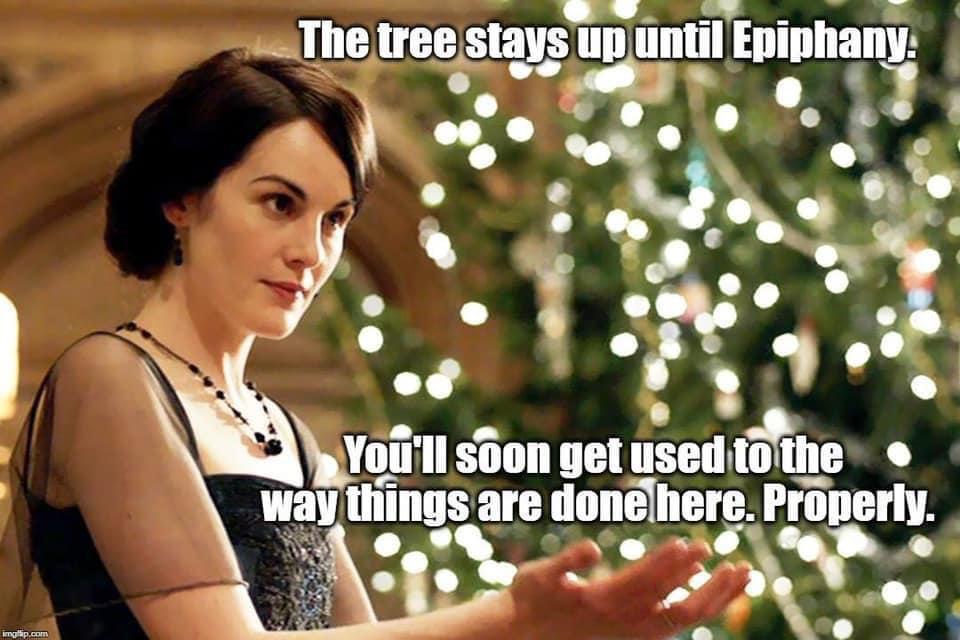
Downton Abbey

“If Candlemas Day is clear and bright,
winter will have another bite.
If Candlemas Day brings cloud and rain,
winter is gone and will not come again.”

“Down with the rosemary, and so
Down with the bays and mistletoe;
Down with the holly, ivy, all,
Wherewith ye dress’d the Christmas Hall”
~Robert Herrick (1591–1674), Ceremony upon Candlemas Eve

Moch maduinn Bhride, Thig an nimhir as an toll; Cha bhoin mise ris an nimhir, Cha bhoin an nimhir rium.
(Early on Bride’s morn, the serpent will come from the hollow I will not molest the serpent, nor will the serpent molest me)
Thig an nathair as an toll, la donn Bride Ged robh tri traighean dh’ an t-sneachd air leachd an lair.
(The serpent will come from the hollow on the brown day of Bridget Though there should be three feet of snow on the flat surface of the ground)
~Carmina Gadelica

I printed a lovely image of Mary and Jesus on tracing paper and we colored them and attached to candle holders. They look lovely!

Celebrating Candlemas:

  • Eat crêpes! Crêpes or pancakes, with their round shape and golden color reminiscent of the solar disc, refer to the return of Spring after the dark and cold of Winter.
  • Candles! Candles! Candles!
  • Make candle holders
  • Read books, especially springtime poetry
  • Take down Christmas decorations
  • Look at weather predictions for the week
  • Have a fun spring teatime and decorate the table with lilies for Mary
  • Get a head start on spring cleaning!

Resources:

  • PB Grace
  • Catholic Icing
  • Catholic Inspired
  • JoyFilled Family
  • Sun Hats and Wellie Boots
  • Badger/Groundhog Candlemas weather folklore history from Yesteryear News
  • Groundhog Day activities
  • Saint Brigid activities
  • Celebrating Spring
  • Candlemas, February 2 by Church of England Liturgy and Ritual
  • Electric Crepe Maker
  • Candlemas Candles
  • Candlemas: February, 1918 by Society Of Saints Peter And Paul 
  • Christmas to Candlemas in a Catholic Home by Helen McLoughlin 
  • Christmas Thru Candlemas: Music for the Feasts of Light II
  • Simeon and Anna meet Jesus Activity & Coloring Story Book

Lord, now you let your servant go in peace,
your word has been fulfilled:
My own eyes have seen the salvation,
which you have prepared in the sight of every people:
a light to reveal you to the nations
and the glory of your people Israel.

Share
Pin236
Share
236 Shares
You might also like:

Filed Under: Faith Tagged With: Christmas, faith, February, folklore, Mary, saint

Shameless Book Review

This blog may contain affiliate links: disclosure.
Please see my suggested resources.

January 24, 2019 By Jennifer Lambert 10 Comments

Shameless: A Sexual Reformation by Nadia Bolz-Weber releases on January 29, 2019.

I never learned about healthy sexuality.

My sex education as a kid consisted of my mom throwing a stack of library books on the dining room table and telling me to teach myself. And in 5th grade, I watched a cheesy film strip when they separated the boys and girls and taught us how our bodies would be changing soon. There were no questions. In 9th grade, during the required coed health class taught by the football coach, there were no questions either.

I didn’t become a Christian until my mid-twenties. I grew up in marginally Christian culture home. I prayed a little rhyme before meals and at bedtime. I knew right from wrong but I had no real foundation why. My parents were and are racist and sexist, which I’ve always assumed was because of their upbringing and the times in which they lived. As an only child born to them later in life, I couldn’t relate much to my peers whose parents were younger and seemed more accepting. My parents will be 76 this spring, living in a huge brick house about 45 minutes south of Atlanta. They seem to hate everything and everyone. They are bitter old white people who complain about the success of others they deem less deserving than they.

When I was 18, my dad found condoms in my purse. Why he was snooping in my purse I will never know or understand. He stormed into my bathroom to confront me. I was just getting out of the bath and I stood there, dripping and trying to wrap myself in a towel, while he berated me about my boyfriend. I was forbidden to see him anymore. I was 18 but treated like a little child. It was easier for me to break up than deal with the family strife.

Fast forward to age 20, when I attempted suicide before Christmas. My father told me I didn’t mean anything to my older by 6 years boyfriend. He was just using me. This time, instead of conceding to my father’s “protection,” I eloped.

My marriages were pretty disastrous. Counselors, both Christian and secular, told me to just allow my husband all the sex he wanted, whenever and however he wanted it – and all would be better. Trite tips on how to parrot his requests to improve communication. I was always the aggressor, refusing to back down in my admonition that communication and sex weren’t the real problems. My first husband was addicted to pornography. My second was mentally ill. But somehow, they were victims.

I researched and did all the self-help – secular and churchy. I dove down that evangelical rabbit hole. I’ve been divorced (gasp!) and church members just wanted to pray for reconciliation (no!). I thought purity culture might be the answer. (It’s not.)

I tried to be the perfect Christian wife. I am not a quiet meek little mouse. I was ostracized, criticized, alienated for being myself. A cis straight white woman – homemaker and homeschooler. I can’t even imagine what others face who are more on the fringes of what church culture deems appropriate.

I’m just really, really, really tired of it all.

Something has to change.

I have three daughters and a son. What narrative about sexuality do I want them to learn? From whom do I want them to learn about it? It’s important to do more than have The Talk. How do I help my kids make sense of it all? I want them to have healthy relationships. It has to be an ongoing conversation and I have to learn alongside my kids and have no fear.

Sex sells. Sex permeates our society. Sex affects all our relationships – with coworkers, acquaintances, authority figures. People who see everything in black and white say just always avoid being alone with someone of the opposite sex, as if that protects everyone from abuse, assault, accusation.

In light of #MeToo and #ChurchToo and abuse, scandals, hatefulness, we need to step up and lead a way into light for those who are lost. We love Jesus, but not the church.

Christians are obsessed with sex. But not in a good way. For generations countless people have suffered pain, guilt, and judgment as a result of this toxic fixation on sex, the human body.

Raw, intimate, and timely, Nadia Bolz-Weber’s latest book offers a full-blown overhaul of our harmful and antiquated ideas about sex, gender, and our bodies.

I love this book because the author addresses sexuality in our society and in our churches and what it could and should be. She relates her own personal experiences – mistakes, shameless choices, and the broken rocky road that we all travel. Her imagery is unique and beautiful. I love her writing and I’ve read all her books.

We need a sexual reformation in the church.

Order now! Shameless: A Sexual Reformation by Nadia Bolz-Weber.

I preordered the book and received a galley copy from the publisher, Convergent/Penguin Random House.

Share
Pin13
Share
13 Shares
You might also like:

Filed Under: Book Reviews Tagged With: book review, shamelessbook

Celebrating Saint Brigid’s Day

This blog may contain affiliate links: disclosure.
Please see my suggested resources.

January 21, 2019 By Jennifer Lambert 11 Comments

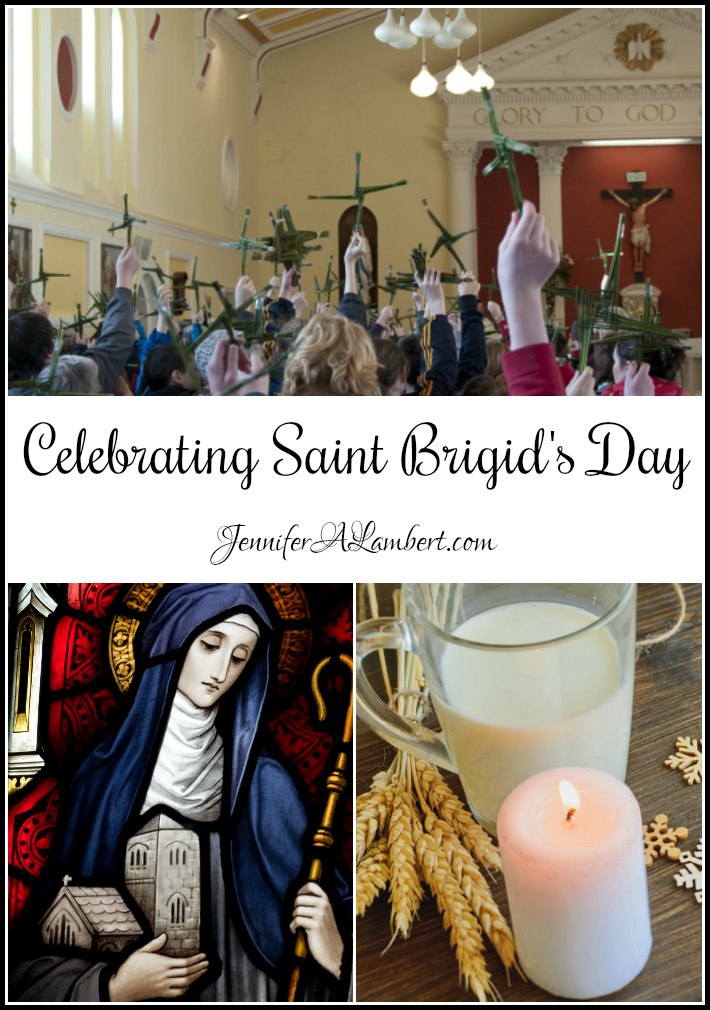
Candlemas…Imbolc, the feast day of the Celtic goddess Brigid marks the beginning of spring, celebrates the arrival of longer, warmer days and the early nature signs of spring on February 1.

Born at a liminal time in a liminal place, Brigid is said to have been born on the threshold of a door (neither within or without the house) and at the breaking of dawn (neither day or night). There is ample proof that Brigid is most likely a continuation of the earlier goddess Brigid/ Brigantia who was worshipped in ancient Ireland.

The word Imbolc means “in the belly,” in the old Irish language, referring to the pregnancy of ewes.

Imbolc is one of the four major “fire” festivals (referred to in Irish mythology from medieval Irish texts. The other three festivals on the old Irish calendar are Beltane, Lughnasadh, and Samhain/Halloween).

St. Brigid is the patron saint of babies, blacksmiths, boatmen, cattle farmers, children whose parents are not married, children whose mothers are mistreated by the children’s fathers, Clan Douglas, dairymaids, dairy workers, fugitives, Ireland, Leinster, mariners, midwives, milkmaids, nuns, poets, the poor, poultry farmers, poultry raisers, printing presses, sailors, scholars, travelers, and watermen.

Celebrating Saint Brigid's Day

Celebrating Saint Brigid’s Day

  • Nature walk to look for signs of spring
  • Eat customary Irish foods
  • Read books!
  • Donate to charity or serve others
  • Make Brigid crosses out of straw
  • Visit a farm to learn about the cattle and sheep
  • Leave out scarves for blessings! Known as a “Bratog Bride” in Irish folklore, this special garment can then be used as a cure for headaches or sore throats.

Customs

Brigid would be symbolically invited into the house and a bed would often be made for her and corn dollies made as her representatives. Often a family member, representing Brigid, would circle the home three times carrying rushes. They would then knock the door three times, asking to be let in. On the third attempt they are welcomed in, the meal is had, and the rushes are then made into crosses.

Irish children, especially girls, often dress up in rags and go door to door like trick or treating, chanting:

“Here comes poor Brigid both deaf and blind,

Put your hand in your pocket and give her a coin

If you haven’t a penny, a halfpenny will do

If you haven’t a halfpenny, God bless you.”

One of the earliest references to the St. Brigid’s Cross is from a 1735 poem:

“St. Bridget’s cross hung over door

Which did the house from fire secure

O Gillo thought, O powerfull charm

To keep a house from taking harm;

And tho’ the dogs and servants slept,

By Bridget’s care the house was kept.”

Resources:

  • Recipes for a Feast of Light
  • St. Brigid’s Blessings and Poems from Brigidine Sisters
  • Shower of Roses
  • The Kennedy Adventures
  • PB Grace
  • Coloring Page from Waltzing Matilda
  • Irish Folklore: St. Brigid
  • Fish Eaters: St. Brigid
  • Imbolc Activities and Recipes

Books:

  • The Life of Saint Brigid: Abbess of Kildare by Jane G. Meyer
  • Brother Wolf, Sister Sparrow by Eric A. Kimmel
  • The Story Of Saint Brigid by Caitriona Clarke
  • Brigid and the Butter: A Legend about Saint Brigid of Ireland by Pamela Love
  • Brigid’s Cloak by Bryce Milligan
  • Saint Brigid and the Cows by Eva K. Betz
  • Folk Tales of St. Brigid by Fr. Joseph Irvin
  • Brigid’s Way: Reflections on the Celtic Divine Feminine by Bee Smith
  • Brigid: History, Mystery, and Magick of the Celtic Goddess by Courtney Weber
  • Brigid of Kildare: A Novel by Heather Terrell
  • Brigid: Meeting The Celtic Goddess Of Poetry, Forge, And Healing Well by Morgan Daimler
  • Brigid of Ireland by Cindy Thomson

Spring is just around the corner!

Linking up: Pinch of Joy, House on Silverado, Eclectic Red Barn, Grammy’s Grid, Random Musings, Suburbia, Mostly Blogging, Pam’s Party, Pieced Pastimes Shelbee on the Edge,, My Life Abundant, InstaEncoouragements, LouLou Girls, Ginger Snap Crafts, Fluster Buster, Ridge Haven Homestead, Jenerally Informed, Stroll Thru Life, My Wee Abode, Penny’s Passion, Bijou Life, Artful Mom, Try it Like it, Soaring with Him, Debbie Kitterman, Anchored Abode, Imparting Grace, Slices of Life, OMHG, Modern Monticello, Cottage Market, Answer is Choco, Momfessionals, Lyli Dunbar, CWJ, Hubbard Home, Lauren Sparks, Moment with Franca, Create with Joy,

Share
Pin54
Share
54 Shares
You might also like:

Filed Under: Faith Tagged With: faith, February, folklore, Ireland, saint, spring

Year 4 History Resources

This blog may contain affiliate links: disclosure.
Please see my suggested resources.

January 14, 2019 By Jennifer Lambert 7 Comments

Year 4 History: 1900-Present Day

It becomes really fascinating when you study world history chronologically and see how interconnected everything is, all the causes and effects.

We use Tapestry of Grace for book lists, but I also peruse Ambleside Online and other lists for a well-rounded history curriculum. I want all sides and perspectives.

We use this history text as a guide: The Story of the World: The Modern Age. 

I typically look at the unit overview and make a checklist of books, topics, and movies. We don’t follow the weekly plan exactly.

I go to the library about every week and get what I can.

I shop thrift stores, yard sales, half-price and used bookstores to get books we love to read again and again.

We love poetry and literature, and I’m always adding to our collection. I want to read them all!

Other books we use throughout our history studies – over several years:

  • This Country of Ours by HE Marshall
  • Our Island Story by HE Marshall
  • The Struggle for Sea Power by MB Synge
  • The Story of Mankind by Hendrik Willem van Loon
  • Magic Treehouse
  • If You Grew Up…
  • American Girl Collection and Real Stories From My Time
  • The Royal Diaries
  • Dear America

We love Netflix and Amazon Prime for streaming. We sometimes view YouTube.

See how we do history.

Year 1

Year 2

Year 3

I’ve read these books to help me educate myself:

Lies My Teacher Told Me: Everything Your American History Textbook Got Wrong by James W. Loewen

A People’s History of the United States by Howard Zinn

Books we read as spines for Year 4:

The Century for Young People by Peter Jennings, Todd Brewster, and Jennifer Armstrong

A History of US by Joy Hakim 

I wasn’t thrilled with how the units were divided in our history curriculum for year 4.

It didn’t seem to give us enough time to cover WWII. Korea and Vietnam were skimmed over. Very little discussion about South America or Africa. The last unit was scarce with literature or history selections and I’m sorry but I think lots has happened in the world during my lifetime.

Great literature has been written in the last century. So much history has happened. It’s hard to connect the dots for kids since we have to look at the origins of the conflicts that could be hundreds of years ago. For church history, we discuss harm missionaries often cause to indigenous peoples or misusing the Bible and wrong doctrine. We like to read other accounts and texts from many religions and faiths.

A wonderful thing is we can actually talk to living people about their memories of recent historical events.

I have the freedom to do my own research and take as much time as we want on different topics of interest.

Unit 1: World War I

Literature

The Wonderful Wizard of Oz

The Call of the Wild

Five Children and It

Pollyanna

The Railway Children

Anne of Green Gables

The Wind in the Willows

Robert Frost poetry

Letters from Rifka

The Great Gatsby

Peter Pan

Winnie the Pooh

The Burgess Bird Book for Children

History

Topics:

Henry Ford

Teddy Roosevelt

Albert Einstein

post-colonial South America

Immigration

Titanic

Jazz music

Temperance Movement in USA

WWI

Russian Revolution

Harlem Renaissance in USA

Books:

War Game

Where Poppies Grow

In Flanders Fields

The World Wars

Harlem Stomp!

Activities

Any museum, site, or exhibit

– See My WWI unit study. We visited Flanders.

Paper Dolls

Music from this period

Art from this period

Church History

Amy Carmichael

Fanny Crosby

Billy Sunday

Eric Liddell

Movies

Rough Riders

American Experience: America 1900

Titanic

The Wizard of Oz

Lawrence of Arabia

Doctor Zhivago

Chariots of Fire

Unit 2: World War II

Literature

Mary Poppins

Our Town

Bud, Not Buddy

Madeline

Mr. Popper’s Penguins

The Red Pony and The Pearl by John Steinbeck

Roll of Thunder, Hear My Cry

Heidi

The Hundred Dresses

The Snow Goose

Thimble Summer

Homer Price

Lord of the Flies

Swallows and Amazons

Pippi Longstocking

Maus

The Amazing Adventures of Kavalier & Clay

Brave New World

History

Topics:

Disney

The Great Depression – see my unit study

Dust Bowl

Prohibition in USA

FDR

Eleanor Roosevelt

Photography

WWII

Stalin

Mao

Communism

Jewish History and Customs

Books:

Terezin

The Cat with the Yellow Star

Night

A Father’s Promise

We Will Not Be Silent

Mercedes and the Chocolate Pilot

Sachiko

Activities

Any museum, site, or exhibit

– See my WWII unit study. We visited Prague, the Anne Frank House, Dachau, and Normandy.

Paper Dolls

Music from this period

Art from this period

Church History

Gladys Aylward

Corrie ten Boom

Richard Wurmbrand

Dietrich Bonhoeffer

Simone Weil

CS Lewis

Movies

Annie

Bright Eyes

Our Town

The Inn of Sixth Happiness

The Sound of Music

White Christmas

Life is Beautiful

The Boys from Brazil

Unit 3: Civil Rights and Conflicts in Asia

Literature

One Grain of Rice

The House of Sixty Fathers

Homeless Bird

The Empty Pot

My Side of the Mountain

The Hardy Boys: The Tower Treasure

Nancy Drew: The Secret of the Old Clock

Old Yeller

Where The Red Fern Grows

Onion John

The Cricket in Times Square

The Phantom Tollbooth

Fahrenheit 451 (see my unit study for this book!)

James and the Giant Peach

Langston Hughes poetry

To Kill a Mockingbird

The Watsons Go to Birmingham – 1963

Lilies of the Field

The Lotus Seed

History

Topics:

Civil Rights

Communism

The Cold War

Cuba

Korea

Vietnam

Cambodia

Space Race

Books:

So Far From the Bamboo Grove

Mission Control, This is Apollo

Activities

Any museum, site, or exhibit

See my units: China, Vietnam, Korea, Diversity here and here

Paper Dolls

Music from this period

Art from this period

Church History

Ida Scudder

Jacob DeShazer

Nate Saint

Jim Elliot

Billy Graham

Brother Andrew

Movies

Ghandi

The Manchurian Candidate original and remake

MacArthur

Cry, the Beloved Country

Lilies of the Field

To Kill a Mockingbird

Malcolm X

Selma

Ray

Mississippi Burning

The Help

Loving

Unit 4: Cold War, Terrorism, 9/11, Current Events

Literature

James Herriot’s Treasury for Children

Have Space Suit – Will Travel

I, Robot

The Breadwinner

Tasting the Sky

Citizen of the Galaxy

Tunnel in the Sky

The Hobbit

Fly Away Home

The Lion, the Witch, and the Wardrobe

The Indian in the Cupboard

The Littles

Falling Up

Maya Angelou

Raising Dragons

History

Topics:

The Cold War

Communism

Berlin Wall

Computers and Technology

Internet

The Middle East

Arab Spring

Cambodian Killing Fields

Rwandan Genocide

Yugoslavia

9/11

Rise of Terrorism

Popular Culture

Civil Rights

The Fellowship Foundation

Enron, WorldCom, Lehman Brothers

Central Park Five

Black Lives Matter

#MeToo

Books:

Red Scarf Girl

Tales of Persia

The Wall: Growing Up Behind the Iron Curtain

Countdown

Revolution

Anthem

Activities

Any museum, site, or exhibit

Paper Dolls

Music from this period

Art from this period

Church History

#ChurchToo

#Exvangelical

Mother Teresa

Elisabeth Elliot

Richard Wurmbrand

Bruchko

Joni: An Unforgettable Story

Dorothy Day

Oscar Romero

Movies

The Neverending Story

Remember the Titans

Willy Wonka and the Chocolate Factory and Charlie and the Chocolate Factory

The Indian in the Cupboard

The Lion, the Witch, and the Wardrobe

The Hobbit

Mr. Holland’s Opus

Hotel Rwanda

Wreck-It Ralph

When They See Us

I’m still adding to my list. There is still so much being learned about recent events and I love researching and learning with my kids.

See my Pinterest board for Year 4 History:

Follow Jennifer’s board Modern History on Pinterest.
History of Modern Times Notebooking Pages
Share
Pin26
Share
26 Shares
You might also like:

Filed Under: Homeschool Tagged With: history, homeschool

My Educational Influences

This blog may contain affiliate links: disclosure.
Please see my suggested resources.

January 12, 2019 By Jennifer Lambert 14 Comments

Education is supposed to influence us.

And it does.

I have never let my schooling interfere with my education. ~Mark Twain

Don’t confuse education with intelligence.

Education is not preparation for life; education is life itself. ~John Dewey

Looking back, I realize that I was so isolated as a middle-class suburban white girl. When I went to college in downtown Atlanta, it was eye-opening. So many different people from different backgrounds. It helped me to grow and learn about the world. 

When I became a teacher, I grew some more as I learned along with and about my students and fellow teachers. 

When I became a mother, I wanted more than public and private schools could offer my children.

When we travel, we learn even more, expanding and shaping our views.

My Educational Influences

Past Teachers

Most of what I learned in school is negative.

Of course, I learned to write and multiply,  but mostly to bend the rules.

I learned to avoid punishment. I was scared of my teachers. I was scared of bad grades.

I had teachers who yelled, tied students to their seats, gave detention for silly things, shamed and ridiculed, refused to allow bathroom passes, threw chalk and erasers and koosh balls, flirted with students…and lots more.

I was a good student. I learned to be invisible. I made good grades.

I had few positive teacher influences. Mostly, I learned what not to do as a teacher.

University Teacher Training

I got a bachelor’s degree in English literature. Yeah, pretty useless in any job market. If I had it to do over, I would at least have gone with journalism. It’s like having a degree in reading.

I earned a master’s degree in education with a 14-month urban education program to get quick teacher certification. And a job.

The program was kinda a joke. Pedagogy and methodology classes. The professors were out of touch with real schools and classrooms. The assignments were irrelevant. Most of what I was taught wasn’t feasible in an actual classroom when I got teaching jobs.

The other dozen students or so in the program were idealists who thought they were going to change the world. Most went to get teaching jobs in wealthy suburban white schools and districts.

Teachers don’t have a lot of autonomy in their classrooms.

We were taught how to manage students with punitive coercion such as humiliation and threats.

Administrators cater to parents and the school board. It’s very political. There’s lots of standardized tests that don’t really mean much.

Students are just seen as numbers and not as living, breathing, changing, growing human beings.

A poignant quip:

Someone asks: “What do you teach?”

Teachers respond: “English.” or “Science.” or “Math.”

A wise teacher responds: “Students.”

Homeschooling opened up a lot of doors for me as I did my own research into the world of educational philosophy.

I had to slowly unlearn everything I had experienced and been taught as a student and teacher.

My Favorite Educational Philosophies

The Well-Trained Mind and Classical Education

The Well-Trained Mind was the first homeschooling book I ever bought. I don’t remember how I found it, probably in an online forum as a great place to begin.

And it was.

Part of the school dilemma results from an over-focus on testing results; home educators are free from that pressure, so you won’t have to decide between test prep and expository writing. ~Susan Wise Bauer

I began homeschooling in 2005. My eldest was almost 5 and I was pregnant with my second. Number three followed a year after number two.

I liked the classics outline and resource lists for each year. It appealed to the intellectual in me as I set about developing a classical education for my daughter.

I loved the foundation on literature and history and still do. We all learn Latin together.

We never focused so much on a lot of memorization and writing early. I don’t like all the rules and scripts in CC.

The Well-Trained Mind was a perfect jumping off point for me as a new homeschool mom and offered us a good transition from school ideas to homeschooling freedom.

Charlotte Mason

I soon learned about Charlotte Mason after our first year of homeschooling.

It seems a softer side of classical education.

I love the idea of living books and nature study, art and music appreciation and history.

I’ve always felt these subjects are so important.

Education is an Atmosphere, a Discipline, a Life. ~Charlotte Mason

Ambleside Online is a great resource but I needed more structure for our growing family.

We love notebooking.

We began to acquire an extensive home library.

Maria Montessori

When my son was born, I encouraged him with self-directed activity, hands-on learning, and collaborative play – from birth.

Montessori has five key areas of learning:

  1. practical life
  2. sensorial
  3. mathematics
  4. language
  5. culture

Never help a child with a task at which he feels he can succeed. ~Maria Montessori

I included my middle girls and son in all aspects of our lives and schooling. It’s amazing how autonomous kids can be if we let them.

Rearranging our school room and providing many opportunities for practical play with small real tools helped our household dynamics.

Rudolf Steiner and Waldorf Education

Waldorf education is independent and inclusive. It upholds the principles of freedom in education.

Waldorf or Rudolf Steiner education is based on an anthroposophical view and understanding of the human being of body, soul, and spirit.

I love the holistic ideals of Waldorf.

Art and music are so important to me and I love all the fun, natural materials in the Waldorf community that encourage learning this.

I love the focus on imagination.

We love nature and the outdoors.

It helped me become a gentler parent. We flow.

Summary:

I learned how to incorporate ideas and lessons that worked for us.

I believe in playtime and lots of informal, natural learning – especially outside – until the child is about 7 or 8 years old.

We work in a nice flow with the seasons, taking breaks frequently to enjoy the weather or rest when we need it.

I think there are lots of benefits to many different educational philosophies.

I love that, as a homeschooler, I have the freedom to pick and choose this and that for my children to learn best as individuals and different stages – practical Montessori, imaginative Waldorf, nature-y artsy Charlotte Mason, Latin and history classical.

It takes courage to do things differently.

ProSchool Membership - Productive Homeschooling
Share
Pin18
Share
18 Shares
You might also like:

Filed Under: Homeschool Tagged With: homeschool, learning

Vietnam Unit Study

This blog may contain affiliate links: disclosure.
Please see my suggested resources.

January 7, 2019 By Jennifer Lambert Leave a Comment

There’s so much more to the history and culture than what the news shows us.

I want my children to understand Asian history in our chronological studies of world history. I don’t want their education based on American stereotypes.

Our {evangelical and expensive} history curriculum was a little disappointing after WWII, so I had to research and find my own material to teach my kids about history that happened in my parents’ lifetime.

Vietnam Unit Study

I want to learn real history along with my kids, not just an American or white perspective.

There’s so much more to Vietnam culture and history than the conflict that the United States participated in during the 1960s and early 1970s.

Vietnam War Veterans Day: March 29 is a fitting choice for a day honoring Vietnam veterans. It was chosen to be observed in perpetuity as March 29, 1973, was the day United States Military Assistance Command, Vietnam was disestablished and also the day the last U.S. combat troops departed Vietnam.  In addition, on and around this same day Hanoi released the last of its acknowledged prisoners of war. 

Vietnam Unit Study

Topics:

  • Indochine colonialism
  • Vietnam War
  • Vietnamese Independence

Activities:

  • Eat in a Vietnamese restaurant
  • Learn to read and write in Vietnamese
  • Watch Vietnamese cartoons
  • Watch films about Vietnam or in Vietnamese and discuss
  • Visit a museum to view Vietnamese art
  • Visit a Vietnam War Memorial
  • Read about Vietnam
  • Learn Asian geography

Printables and Lessons:

Vietnam Conflict from The Homeschool Mom
Vietnam War from The Homeschool Helper
Vietnam Lapbook from Homeschool Share
In The Hands of a Child Vietnam Curriculum
Vietnam and the Water Buffalo by Write Bonnie Rose
Vietnam Geography and Culture Notebooking from Notebooking Pages
Vietnam Flag from Activity Village
Vietnam from National Geographic

Book list:

Water Buffalo Days: Growing Up in Vietnam
Inside Out and Back Again
Escape from Saigon: How a Vietnam War Orphan Became an American Boy
Going Home, Coming Home/Ve Nha, Tham Que Huong
Cracker! The Best Dog in Vietnam
Weeping Under This Same Moon
Goodbye, Vietnam
The Lotus Seed

Films (use discretion):

Indochine with Catherine Deneuve
The Scent of Green Papaya
The Purple Horizon
Tam Cam
Green Dragon
Rescue Dawn
Uncommon Valor
We Were Soldiers
Full Metal Jacket
Forrest Gump
Hamburger Hill
Soldiers of Change
Platoon
Apocalypse Now
Born on the Fourth of July
Good Morning, Vietnam
The Deer Hunter
Flight of the Intruder
Casualties Of War
Tigerland
The Killing Fields

Country Study Notebooking Pages

What stereotypes did you learn about Vietnam?

Share
Pin93
Share
93 Shares
You might also like:

Filed Under: Homeschool Tagged With: Asia, geography, history, homeschool, military, unit study, Vietnam

Best Books of 2018

This blog may contain affiliate links: disclosure.
Please see my suggested resources.

January 1, 2019 By Jennifer Lambert Leave a Comment

I read a lot.

Like a lot, a lot.

I can’t remember how many books I read this past year, but I average about 1-2 per week.

I primarily read fiction, self help, theology, education, history, and lots of fun and beautiful books with my kids.

My Favorite Books I Read in 2018

Shameless: A Sexual Reformation by Nadia Bolz-Weber. This book is shattering. Look for my review soon! And preorder your own copy.

Almost Everything: Notes on Hope by Anne Lamott. I love everything she writes. Hope.

Stolen Jesus: An Unconventional Search for the Real Savior by Jami Amerine. Just a fun, true read. I nodded along and highlighted a lot.

Immortal Diamond: The Search for Our True Self by Richard Rohr. I adore everything this man does.

Falling Upward: A Spirituality for the Two Halves of Life by Richard Rohr. Just more of the same. Great.

Feast: True Love in and out of the Kitchen by Hannah Howard. I find myself thinking about this book a lot and our relationship with food.

Love is Stronger than Death by Cynthia Bourgeault. Breaking down walls and experiencing grief in a whole new way.

Leaving Church: A Memoir of Faith by Barbara Brown Taylor. This book helped me grapple with my issues attending church. or not.

Liturgy of the Ordinary: Sacred Practices in Everyday Life by Tish Harrison Warren. I really like the idea of everyday ordinary being sacred.

Future Home of the Living God: A Novel by Louise Erdrich. Brilliant and artful in the style of Margaret Atwood with a Native flair.

What have you been reading?

Share
Pin16
Share
16 Shares
You might also like:

Filed Under: Family Tagged With: book list

Suggested ResourcesCheckout 51

Archives

Popular Posts

10 DIY Gifts with Essential Oils10 DIY Gifts with Essential Oils
Natural Remedies for HeadacheNatural Remedies for Headache
10 Natural Remedies to Keep on Hand10 Natural Remedies to Keep on Hand
Henna Hands CraftHenna Hands Craft
Homemade Turkey Divan CasseroleHomemade Turkey Divan Casserole
This website uses cookies to improve your experience. We'll assume you're ok with this, but you can opt-out if you wish.Accept Reject Read More
Privacy & Cookies Policy

Privacy Overview

This website uses cookies to improve your experience while you navigate through the website. Out of these, the cookies that are categorized as necessary are stored on your browser as they are essential for the working of basic functionalities of the website. We also use third-party cookies that help us analyze and understand how you use this website. These cookies will be stored in your browser only with your consent. You also have the option to opt-out of these cookies. But opting out of some of these cookies may affect your browsing experience.
Necessary
Always Enabled
Necessary cookies are absolutely essential for the website to function properly. This category only includes cookies that ensures basic functionalities and security features of the website. These cookies do not store any personal information.
Non-necessary
Any cookies that may not be particularly necessary for the website to function and is used specifically to collect user personal data via analytics, ads, other embedded contents are termed as non-necessary cookies. It is mandatory to procure user consent prior to running these cookies on your website.
SAVE & ACCEPT